


Pressed for time: the circadian clock and hypertension
- PMID: 19679741
- PMCID: PMC3774422
- DOI: 10.1152/japplphysiol.00661.2009
Pressed for time: the circadian clock and hypertension
Abstract
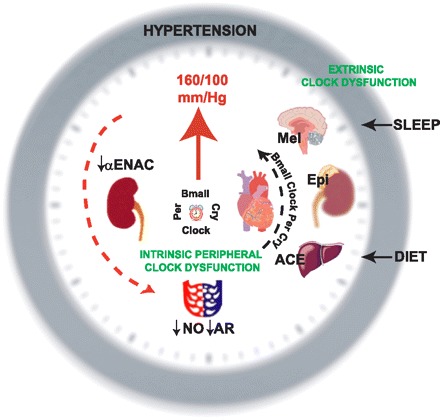
Hypertension is a major risk factor for cardiovascular disease and death. The "silent" rise of blood pressure that occurs over time is largely asymptomatic. However, its impact is deafening-causing and exacerbating cardiovascular disease, end-organ damage, and death. The present article addresses recent observations from human and animal studies that provide new insights into how the circadian clock regulates blood pressure, contributes to hypertension, and ultimately evolves vascular disease. Further, the molecular components of the circadian clock and their relationship with locomotor activity, metabolic control, fluid balance, and vascular resistance are discussed with an emphasis on how these novel, circadian clock-controlled mechanisms contribute to hypertension.
Figures
References
-
- Anan F, Masaki T, Fukunaga N, Teshima Y, Iwao T, Kaneda K, Umeno Y, Okada K, Wakasugi K, Yonemochi H, Eshima N, Saikawa T, Yoshimatsu H. Pioglitazone shift circadian rhythm of blood pressure from non-dipper to dipper type in type 2 diabetes mellitus. Eur J Clin Invest 37: 709–714, 2007 - PubMed
-
- Appel LJ, Moore TJ, Obarzanek E, Vollmer WM, Svetkey LP, Sacks FM, Bray GA, Vogt TM, Cutler JA, Windhauser MM, Lin PH, Karanja N. A clinical trial of the effects of dietary patterns on blood pressure. DASH Collaborative Research Group. N Engl J Med 336: 1117–1124, 1997 - PubMed
Publication types
MeSH terms
Substances
Grants and funding
LinkOut - more resources
Full Text Sources
Medical
