


'I have no interest in drinking': a cross-national comparison of reasons why men and women abstain from alcohol use
- PMID: 19681798
- PMCID: PMC2891671
- DOI: 10.1111/j.1360-0443.2009.02667.x
'I have no interest in drinking': a cross-national comparison of reasons why men and women abstain from alcohol use
Abstract
Aims: To examine country differences in reasons for abstaining including the association of reasons with country abstaining rate and drinking pattern.
Participants: Samples of men and women from eight countries participating in the GENACIS (Gender Alcohol and Culture: an International Study) project.
Methods: Surveys were conducted with 3338 life-time abstainers and 3105 former drinkers. Respondents selected all applicable reasons for not drinking from a provided list. Analyses included two-level hierarchical linear modelling (HLM) regression.
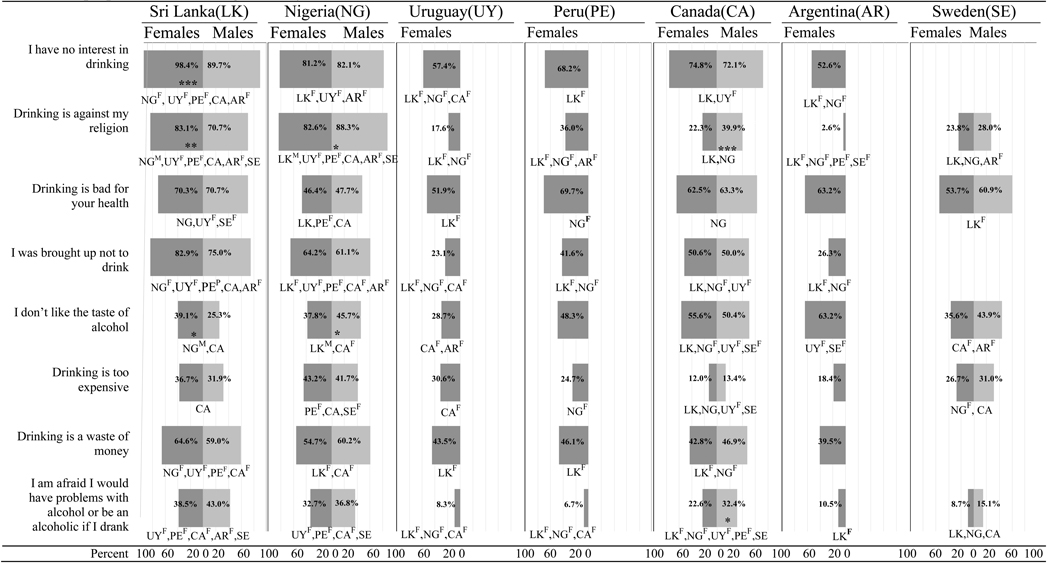
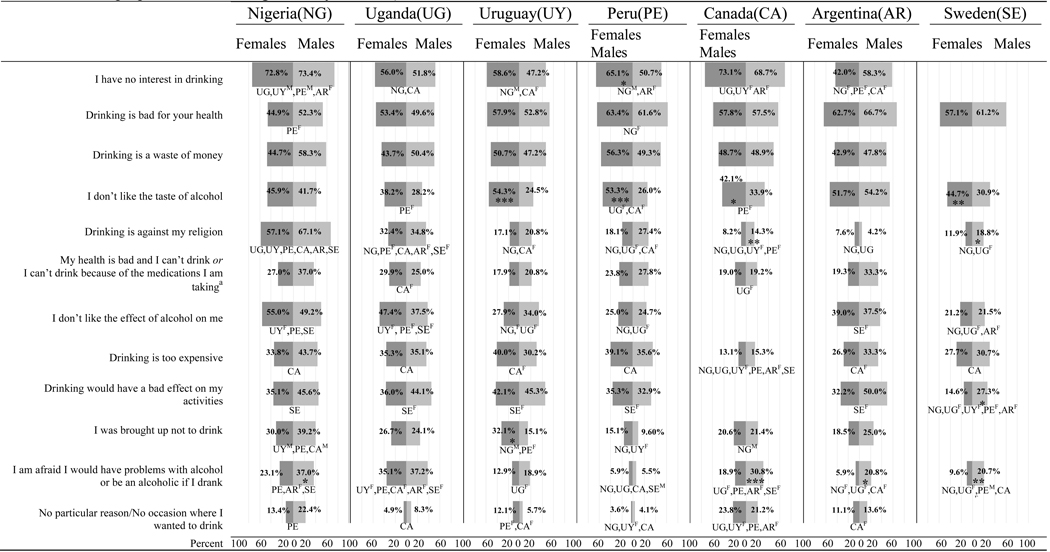
Findings: Reasons for abstaining differed significantly for life-time abstainers compared to former drinkers, by gender and age, and by country-level abstaining rate and frequency of drinking. Life-time abstainers were more likely than former drinkers to endorse 'no interest', 'religion' and 'upbringing' and more reasons overall. Gender differences, especially among former drinkers, suggested that norms restricting drinking may influence reasons that women abstain ('no interest', 'not liking taste') while drinking experiences may be more important considerations for men ('afraid of alcohol problems', 'bad effect on activities'). Younger age was associated with normative reasons ('no interest', 'taste', 'waste of money') and possibly bad experiences ('afraid of problems'). Reasons such as 'religion', 'waste of money' and 'afraid of alcohol problems' were associated with higher country-level rates of abstaining. Higher endorsement of 'drinking is bad for health' and 'taste' were associated with a country pattern of less frequent drinking while 'not liking effects' was associated with higher drinking frequency.
Conclusions: Reasons for abstaining depend on type of abstainer, gender, age and country drinking norms and patterns.
© 2009 The Authors. Journal compilation © 2009 Society for the Study of Addiction.
Conflict of interest statement
Conflict of interest: none
Figures
References
-
- Rehm J, Room R, Monteiro M, Gmel G, Graham K, Rehn N, Sempos C, Frick U, Jernigan D. Ezzati M, Lopez A, Rodgers A, Murray C, editors. Comparative Quantification of Health Risks. Geneva: World Health Organization (WHO); 2004. Alcohol use.
-
- World Health Organization. Global status report on alcohol. 2004. [Accessed December 8, 2008]. http://www.who.int/substance_abuse/publications/global_status_report_200....
-
- Ibanga A, Adetula A, Dagona Z, Karick H, Ojiji O. The contexts of alcohol consumption in Nigeria. In: Obot I, Room R, editors. Alcohol, gender and drinking problems. Geneva: World Health Organization; 2005.
-
- Hettige S, Paranagama D. Obot I, Room R, editors. Alcohol, gender and drinking problems. Geneva: World Health Organization; 2005. Gender and alcohol in Sri Lanka.
-
- Krause N. Race, religion and abstinence from alcohol in late life. Journal of Aging and Health. 2003;15(3):508–533. - PubMed
Publication types
MeSH terms
Grants and funding
LinkOut - more resources
Full Text Sources
Medical
Research Materials
