


Pain, functional limitations, and aging
- PMID: 19682122
- PMCID: PMC2925684
- DOI: 10.1111/j.1532-5415.2009.02388.x
Pain, functional limitations, and aging
Abstract
Objectives: To examine the relationship between functional limitations and pain across a spectrum of age, ranging from mid life to advanced old age.
Design: Cross-sectional study.
Setting: The 2004 Health and Retirement Study (HRS), a nationally representative study of community-living persons aged 50 and older.
Participants: Eighteen thousand five hundred thirty-one participants in the 2004 HRS.
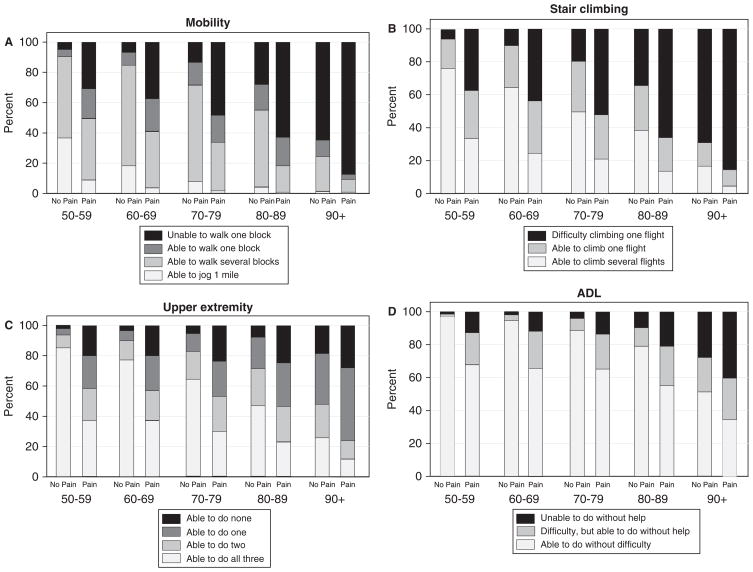
Measurements: Participants who reported that they were often troubled by pain that was moderate or severe most of the time were defined as having significant pain. For each of four functional domains, subjects were classified according to their degree of functional limitation: mobility (able to jog 1 mile, able to walk several blocks, able to walk one block, unable to walk one block), stair climbing (able to climb several flights, able to climb one flight, not able to climb a flight), upper extremity tasks (able to do 3, 2, 1, or 0), and activity of daily living (ADL) function (able to do without difficulty, had difficulty but able to do without help, need help).
Results: Twenty-four percent of participants had significant pain. Across all four domains, participants with pain had much higher rates of functional limitations than subjects without pain. Participants with pain were similar in terms of their degree of functional limitation to participants 2 to 3 decades older. For example, for mobility, of subjects aged 50 to 59 without pain, 37% were able to jog 1 mile, 91% were able to walk several blocks, and 96% were able to walk one block without difficulty. In contrast, of subjects aged 50 to 59 with pain, 9% were able to jog 1 mile, 50% were able to walk several blocks, and 69% were able to walk one block without difficulty. Subjects aged 50 to 59 with pain were similar in terms of mobility limitations to subjects aged 80 to 89 without pain, of whom 4% were able to jog 1 mile, 55% were able to walk several blocks, and 72% were able to walk one block without difficulty. After adjustment for demographic characteristics, socioeconomic status, comorbid conditions, depression, obesity, and health habits, across all four measures, participants with significant pain were at much higher risk for having functional limitations (adjusted odds ratio (AOR)=2.85, 95% confidence interval (CI)=2.20-3.69, for mobility; AOR=2.84, 95% CI=2.48-3.26, for stair climbing; AOR=3.96, 95% CI=3.43-4.58, for upper extremity tasks; and AOR=4.33; 95% CI=3.71-5.06, for ADL function).
Conclusion: Subjects with pain develop the functional limitations classically associated with aging at much earlier ages.
Conflict of interest statement
Figures
Comment in
-
Pain management to promote independence in older adults.J Am Geriatr Soc. 2010 Jun;58(6):1195-6. doi: 10.1111/j.1532-5415.2010.02878.x. J Am Geriatr Soc. 2010. PMID: 20722852 No abstract available.
References
-
- Covinsky KE, Palmer RM, Fortinsky RH, et al. Loss of independence in activities of daily living in older adults hospitalized with medical illnesses. Increased vulnerability with age. J Am Geriatr Soc. 2003;51:451–458. - PubMed
-
- Guralnik JM, Land KC, Blazer D, et al. Educational status and active life expectancy among older blacks and whites. N Engl J Med. 1993;329:110–116. - PubMed
-
- Guralnik JM, LaCroix AZ, Abbott RD, et al. Maintaining mobility in late life. I. Demographic characteristics and chronic conditions. Am J Epidemiol. 1993;137:845–857. - PubMed
-
- Guralnik JM, Fried LP, Salive ME. Disability as a public health outcome in the aging population. Annu Rev Public Health. 1996;17:25–46. - PubMed
Publication types
MeSH terms
Grants and funding
LinkOut - more resources
Full Text Sources
Medical
