. 2009 Sep;73(6):1043-57.
doi: 10.1111/j.1365-2958.2009.06830.x. Epub 2009 Aug 4.

The transcriptionally active regions in the genome of Bacillus subtilis

Affiliations
Free PMC article

The transcriptionally active regions in the genome of Bacillus subtilis

Simon Rasmussen et al. Mol Microbiol. 2009 Sep.
Free PMC article

Abstract

The majority of all genes have so far been identified and annotated systematically through in silico gene finding. Here we report the finding of 3662 strand-specific transcriptionally active regions (TARs) in the genome of Bacillus subtilis by the use of tiling arrays. We have measured the genome-wide expression during mid-exponential growth on rich (LB) and minimal (M9) medium. The identified TARs account for 77.3% of the genes as they are currently annotated and additionally we find 84 putative non-coding RNAs (ncRNAs) and 127 antisense transcripts. One ncRNA, ncr22, is predicted to act as a translational control on cstA and an antisense transcript was observed opposite the housekeeping sigma factor sigA. Through this work we have discovered a long conserved 3' untranslated region (UTR) in a group of membrane-associated genes that is predicted to fold into a large and highly stable secondary structure. One of the genes having this tail is efeN, which encodes a target of the twin-arginine translocase (Tat) protein translocation system.


Figures
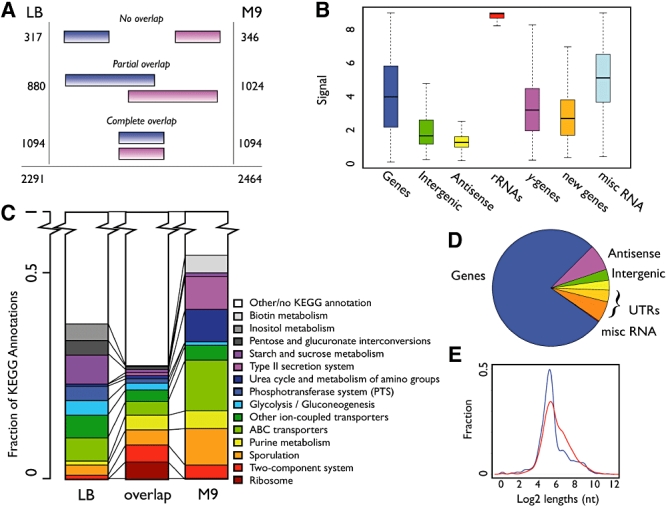
Fig. 1
Fig. 1
Expression in LB and M9. A. Diagram showing the overlap between TARs identified in the two media. No overlap: less than 5% overlap; Partial overlap: between 5% and 85% overlap (can overlap multiple TARs); Complete overlap: overlap of 85% or more. B. Box plot showing the log2-transformed signal range of the probes within annotated genes (non-y-genes), the regions between genes (Intergenic), antisense to known annotation, rRNAs, y-genes, new genes and misc RNAs as by the re-annotation by Barbe et al. C. Representation of the top 14 KEGG terms from genes uniquely expressed in LB and M9, and genes common to the two media. D. Pie chart illustrating the physical position of the probes returning a signal above background. Blue: ORF/gene; dark orange: 5′ UTR; orange: intergenic UTR; yellow: 3′ UTR; green: intergenic region (IR); magenta: antisense; red: misc RNA (Barbe et al., 2009). E. Density plot showing the log2 lengths (nt) of 5′ UTRs (red) and 3′ UTRs (blue) as they are determined in the study.
Fig. 3
Fig. 3
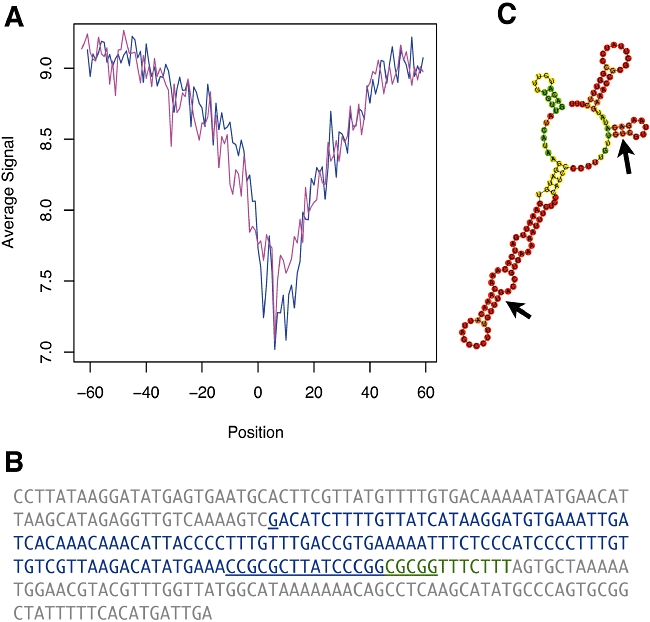
A. Average genomic DNA signal intensity over Kingsford predicted terminators (Kingsford et al., 2007). Position 0 corresponds to the middle nucleotide of the predicted terminator. Blue: Watson strand; magenta: Crick strand. B. The ncr22 transcript and ∼100 nt upstream and downstream. Grey: intergenic nt; blue: identified transcript; underlined: transcription start site (+1) determined by 5′ RLM-RACE and stem-loop of terminator sequence; green: last part of terminator stem-loop and T-tail not within the identified transcript. C. Fold of ncr22 transcript using RNAfold, coloured as base-pair probabilities. Blue equals zero and red equals 1. The two arrows indicate binding sequence to cstA transcript upstream of the start codon.
Fig. 2
Fig. 2
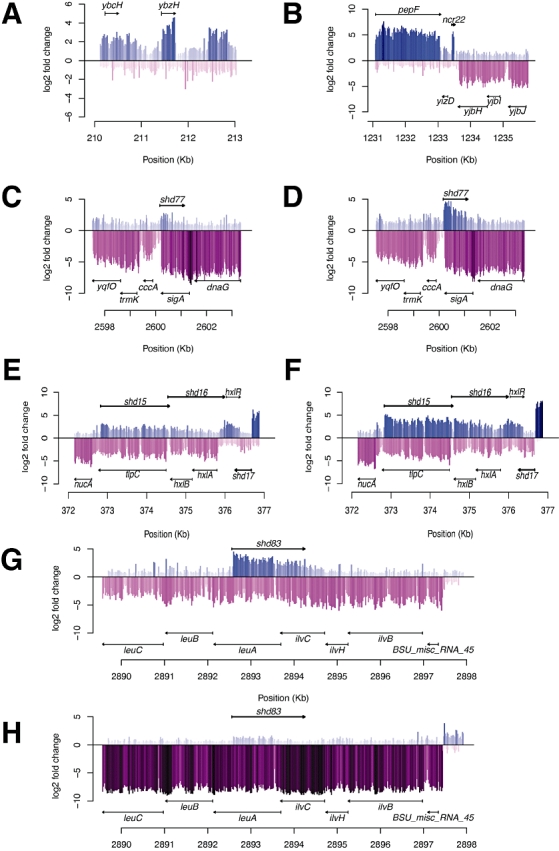
Expression of different regions of the B. subtilis genome during growth, where the position and direction of genes are indicated with arrows. Expression on the Watson strand is blue, Crick strand is magenta and the colour intensity also indicates signal strength. A. Expression in the 210–212 kb region in LB showing new protein-coding gene ybzH expressed monocistronic. B. Expression during growth in LB medium in the region 1231–1236 kb, showing expression of the novel non-coding RNA ncr22. C. Antisense expression in the region 2598–2603 kb in LB (shd77) of sigA. D. As (C), but expression in M9. E. Antisense expression in the region 372–377 kb in LB (shd15-shd17) of tlpC, hxlB, hxlA and hxlR. F. As (E), but expression in M9. G. Antisense expression in the region 2890–2898 kb during growth in LB (shd83) of the operon ilvBHC-leuABC. H. As (G), but expression in M9.
Fig. 5
Fig. 5
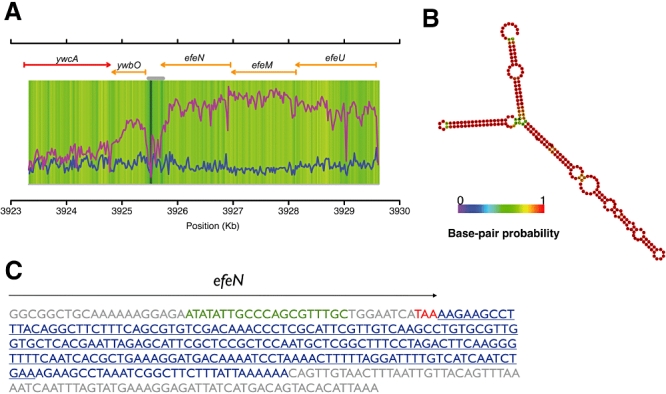
A. Expression of the genomic area near efeN as an example of the identified conserved, stable structure forming 3′ UTRs. Watson strand is blue, Crick strand is magenta and the results from the DNA hybridization are shown in a colour gradient from dark green (low signal) to yellow (high signal). The grey bar indicated the location of the 3′ UTR transcript. B. RNA structure, folded using RNAfold, of 220 nt downstream of stop codon of efenN coloured as base-pair probabilities. Blue equals zero and red equals 1. C. 3′ sequence of efeN containing transcript. Grey: efeN CDS, and intergenic nt; green: RLM-RACE primer; red: efeN stop codon; blue: 3′ UTR identified by RLM-RACE and the sequence folded in (B); underlined: the conserved sequence.
Fig. 4
Fig. 4
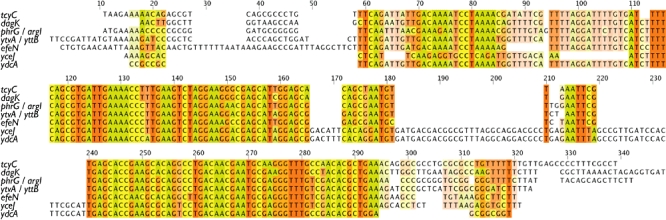
Multiple alignment in clustalw2 (Larkin et al., 2007) of the 250 nucleotides downstream of tcyC, dagK, phrG (shared with argI), ytvA (shared with yttB), efeN, yceJ and ydcA. efeN, yceJ and ydcA have the reverse complement of the sequence and are here aligned using the reverse complement. Bases are coloured A = green, T = red, C = yellow, G = orange and the intensity at each position indicates base conservation. No conservation is uncoloured.

References

    1. Altschul SF, Gish W, Miller W, Myers EW, Lipman DJ. Basic local alignment search tool. J Mol Biol. 1990;215:403–410. - PubMed
    1. Anagnostopoulos C, Spizizen J. Requirements for transformation in Bacillus subtilis. J Bacteriol. 1961;81:741–746. - PMC - PubMed
    1. Ando Y, Asari S, Suzuma S, Yamane K, Nakamura K. Expression of a small RNA, BS203 RNA, from the yocI–yocJ intergenic region of the Bacillus subtilis genome. FEMS Microbiol Lett. 2002;207:29–33. - PubMed
    1. Auchtung JM, Lee CA, Grossman AD. Modulation of the ComA-dependent quorum response in Bacillus subtilis by multiple Rap proteins and Phr peptides. J Bacteriol. 2006;188:5273–5285. - PMC - PubMed
    1. Barbe V, Cruveiller S, Kunst F, Lenoble P, Meurice G, Sekowska A, et al. From a consortium sequence to a unified sequence: the Bacillus subtilis 168 reference genome a decade later. Microbiology. 2009;155:1758–1775. - PMC - PubMed

Publication types

MeSH terms