


Development and validation of a simple questionnaire for the identification of hereditary breast cancer in primary care
- PMID: 19682358
- PMCID: PMC2739222
- DOI: 10.1186/1471-2407-9-283
Development and validation of a simple questionnaire for the identification of hereditary breast cancer in primary care
Abstract
Background: Breast cancer is a significant public health problem worldwide and the development of tools to identify individuals at-risk for hereditary breast cancer syndromes, where specific interventions can be proposed to reduce risk, has become increasingly relevant. A previous study in Southern Brazil has shown that a family history suggestive of these syndromes may be prevalent at the primary care level. Development of a simple and sensitive instrument, easily applicable in primary care units, would be particularly helpful in underserved communities in which identification and referral of high-risk individuals is difficult.
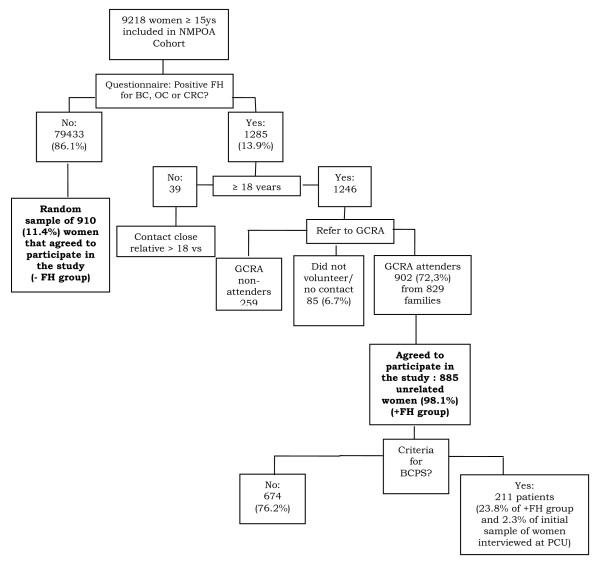
Methods: A simple 7-question instrument about family history of breast, ovarian and colorectal cancer, FHS-7, was developed to screen for individuals with an increased risk for hereditary breast cancer syndromes. FHS-7 was applied to 9218 women during routine visits to primary care units in Southern Brazil. Two consecutive samples of 885 women and 910 women who answered positively to at least one question and negatively to all questions were included, respectively. The sensitivity, specificity and positive and negative predictive values were determined.
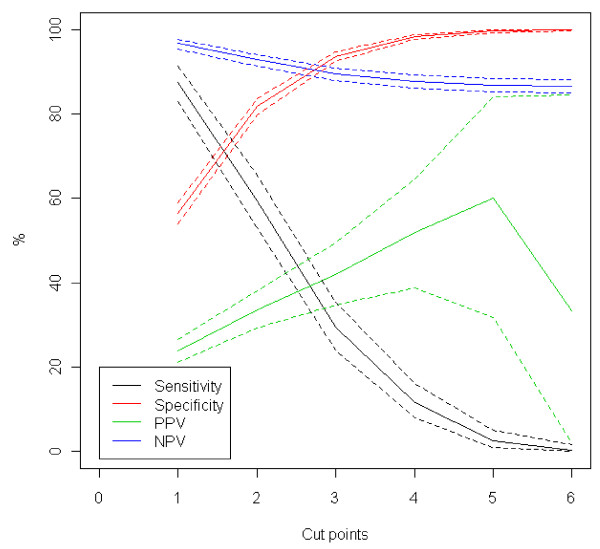
Results: Of the 885 women reporting a positive family history, 211 (23.8%; CI95%: 21.5-26.2) had a pedigree suggestive of a hereditary breast and/or breast and colorectal cancer syndrome. Using as cut point one positive answer, the sensitivity and specificity of the instrument were 87.6% and 56.4%, respectively. Concordance between answers in two different applications was given by a intra-class correlation (ICC) of 0.84 for at least one positive answer. Temporal stability of the instrument was adequate (ICC = 0.65).
Conclusion: A simple instrument for the identification of the most common hereditary breast cancer syndrome phenotypes, showing good specificity and temporal stability was developed and could be used as a screening tool in primary care to refer at-risk individuals for genetic evaluations.
Figures
References
-
- World Health Organization Webpage. http://www.who.int
-
- Cancer Research UK. http://info.cancerresearchuk.org/cancerstats/geographic/world/commoncanc...
-
- Tavassoli FA, Devilee P, (Eds.) World Health Organization Classification of Tumours. Pathology and Genetics of Tumours of the Breast and Female Genital Organs. IARC Press: IARC Press: Lyon; 2003.
-
- Brazilian National Cancer Institute. http://www.inca.gov.br
-
- Cadaval Gonçalves AT, Costa Jobim PF, Vanacor R. Increase in breast cancer mortality in Southern Brazil from 1980 to 2002. Cad Saúde Pública. 2007;23:1785–1790. - PubMed
Publication types
MeSH terms
LinkOut - more resources
Full Text Sources
Medical
