


Family psychiatric history, peritraumatic reactivity, and posttraumatic stress symptoms: a prospective study of police
- PMID: 19683259
- PMCID: PMC2818084
- DOI: 10.1016/j.jpsychires.2009.05.011
Family psychiatric history, peritraumatic reactivity, and posttraumatic stress symptoms: a prospective study of police
Abstract
Background: Family history of psychiatric and substance use disorders has been associated with posttraumatic stress disorder (PTSD) in cross-sectional studies.
Method: Using a prospective design, we examined the relationships of family history of psychiatric and substance use disorders to posttraumatic stress symptoms in 278 healthy police recruits. During academy training, recruits were interviewed on family and personal psychopathology, prior cumulative civilian trauma exposure, and completed self-report questionnaires on nonspecific symptoms of distress and alcohol use. Twelve months after commencement of active duty, participants completed questionnaires on critical incident exposure over the previous year, peritraumatic distress to the worst critical incident during this time, and posttraumatic stress symptoms.
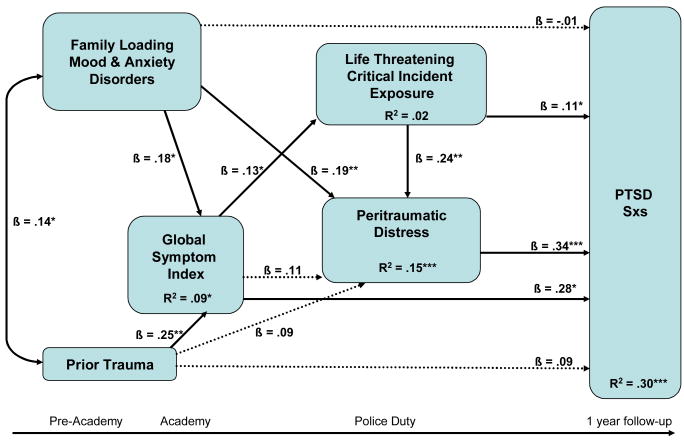
Results: A path model indicated: (1) family loading for mood and anxiety disorders had an indirect effect on posttraumatic stress symptoms at 12 months that was mediated through peritraumatic distress to the officer's self-identified worst critical incident, (2) family loading for substance use disorders also predicted posttraumatic stress symptoms at 12 months and this relationship was mediated through peritraumatic distress.
Conclusion: These findings support a model in which family histories of psychopathology and substance abuse are pre-existing vulnerability factors for experiencing greater peritraumatic distress to critical incident exposure which, in turn, increases the risk for development of symptoms of posttraumatic stress disorder. Replication in other first responders, military and civilians will be important to determine generalizability of these findings.
Figures

References
-
- Benazzi F. Bipolar II disorder family history using the family history screen: findings and clinical implications. Compr Psychiatry. 2004;45:77–82. - PubMed
-
- Binder EB, Bradley RG, Liu W, Epstein MP, Deveau TC, Mercer KB, Tang Y, Gillespie CF, Heim CM, Nemeroff CB, Schwartz AC, Cubells JF, Ressler KJ. Association of FKBP5 polymorphisms and childhood abuse with risk of posttraumatic stress disorder symptoms in adults. Jama. 2008;299:1291–1305. - PMC - PubMed
-
- Blanchard EB, Jones-Alexander J, Buckley TC, Forneris CA. Psychometric properties of the PTSD Checklist (PCL) Behaviour Research & Therapy. 1996:34. - PubMed
-
- Bremner JD. Neuroimaging studies in post-traumatic stress disorder. Curr Psychiatry Rep. 2002;4:254–263. - PubMed
-
- Brunet A, Weiss D, Best SR, Liberman A, Fagan J, Marmar CR. International Society for Traumatic Stress Studies. Vol. 49. Washington, DC: 1998. Assessing recurring traumatic exposure : the Critical Incident History Questionnaire.
