


Innate immunity, coagulation and placenta-related adverse pregnancy outcomes
- PMID: 19683334
- PMCID: PMC2788065
- DOI: 10.1016/j.thromres.2009.07.012
Innate immunity, coagulation and placenta-related adverse pregnancy outcomes
Abstract
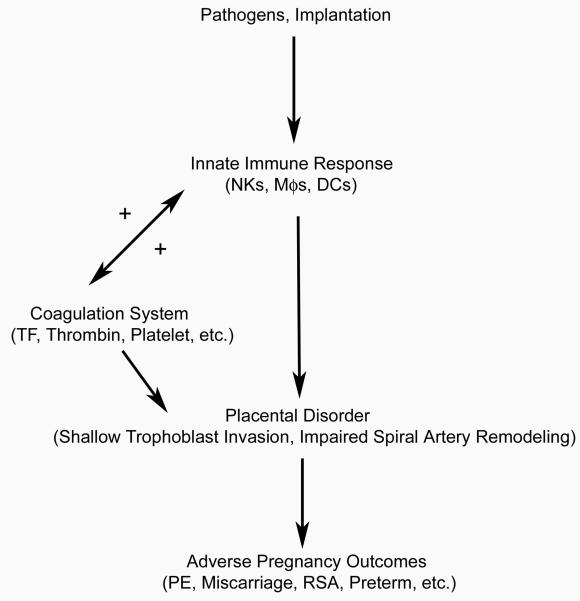
Maternal immunity undergoes subtle adjustment in order to tolerate the semi-allogeneic embryo and maintain the host defense against potential pathogens. Concomitantly, coagulation systems change from an anti-coagulant state to a pro-coagulant state to meet the hemostatic challenge of placentation and delivery. Innate immunity and blood coagulation systems are the first line of defense to protect a host against exogenous challenges, including alloantigens and mechanical insults, and preserve the integrity of an organism. The interactions between coagulation and immune systems have been extensively studied. Immune cells play a pivotal role in the initiation of the coagulation cascade, whereas coagulation proteases display substantial immuno-modulatory effects. Upon exogenous challenges, the immune and coagulation systems are capable of potentiating each other leading to a vicious cycle. Natural killer (NK) cells, macrophages (Mphis) and dendritic cells (DCs) are three major innate immune cells that have been demonstrated to play essential roles in early pregnancy. However, immune maladaptation and hemostatic imbalance have been suggested to be responsible for adverse pregnant outcomes, such as preeclampsia (PE), miscarriage, recurrent spontaneous abortion (RSA) and intrauterine growth restriction (IUGR). In this review, we will summarize the mutual regulation between blood coagulation and innate immune systems as well as their roles in the maintenance of normal pregnancy and in the pathogenesis of adverse pregnancy outcomes.
Figures
References
-
- Gallucci S, Matzinger P. Danger signals: SOS to the immune system. Curr Opin Immunol. 2001;13:114–119. - PubMed
-
- Opal SM. Phylogenetic and functional relationships between coagulation and the innate immune response. Crit Care Med. 2000;28:S77–80. - PubMed
-
- Robertson SA, Redman CW, McCracken SA, Hunt JS, Dimitriadis E, Moffett-King A, Chamley L. Immune modulators of implantation and placental development--a workshop report. Placenta. 2003;24(Suppl A):S16–20. - PubMed
-
- Duley L. Maternal mortality associated with hypertensive disorders of pregnancy in Africa, Asia, Latin America and the Caribbean. Br J Obstet Gynaecol. 1992;99:547–553. - PubMed
-
- Challis JRG. Mechanism of parturition and preterm labor. Obstet Gynecol Surv. 2000;55:650–660. - PubMed
Publication types
MeSH terms
Grants and funding
LinkOut - more resources
Full Text Sources
