


Adenylyl cyclase--A-kinase anchoring protein complexes: the next dimension in cAMP signaling
- PMID: 19684092
- PMCID: PMC2774998
- DOI: 10.1124/mol.109.059345
Adenylyl cyclase--A-kinase anchoring protein complexes: the next dimension in cAMP signaling
Abstract
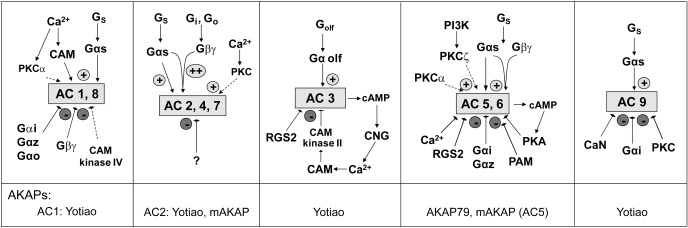
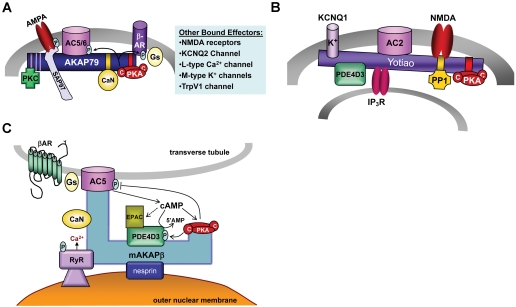
The formation of multiprotein complexes is a repeated theme in biology ranging from the regulation of the extracellular signal-regulated kinase and cAMP signaling pathways to the formation of postsynaptic density complexes or tight junctions. A-kinase anchoring proteins (AKAPs) are well known for their ability to scaffold protein kinase A and components upstream and downstream of cAMP production, including G protein-coupled receptors, cAMP-dependent Rap-exchange factors, and phosphodiesterases. Specific adenylyl cyclase (AC) isoforms have also been identified as components of AKAP complexes, namely AKAP79, Yotiao, and mAKAP. In this review, we summarize recent evidence for AC-AKAP complexes and requirements for compartmentalization of cAMP signaling. The ability of AKAPs to assemble intricate feedback loops to control spatiotemporal aspects of cAMP signaling adds yet another dimension to the classic cAMP pathway.
Figures
References
-
- Bauman AL, Michel JJ, Henson E, Dodge-Kafka KL, Kapiloff MS. (2007) The mAKAP signalosome and cardiac myocyte hypertrophy. IUBMB Life 59:163–169 - PubMed
-
- Belcheva MM, Gucker S, Chuang DM, Clark WG, Jefcoat LB, McHale RJ, Toth G, Borsodi A, Coscia CJ. (1995) Modulation of opioid binding associated with nuclear matrix and nuclear membranes of NG108–15 cells. J Pharmacol Exp Ther 274:1513–1523 - PubMed
-
- Berrera M, Dodoni G, Monterisi S, Pertegato V, Zamparo I, Zaccolo M. (2008) A toolkit for real-time detection of cAMP: insights into compartmentalized signaling. Handb Exp Pharmacol 186:285–298 - PubMed
-
- Boivin B, Lavoie C, Vaniotis G, Baragli A, Villeneuve LR, Ethier N, Trieu P, Allen BG, Hébert TE. (2006) Functional beta-adrenergic receptor signalling on nuclear membranes in adult rat and mouse ventricular cardiomyocytes. Cardiovasc Res 71:69–78 - PubMed
Publication types
MeSH terms
Substances
Grants and funding
LinkOut - more resources
Full Text Sources
