. 2009 Aug;21(8):2473-84.
doi: 10.1105/tpc.109.065870. Epub 2009 Aug 14.

A serine carboxypeptidase-like acyltransferase is required for synthesis of antimicrobial compounds and disease resistance in oats

Affiliations

A serine carboxypeptidase-like acyltransferase is required for synthesis of antimicrobial compounds and disease resistance in oats

Sam T Mugford et al. Plant Cell. 2009 Aug.

Abstract

Serine carboxypeptidase-like (SCPL) proteins have recently emerged as a new group of plant acyltransferases. These enzymes share homology with peptidases but lack protease activity and instead are able to acylate natural products. Several SCPL acyltransferases have been characterized to date from dicots, including an enzyme required for the synthesis of glucose polyesters that may contribute to insect resistance in wild tomato (Solanum pennellii) and enzymes required for the synthesis of sinapate esters associated with UV protection in Arabidopsis thaliana. In our earlier genetic analysis, we identified the Saponin-deficient 7 (Sad7) locus as being required for the synthesis of antimicrobial triterpene glycosides (avenacins) and for broad-spectrum disease resistance in diploid oat (Avena strigosa). Here, we report on the cloning of Sad7 and show that this gene encodes a functional SCPL acyltransferase, SCPL1, that is able to catalyze the synthesis of both N-methyl anthraniloyl- and benzoyl-derivatized forms of avenacin. Sad7 forms part of an operon-like gene cluster for avenacin synthesis. Oat SCPL1 (SAD7) is the founder member of a subfamily of monocot-specific SCPL proteins that includes predicted proteins from rice (Oryza sativa) and other grasses with potential roles in secondary metabolism and plant defense.


Figures

Figure 1.
Figure 1.
Structures of Avenacins and Des-acyl Avenacins. (A) Avenacins A-1 and B-1 (left) are esterified at the C-21 position with N-methyl anthranilate, and avenacins A-2 and B-2 (right) with benzoate. (B) Des-acyl avenacins A and B.
Figure 2.
Figure 2.
SCPL1, a Gene That Is Predicted to Encode an SCPL Protein, Is Linked to and Coexpressed with Sad1 and Sad2. (A) BAC contig showing the positions of the Sad1, Sad2, and SCPL1 genes. (B) RNA gel blot analysis of transcripts of SCPL1 and the two cloned avenacin pathway genes Sad1 and Sad2; RNA loading was monitored with methylene blue. (C) mRNA in situ localization of Sad1 and SCPL1 transcripts in A. strigosa root tips. No signal was observed for sections probed with sense control probes. Bars = 100 μm.
Figure 3.
Figure 3.
sad7 Mutants Accumulate Des-Acyl Avenacins. LC-MS analysis of root extracts of wild-type and mutant oat lines. Total ion chromatograms for wild-type (WT), sad1, and sad7 mutants reveal accumulation of unacylated intermediates (des-acyl avenacins A and B) in the sad7 mutants. The peak at 4.4 min is comprised of a major ion at 984 amu, corresponding to avenacin A-1/A-2 minus the acyl group [M+Na+] (des-acyl avenacin A) (Figure 1B). Similarly, the peak at 5.8 min is comprised of a major ion at 968 amu, which corresponds to avenacins B-1/B-2 minus the acyl group [M+Na+] (des-acyl avenacin B) (Figure 1B). The identity of these compounds is supported by MS2 fragmentation data (see Supplemental Figures 2A to 2C online). The minor avenacin B-2 is present only in trace amounts in root extracts from wild-type seedlings but can be detected by MS.
Figure 4.
Figure 4.
Oat SCPL1 Defines a Clade of Monocot-Specific SCPL Proteins. A neighbor-joining phylogenetic analysis of SCP and SCPL proteins is shown. Bootstrap values (percentage values from 1000 replicates) are presented for key branches. The scale bar indicates 0.1 substitutions per site. The highlighted clades are based on the classification of Fraser et al. (2005). Blue circles indicate functionally characterized SCPL acyltransferase enzymes that have previously been reported: SCT, sinapoylglucose:choline sinapoyltransferases from Arabidopsis (Shirley et al., 2001) and B. napus (Weier et al., 2008); SMT, Arabidopsis sinapoylglucose:malate sinapoyltransferase (Lehfeldt et al., 2000); SAT, Arabidopsis sinapoylglucose:anthocyanin sinapoyltransferase (Fraser et al., 2007); SST, Arabidopsis sinapoylglucose:sinapoylglucose sinapoyltransferase (Fraser et al., 2007); GAC, glucose acyltransferase from wild tomato (Li and Steffens, 2000). Oat SCPL1 (SAD7) is indicated by the red circle. Protein sequence accession numbers, sequence alignment, and further details of the sequences used for this phylogenetic analysis are provided in Supplemental Table 1, Supplemental Data Set 1, and Supplemental Figure 1 online.
Figure 5.
Figure 5.
Roots of sad7 Mutants Contain UV Fluorescent Material. Unlike other avenacin-deficient mutants, such as sad1, sad7 mutants exhibit some blue fluorescence under UV illumination (although this is weaker than that observed in wild-type roots). Images of 3-d-old roots under UV illumination (wavelength 290 to 320 nm). Bars = 100 μm.
Figure 6.
Figure 6.
sad7 Mutants Accumulate N-Methyl Anthraniloyl-O-Glucose. (A) LC-MS analysis of fluorescent components of root extracts from wild-type (WT) and mutant A. strigosa lines. The peak eluting at 6.2 min consists of a major ion of 336 amu corresponding to N-methyl anthraniloyl-O-glucose (NMA-glc) [M+Na+]. The identity of this compound is supported by MS2 fragmentation data (see Supplemental Figures 2D to 2F online). (B) Quantification of N-methyl anthraniloyl-O-glucose from LC separations based on fluorescence (n = 3) ± se. Different letters (a or b) indicate significant differences in N-methyl anthraniloyl-O-glucose levels (P < 0.01, t test with Bonferroni correction). The concentration of avenacin A-1 in wild-type root extracts was 103.2 pmol/root tip ±18.
Figure 7.
Figure 7.
SCPL1 Is Posttranslationally Cleaved. (A) Alignment of SCP and SCPL protein sequences covering the site of posttranslational cleavage. Sequences known to be posttranslationally cleaved are indicated with an asterisk. Sequences shown are SCPL1 (SAD7) (amino acids 210 to 411); CPDWII, T. aestivum Ser carboxypeptidase II (P08819) (amino acids 185 to 356); GAC S. pennellii glucose acyltransferase (AAF64227) (amino acids 205 to 380); SCT, Arabidopsis sinapoylglucose:choline sinapoyltransferase (AY033947) (amino acids 216 to 391); SMT, Arabidopsis sinapoylglucose:malate sinapoyltransferase (AF275313) (amino acids 201 to 350); and CPY, Saccharomyces cerevisiae carboxypeptidase Y (1YSC) (amino acids 174 to 334 of the mature peptide sequence). The regions of the T. aestivum CPDWII and S. pennellii GAC enzymes that have been shown to be present in the mature proteins are boxed, indicating the likely sites of cleavage (Liao and Remmington, 1990; Li and Steffens, 2000). Similar amino acids are highlighted in black, dark, or light gray (100, >60, and >40% similarity, respectively). Conserved Cys residues that are likely to form intersubunit disulphide bond are indicated by black circles. (B) Immunoblot analysis of protein extracts from roots from seedlings of wild-type (WT) and sad7 mutant A. strigosa lines probed with anti-SCPL1 antisera (left) and a replicate gel stained with Coomassie blue (right). A weaker background band of ∼62 kD was detected on the immunoblot in samples from both leaves and roots. Since this is larger than the predicted full-length SCPL1 protein and SCPL1 is expressed only in roots, this is unlikely to be an SCPL1 gene product. Replicate blots probed with pre-immune sera did not result in the detection of any bands. (C) Proposed processing of the SCPL1 protein from the 52-kD full-length protein, via a 33-kD intermediate, to the mature 29- and 19-kD subunits.
Figure 8.
Figure 8.
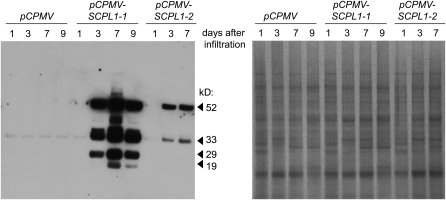
Heterologous Expression of SCPL1 in N. benthamiana Leaves Using the CPMV Expression System. Left, immunoblot using polyclonal antisera raised against SCPL1. Total soluble protein extracts were prepared from N. benthamiana leaves that had been infiltrated with A. tumefaciens carrying either the CPMV empty vector construct (pCPMV), CPMV vector modified to express the SCPL1 protein (pCPMV-SCPL1-1), or a C-terminal His-tagged version of this (pCPMV-SCPL1-2). Samples were collected 1, 3, 7, and 9 d after leaf infiltration. Right, replicate gel stained with Coomassie blue showing protein loading.

Comment in

References

    1. Baumert, A., Milkowski, C., Schmidt, J., Nimtz, M., Wray, V., and Strack, D. (2005). Formation of a complex pattern of sinapate esters in Brassica napus seeds, catalysed by enzymes of a serine carboxypeptidase-like acyltransferase family. Phytochemistry. 66: 1334–1345. - PubMed
    1. Cañizares, M.C., Liu, L., Perrin, Y., Tsakiris, E., and Lomonossoff, G.P. (2006). A bipartite system for the constitutive and inducible expression of high levels of foreign proteins in plants. Plant Biotechnol. 4: 183–193. - PubMed
    1. D'Auria, J.C. (2006). Acyltransferases in plants: A good time to be BAHD. Curr. Opin. Plant Biol. 9: 331–340. - PubMed
    1. Dixon, R.A. (2001). Natural products and plant disease resistance. Nature 441: 843–847. - PubMed
    1. Dudareva, N., D'Auria, J.C., Nam, K.H., Raguso, R.A., and Pichersky, E. (1998). Acetyl-CoA:benzylalcohol acetyltransferase - An enzyme involved in floral scent production in Clarkia breweri. Plant J. 14: 297–304. - PubMed

Publication types

MeSH terms

Associated data

LinkOut - more resources