The effect of mood on sleep onset latency and REM sleep in interepisode bipolar disorder
- PMID: 19685943
- PMCID: PMC4185310
- DOI: 10.1037/a0016605
The effect of mood on sleep onset latency and REM sleep in interepisode bipolar disorder
Abstract
The present study investigates whether interepisode mood regulation impairment contributes to disturbances in sleep onset latency (SOL) and rapid eye movement (REM) sleep. Individuals with interepisode bipolar disorder (n = 28) and healthy controls (n = 28) slept in the laboratory for 2 baseline nights, a happy mood induction night, and a sad mood induction night. There was a significant interaction whereby on the happy mood induction night the bipolar group exhibited significantly longer SOL than did the control group, while there was no difference on the baseline nights. In addition, control participants exhibited shorter SOL on the happy mood induction night compared to the baseline nights, a finding that was not observed in the bipolar group. On the sad mood induction night, participants in both groups had shorter SOL and increased REM density when compared to the baseline nights. Bipolar participants exhibited heightened REM density compared to control participants on both nights. These results raise the possibility that regulation of positive stimuli may be a contributor to difficulties with SOL, while hyperactivity may be characteristic of REM sleep.
Figures
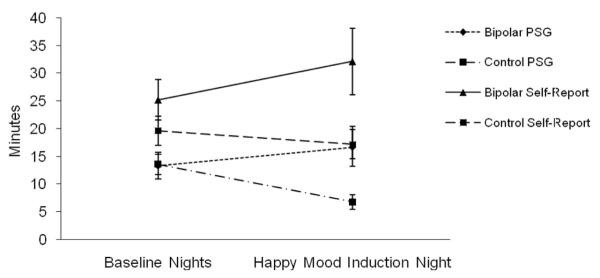
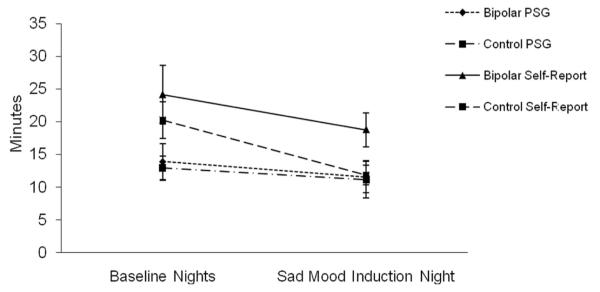
References
-
- Agnew HW, Webb WB, Williams RL. The first night effect: An EEG study of sleep. Psychophysiology. 1966;2:263–266. - PubMed
-
- Albersnagel FA. Velten and musical mood induction procedures: A comparison with accessibility of thought associations. Behavior Research and Therapy. 1988;26(1):79–96. - PubMed
-
- American Psychiatric Association . Diagnostic and statistical manual of mental disorders. 4th ed., text rev Author; Washington, DC: 2000.
-
- Angst J, Sellaro R. Historical perspectives and natural history of bipolar disorder. Biological Psychiatry. 2000;48:445–457. - PubMed
-
- Barbini B, Bertelli S, Colombo C, Smeraldi E. Sleep loss, a possible factor in augmenting manic episode. Psychiatry Research. 1996;65:121–125. - PubMed