


Youth meeting symptom and impairment criteria for mania-like episodes lasting less than four days: an epidemiological enquiry
- PMID: 19686330
- PMCID: PMC4286871
- DOI: 10.1111/j.1469-7610.2009.02129.x
Youth meeting symptom and impairment criteria for mania-like episodes lasting less than four days: an epidemiological enquiry
Abstract
Background: Little is known about short-duration episodes of mania-like symptoms in youth. Here we determine the prevalence, morbid associations, and contribution to social impairment of a phenotype characterised by episodes during which symptom and impairment criteria for mania are met, but DSM-IV duration criteria are not (bipolar not otherwise specified; BP-NOS).
Methods: A cross-sectional national survey of a sample (N = 5,326) of 8-19-year-olds from the general population using information from parents and youth. Outcome measures were prevalence rates and morbid associations assessed by the Developmental and Well-Being Assessment, and social impairment assessed by the impact scale of the Strengths and Difficulties Questionnaire.
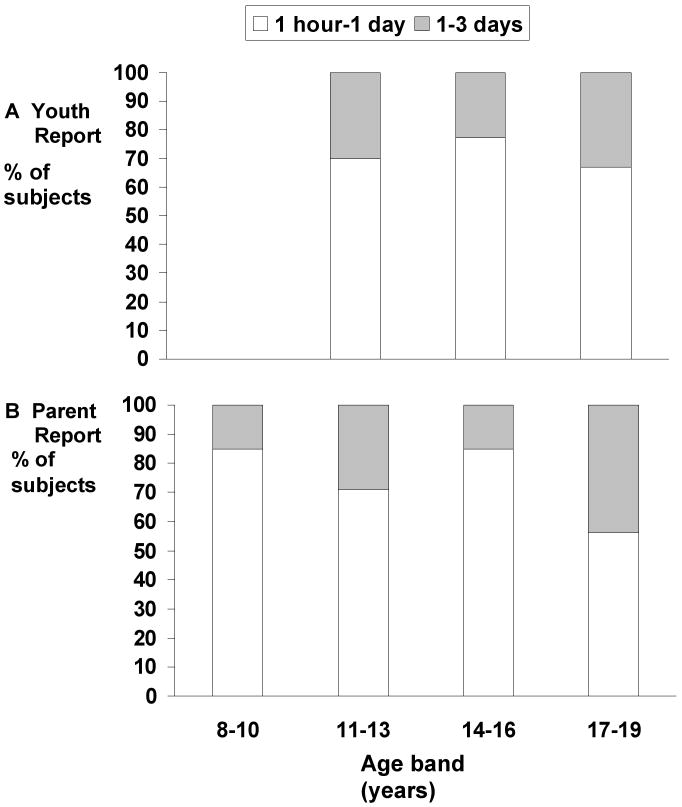
Results: While only seven individuals (.1%) met definite or probable DSM-IV criteria for BPI or BPII, the prevalence of BP-NOS was 10-fold higher, 1.1% by parent report and 1.5% by youth report. Parent-youth agreement was very low: kappa = .02, p > .05 for BP-NOS. Prevalence and episode duration for BP-NOS did not vary by age. BP-NOS showed strong associations with externalising disorders. After adjusting for a dimensional measure of general psychopathology, self-reported (but not parent-reported) BP-NOS remained associated with overall social impairment.
Conclusions: BP meeting full DSM-IV criteria is rare in youth. BP-NOS, defined by episodes shorter than those required by DSM-IV, but during which DSM-IV symptom and impairment criteria are met, is commoner and may be associated with social impairment that is beyond what can be accounted for by other psychopathology. These findings support the importance of research into these short episodes during which manic symptoms are met in youth but they also call into question the extent to which BP-NOS in youth is a variant of DSM-IV BP - superficially similar symptoms may not necessarily imply deeper similarities in aetiology or treatment response.
Conflict of interest statement
The authors have no conflicts of interest to declare.
Figures
References
-
- American Psychiatric, A. Diagnostic and Statistical Manual of Mental Disorders: DSM-IV-TR. Washington, DC: American Psychiatric Press; 2000.
-
- Angst J, Gamma A, Benazzi F, Ajdacic V, Eich D, Rossler W. Toward a re-definition of subthreshold bipolarity: epidemiology and proposed criteria for bipolar-II, minor bipolar disorders and hypomania. J Affect Disord. 2003;73:133–146. - PubMed
-
- APA. Diagnostic and Statistical Manual of Mental Disorders: DSM-IV-TR. Washington, DC: American Psychiatric Press; 2000.
-
- Axelson D, Birmaher B, Strober M, Gill MK, Valeri S, Chiappetta L, Ryan N, Leonard H, Hunt J, Iyengar S, Bridge J, Keller M. Phenomenology of children and adolescents with bipolar spectrum disorders. Archives of General Psychiatry. 2006;63:1139. - PubMed
Publication types
MeSH terms
Grants and funding
LinkOut - more resources
Full Text Sources
Medical
Miscellaneous
