


Options for control of foot-and-mouth disease: knowledge, capability and policy
- PMID: 19687036
- PMCID: PMC2865093
- DOI: 10.1098/rstb.2009.0100
Options for control of foot-and-mouth disease: knowledge, capability and policy
Abstract
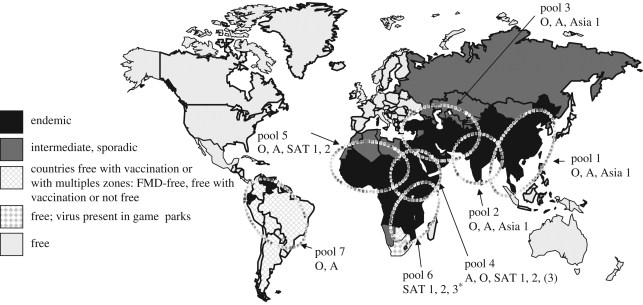
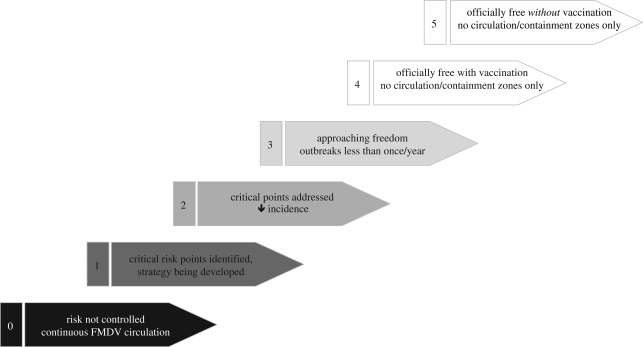
Foot-and-mouth disease can be controlled by zoo-sanitary measures and vaccination but this is difficult owing to the existence of multiple serotypes of the causative virus, multiple host species including wildlife and extreme contagiousness. Although intolerable to modern high-production livestock systems, the disease is not usually fatal and often not a priority for control in many developing countries, which remain reservoirs for viral dissemination. Phylogenetic analysis of the viruses circulating worldwide reveals seven principal reservoirs, each requiring a tailored regional control strategy. Considerable trade benefits accrue to countries that eradicate the disease but as well as requiring regional cooperation, achieving and maintaining this status using current tools takes a great deal of time, money and effort. Therefore, a progressive approach is needed that can provide interim benefits along the pathway to final eradication. Research is needed to understand and predict the patterns of viral persistence and emergence and to improve vaccine selection. Better diagnostic methods and especially better vaccines could significantly improve control in both the free and the affected parts of the world. In particular, vaccines with improved thermostability and a longer duration of immunity would facilitate control and make it less reliant on advanced veterinary infrastructures.
Figures
References
-
- Acharya R., Fry E., Stuart D., Fox G., Rowlands D., Brown F.1989The three-dimensional structure of foot-and-mouth disease virus at 2.9 A resolution. Nature 337, 709–716 (doi:10.1038/337709a0) - DOI - PubMed
-
- Alexandersen S., Zhang Z., Donaldson A. I., Garland A. J.2003The pathogenesis and diagnosis of foot-and-mouth disease. J. Comp. Pathol. 129, 1–36 (doi:10.1016/S0021-9975(03)00041-0) - DOI - PubMed
-
- Anderson I.2002Foot and mouth disease. 2001: Lessons to be learned inquiry report .Report to the Prime Minister and the Secretary of State for Environment Food and Rural Affairs, London, UK
-
- Anonymous 2003Council Directive 2003/85/EC on Community measures for the control of foot-and-mouth disease repealing Directive 85/511/EEC and Decisions 89/531/EEC and 96/665/EEC and amending Directive 92/46/EEC. Article 21 & 45. Off. J. Eur. Union, L306
-
- Arnold M. E., Paton D. J., Ryan E., Cox S. J., Wilesmith J. W.2008Modelling studies to estimate the prevalence of foot-and-mouth disease carriers after reactive vaccination. Proc. Biol. Sci. 275, 107–115 (doi:10.1098/rspb.2007.1154) - DOI - PMC - PubMed
Publication types
MeSH terms
Substances
LinkOut - more resources
Full Text Sources
Other Literature Sources
