


Weight patterns in children with higher risk ALL: A report from the Children's Oncology Group (COG) for CCG 1961
- PMID: 19688832
- PMCID: PMC3044478
- DOI: 10.1002/pbc.22237
Weight patterns in children with higher risk ALL: A report from the Children's Oncology Group (COG) for CCG 1961
Abstract
Background: This retrospective analysis defined and described patterns and predictors of weight change during treatment in children with acute lymphocytic leukemia (ALL) with high-risk features who received treatment on Children's Cancer Group protocol CCG 1961.
Procedure: Patients (1,638) were enrolled in CCG 1961 from November 1996 to May 2002. Weight was measured as BMI percent (%), specific for age and gender, and defined as 100 x ln(BMI/median BMI).
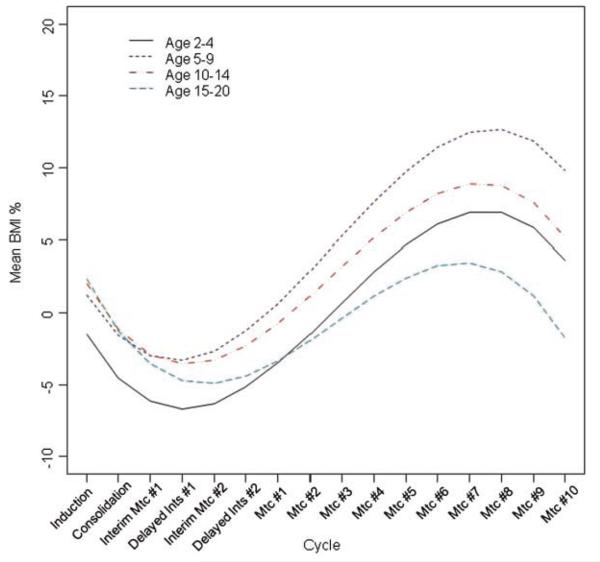
Results: By the end of treatment, 23% of children were obese (BMI >or=95%), compared with 14% at diagnosis. Children who received post-induction intensified therapy (arms C, D, SER with Doxorubicin or Idarubicin) had higher gastrointestinal toxicities and lower BMI% from consolidation through interim maintenance 1. BMI% then increased for all arms between delayed intensification and maintenance 1 or 2. Children who were of Black or Hispanic race, obese at diagnosis, or who had grade 3 or 4 pancreatitis/glucose toxicities during induction had higher BMI% throughout treatment. Children were more likely to be obese at the end of the study if they were aged 5-9 years at diagnosis or female gender. Cranial radiation was not a predictor of obesity.
Conclusions: Successful treatment of higher risk childhood ALL was associated with obesity, independent of cranial irradiation. The beginning of maintenance therapy may be the best time to intervene with nutritional and behavioral interventions, particularly for children who are obese or aged 5-9 years at diagnosis, female, Black or Hispanic, or those with metabolic toxicities during induction.
(c) 2009 Wiley-Liss, Inc.
Figures

References
-
- Rogers PC, Meacham LR, Oeffinger KC, et al. Review: Obesity in pediatric oncology. Pediatr Blood Cancer. 2005;45:881–891. - PubMed
-
- Butturini AM, Dorey FJ, Lange BJ, et al. Obesity and outcomes in pediatric acute lymphoblastic leukemia. J Clin Oncol. 2007;25:2063–2069. - PubMed
-
- Sklar CA, Mertens AC, Walter A, et al. Changes in body mass index and prevalence of overweight in survivors of childhood acute lymphoblastic leukemia: Role of cranial irradiation. Med Pediatr Oncol. 2000;35:91–95. - PubMed
Publication types
MeSH terms
Substances
Grants and funding
LinkOut - more resources
Full Text Sources
Medical
