


Psychometric analysis of the self-harm inventory using Rasch modelling
- PMID: 19689823
- PMCID: PMC2736947
- DOI: 10.1186/1471-244X-9-53
Psychometric analysis of the self-harm inventory using Rasch modelling
Abstract
Background: Deliberate Self-Harm (DSH) is the intentional destruction of healthy body tissue without suicidal intent. DSH behaviours in non-clinical populations vary, and instruments containing a range of behaviours may be more informative than ones with restricted content. The Self-Harm Inventory (SHI) is a widely used measure of DSH in clinical populations (mental and physical health) and covers a broad range of behaviours (self-injury, risk taking and self-defeating acts). The test authors recommend the SHI to screen for Borderline Personality Disorder (BPD) using a cut-off score of five or more. The aim of this study was to investigate the psychometric characteristics of the SHI in non-clinical samples.
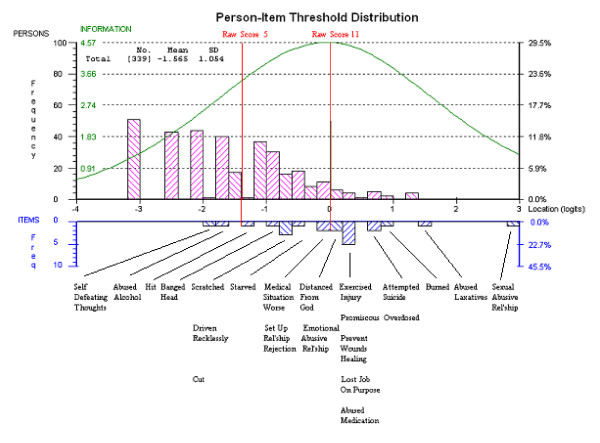
Methods: The SHI was administered to a sample of 423 non-clinical participants (university students, age range 17 to 30). External validation was informed by the administration of the Depression Anxiety Stress Scales 21 (DASS-21) to a sub-sample (n = 221). Rasch analysis of the SHI was conducted to provide a stringent test of unidimensionality and to identify the DSH behaviours most likely to be endorsed at each total score.
Results: The SHI showed adequate fit to the Rasch model and no modifications were required following checks of local response dependency, differential item functioning and unidimensionality. The scale identified gender and age differences in scores, with females and older participants reporting higher levels of DSH. SHI scores and DASS-21 scores were related.
Conclusion: The recommended cut-off point of five is likely to comprise mild forms of DSH and may not be indicative of psychopathology in a non-clinical population. Rather it may be more indicative of developmentally related risk taking behaviours while a higher cut-off point may be more suggestive of psychopathology as indicated by higher levels of depression, stress and anxiety.
Figures
References
Publication types
MeSH terms
LinkOut - more resources
Full Text Sources
Medical
