. 2009 Oct 9;284(41):27857-27865.
doi: 10.1074/jbc.M109.000950. Epub 2009 Aug 18.

The NF-kappaB factor RelB and histone H3 lysine methyltransferase G9a directly interact to generate epigenetic silencing in endotoxin tolerance

Affiliations

The NF-kappaB factor RelB and histone H3 lysine methyltransferase G9a directly interact to generate epigenetic silencing in endotoxin tolerance

Xiaoping Chen et al. J Biol Chem. .

Abstract

The interplay of transcription factors, histone modifiers, and DNA modification can alter chromatin structure that epigenetically controls gene transcription. During severe systemic inflammatory (SSI), the generation of facultative heterochromatin from euchromatin reversibly silences transcription of a set of acute proinflammatory genes. This gene-specific silencing is a salient feature of the endotoxin tolerant phenotype that is found in blood leukocytes of SSI patients and in a human THP-1 cell model of SSI. We previously reported that de novo induction of the NF-kappaB transcription factor RelB by endotoxin activation is necessary and sufficient for silencing transcription of acute proinflammatory genes in the endotoxin tolerant SSI phenotype. Here, we examined how RelB silences gene expression and found that RelB induces facultative heterochromatin formation by directly interacting with the histone H3 lysine 9 methyltransferase G9a. We found that heterochromatin protein 1 (HP1) and G9a formed a complex at the interleukin-1beta promoter that is dependent on the Rel homology domain (RHD) of RelB. RelB knockdown disassociated the complex and reversed transcription silencing. We also observed that whereas RelB chromatin binding was independent of G9a, RelB transcriptional silencing required G9a accumulation at the silenced promoter. Binding between RelB and G9a was confirmed by glutathione S-transferase pulldown in vitro and coimmunoprecipitation in vivo. These data provide novel insight into how RelB is required to initiate silencing in the phenotype associated with severe systemic inflammation in humans, a disease with major morbidity and mortality.


Figures

FIGURE 1.
FIGURE 1.
RelB, G9a, and HP1 form a complex at the silenced IL-1β promoter. A, a diagrammatic representation of the IL-1β proximal promoter region analyzed by ChIP. The NF-κB site and the location of the primers used in PCR are shown. B, chromatin from normal or silenced cells stimulated for 3 h with 1.0 μg/ml LPS was cross-linked and immunoprecipitated with RelB antibody (1°). To demonstrate that G9a and HP1 form a complex with RelB at the silenced IL-1β promoter, RelB-specific ChIP complexes were further immunoprecipitated with anti-G9a or HP1 antibodies (2°) as described under “Experimental Procedures.” Input to the RelB ChIP and IgG controls is also shown. These results are representative of three independent observations. N, normal; S, silenced.
FIGURE 2.
FIGURE 2.
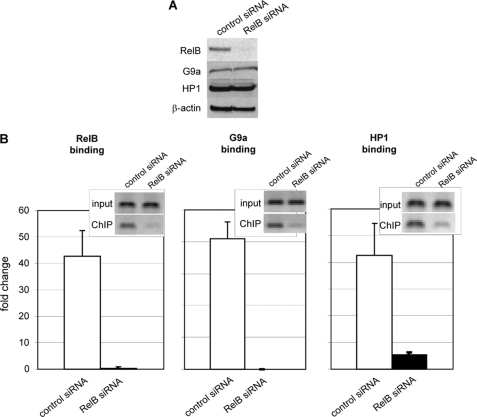
G9a and HP1 binding to the IL-1β promoter is dependent on RelB. A, nuclear extracts from silenced cells transfected with control siRNA or RelB siRNA were analyzed by immunoblot as described under “Experimental Procedures” and show decreased expression of RelB. No detectable change in G9a or HP1 protein levels was observed. β-Actin gel loading control is also shown. Results shown are representative of three independent experiments. B, RelB knockdown in silenced cells significantly (p ≤ 0.05) decreases RelB binding to the IL-1β promoter. Silenced cells were transfected with control siRNA (open bars) or RelB siRNA (closed bars). RelB (left), G9a (middle), or HP1 (right) ChIP DNA was analyzed for the presence of IL-1β promoter sequences by standard PCR (inset) or real-time PCR (bar graph) as described under “Experimental Procedures.” ChIP analysis also shows that RelB knockdown significantly decreased G9a and HP1 at the IL-1β promoter. Results shown are the mean ± S.E. from three independent real-time PCR ChIP experiments as described under “Experimental Procedures.”.
FIGURE 3.
FIGURE 3.
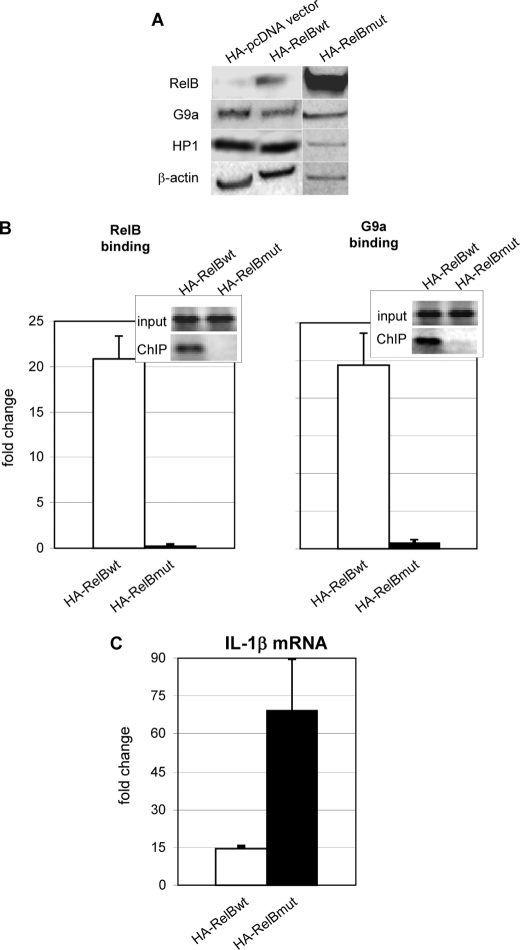
IL-1β promoter silencing and RelB-dependent G9a binding to the IL-1β promoter requires the RHD domain of RelB. A, nuclear extracts from THP-1 cells transfected with HA-pcDNA, HA-RelBwt, or HA-RelBmut expression vectors were analyzed by immunoblotting as described under “Experimental Procedures.” RelB expression was increased in nuclear extracts from cells transfected with RelBwt or RelBmut. No detectable difference in G9a or HP1 protein levels was observed. Results shown are representative of three independent experiments. B, THP-1 cells were transfected with HA-RelBwt (open bars) or HA-RelBmut (closed bars). RelB (left) or G9a (right) chromatin-immunoprecipitated DNA was analyzed for the presence of IL-1β promoter sequences by standard PCR (inset) or real-time PCR (bar graph) as described under “Experimental Procedures.” The lack of RHD in the RelBmut significantly (p ≤ 0.05) decreased RelB as well as G9a binding to the IL-1β promoter. Results shown are the mean ± S.E. from three independent real-time PCR experiments as described under “Experimental Procedures.” C, real time measurement of IL-1β mRNA shows that promoter silencing requires the RHD domain of RelB (compare HA-RelBwt (open bars) with HA-RelBmut (closed bars)). Results shown are the mean ± S.E. from three independent measurements of IL-1β mRNA. wt, wild type.
FIGURE 4.
FIGURE 4.
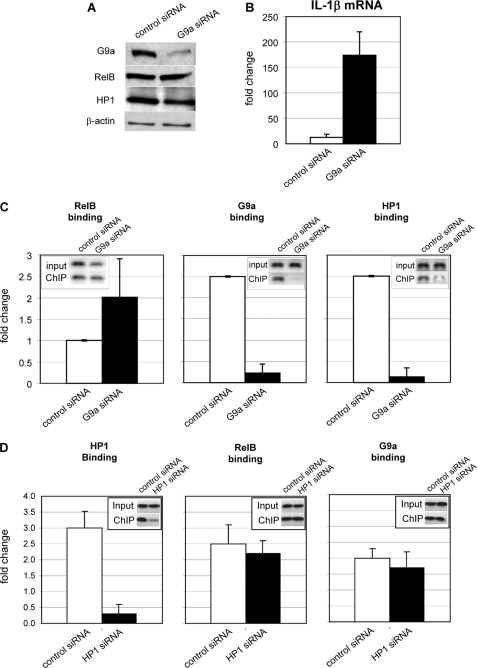
RelB-dependent gene silencing is mediated by G9a. A, nuclear extracts from silenced cells transfected with control siRNA or G9a siRNA were analyzed by immunoblotting as described under “Experimental Procedures” and show decreased expression of G9a. No detectable change in RelB or HP1 protein levels was observed. Results shown are representative of three independent experiments. B, real-time PCR measurement of IL-1β mRNA shows that promoter silencing is mediated by G9a (compare control siRNA (open bars) with G9a siRNA (closed bars)). Results shown are the mean ± S.E. from three independent real-time PCR measurements of IL-1β mRNA as described under “Experimental Procedures.” C, silenced cells were transfected with control siRNA (open bars) or G9a siRNA (closed bars). RelB (left), G9a (middle), or HP1 (right) chromatin-immunoprecipitated DNA was analyzed by standard PCR (inset) or real-time PCR (bar graph) for the presence of IL-1β promoter sequences as described under “Experimental Procedures.” G9a knockdown in silenced cells did not affect (p ≥ 0.05) RelB binding to the IL-1β promoter. ChIP analysis also shows that G9a knockdown significantly (p ≤ 0.05) decreased HP1 binding at the IL-1β promoter. Results shown are the mean ± S.E. from three independent experiments. D, silenced cells were transfected with control siRNA (open bars) or HP1 siRNA (closed bars). Chromatin was immunoprecipitated with HP1, RelB, or G9a antibody, and chromatin-immunoprecipitated DNA was analyzed was analyzed by standard PCR (inset) or real-time PCR as described in C. HP1 knockdown did not affect (p ≥ 0.05) RelB or G9a binding to the IL-1β promoter. Results shown are the mean ± S.E. from three independent experiments.
FIGURE 5.
FIGURE 5.
RelB and G9a co-immunoprecipitate in silenced cells and in vitro. A, silenced cells were transfected with empty vector or HA-RelBwt construct as described under “Experimental Procedures.” Whole cell extracts were prepared and incubated with anti-G9a, anti-HA RelB, or control IgG antibodies. Immunocomplexes were isolated, and co-immunoprecipitated proteins were analyzed by immunoblotting. Primary (1°) antibodies were used for isolation and purification of immune complexes; secondary (2°) antibodies were used for visualization of immunocomplex by immunoblot and show that HA-RelBwt forms a protein complex with G9a. These results are representative of three independent experiments. B, GST-G9a bacterially expressed fusion proteins were tested for direct protein-protein interaction with in vitro expressed RelB as described under “Experimental Procedures.” GST-G9a (N-terminal) fusion protein forms a stable complex with RelB, whereas GST-G9a (C-terminal) fusion protein does not show interaction with RelB above background (GST vector). Resin alone and RelB input to the GST pulldown assay (TNT/RelB) are also shown. These results are representative of three independent experiments.
FIGURE 6.
FIGURE 6.
Model for TLR-4-induced RelB-dependent formation of facultative heterochromatin and transcription silencing of acute proinflammatory genes in the SSI phenotype. This conceptual model is based on this study and components of our previously published work. SSI is initiated when euchromatin is activated by membrane sensors such as TLR4 that couple to NF-κB activation and subsequent binding of p65 and p50 heterodimers to the promoters of a set of acute proinflammatory genes. Subsequent induction of RelB leads to its recruitment and direct binding to G9a. G9a dimethylates H3K9 to which HP1 binds and links to Dnmt3 binding and DNA CpG methylation. Linker histone H1 and HMGB1 (not shown) are recruited and may facilitate remodeling of the nucleosome(s) that “locks” compacted chromatin and stabilizes the p50/RelB/G9a bond.

References

    1. Hotchkiss R. S., Karl I. E. (2003) N. Engl. J. Med. 348, 138–150 - PubMed
    1. Riedemann N. C., Guo R. F., Ward P. A. (2003) J. Clin. Invest. 112, 460–467 - PMC - PubMed
    1. McCall C. E., Yoza B. K. (2007) Am. J. Respir. Crit. Care Med. 175, 763–767 - PMC - PubMed
    1. Cobb J. P., Buchman T. G., Karl I. E., Hotchkiss R. S. (2000) Surg. Infect. (Larchmt) 1, 207–215 - PubMed
    1. Ramirez-Carrozzi V. R., Nazarian A. A., Li C. C., Gore S. L., Sridharan R., Imbalzano A. N., Smale S. T. (2006) Genes Dev. 20, 282–296 - PMC - PubMed

Publication types

MeSH terms