. 2007 Feb 7:1:205-13.

Ceruloplasmin (2-D PAGE) Pattern and Copper Content in Serum and Brain of Alzheimer Disease Patients

Affiliations

Ceruloplasmin (2-D PAGE) Pattern and Copper Content in Serum and Brain of Alzheimer Disease Patients

Rosanna Squitti et al. Biomark Insights. .

Abstract

A dysfunction in copper homeostasis seems to occur in Alzheimer's disease (AD). We previously evidenced that an excess of non-ceruloplasmin-copper (NCC) correlated with the main functional, anatomical as well as cerebrospinal markers of the disease. Aim of our study was to investigate ceruloplasmin isoforms as potential actors in this AD copper dysfunction. Our data show that AD patients have ceruloplasmin fragments of low molecular weight (<50 kDa) both in their serum and brain, contrary to healthy controls. Ceruloplasmin isoforms of higher molecular weight (115 and 135 kDa in serum and 135 kDa in brain), as well as copper levels in the brain, instead, do not seem to mark a difference between AD and healthy subjects. These data suggest a ceruloplasmin fragmentation in the serum of AD patients. Some clues in this direction have been found also in the AD brain.

Keywords: Alzheimer’s disease; SDS-PAGE; brain; ceruloplasmin; copper; serum.


Figures

Figure 1
Figure 1
2D analysis of serum ceruloplasmin in AD (A) and control (B). The pH 5–5.7 range is shown. Note how similar is the protein pattern at about 135 and 115 kDa. Low molecular weight (<50 kDa) positive spots are present only in AD serum (B). 450 μl of a 1.5 mg/mL protein solution were loaded per gel. Ceruloplasmin content in both pools was made to 28 mg/dL and each serum sample contributed equally to the ceruloplasmin content.
Figure 2
Figure 2
2D quantitative analysis of serum ceruloplasmin isoforms at 135 and 115 kDa. A master map created by using PDQuest software from a triplicate of AD sample and a quadruplicate of control sample. The optical density analysis of the spots did not show statistically significant differences between AD and control sample.
Figure 3
Figure 3
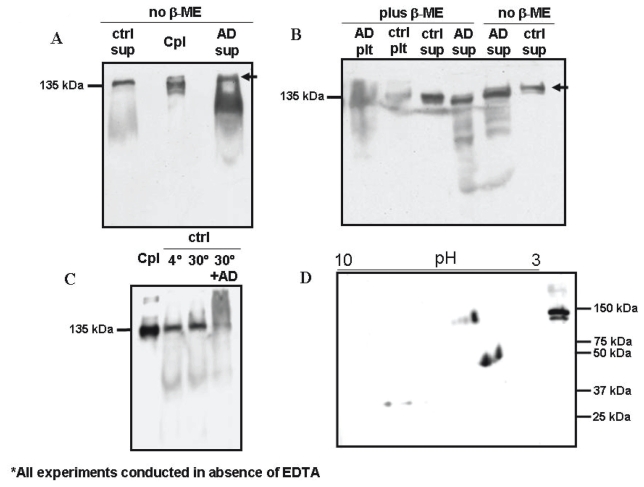
Brain ceruloplasmin shows proteolysis products in AD sample. A. Monodimensional SDS-PAGE performed in the absence of β-mercapto-ethanol shows a higher amount of the 115 kDa isoform in the AD sample. A ≅ 200kDa band is indicated by the arrow; B. Same as Panel A in the presence of β-mercapto-ethanol shows disappearance of the ≅ 200 kDa band, lower molecular weight fragments in the AD sample and presence of ceruloplasmin in cytosol and membrane fractions; C. Control sample shows a sharp band at the expected MW, even after 3 hours incubation at 30°C, whereas a smear at higher molecular weight appears when it is incubated in presence of 1/10 of the AD sample; D. 2D map of a brain extract from AD patients shows few spots at the full-length MW and some intense spots at lower molecular weight (<50 kDa). Cpl, ceruloplasmin; ctrl, control; AD, Alzheimer disease; plt, membrane fraction; sup, cytosol fraction.

References

    1. Abe A, Yamashita S, Noma A. Sensitive, direct colorimetric assay for copper in serum. Clin Chem. 1989;35(4):552–4. - PubMed
    1. Barnham KJ, McKinstry WJ, Multhaup G, et al. Structure of the Alzheimer’s disease amyloid precursor protein copper binding domain. A regulator of neuronal copper homeostasis. J Biol Chem. 2003;278:17401–7. - PubMed
    1. Bayer TA, Schafer S, Simons A, et al. Dietary Cu stabilizes brain superoxide dismutase 1 activity and reduces amyloid Abeta production in APP23 transgenic mice. Proc Natl Acad Sci USA. 2003;100:14187–92. - PMC - PubMed
    1. Bielli P, Calabrese L. Structure to function relationships in ceruloplasmin: a ‘moonlighting’ protein. Cell Mol Life Sci. 2002;59:1413–27. - PMC - PubMed
    1. Bomboi G, Marchione F, Sepe-Monti M, et al. Correlation between metal ions and clinical findings in subjects affected by Alzheimer’s disease. Ann Ist Super Sanità. 2005;41:205–12. - PubMed

LinkOut - more resources