


Central neuromuscular dysfunction of the deltoid muscle in patients with chronic rotator cuff tears
- PMID: 19690944
- PMCID: PMC2744738
- DOI: 10.1007/s10195-009-0061-7
Central neuromuscular dysfunction of the deltoid muscle in patients with chronic rotator cuff tears
Abstract
Background: Previous surface electromyogram (EMG) studies have shown that chronic rotator cuff tears (RCT) may be associated with a altered activation of adjacent shoulder muscles. The effect of RCT on central neuromuscular control mechanisms of the shoulder girdle muscles such as the deltoideus muscle (DM), a key muscle of shoulder function, has as not yet been studied in detail.
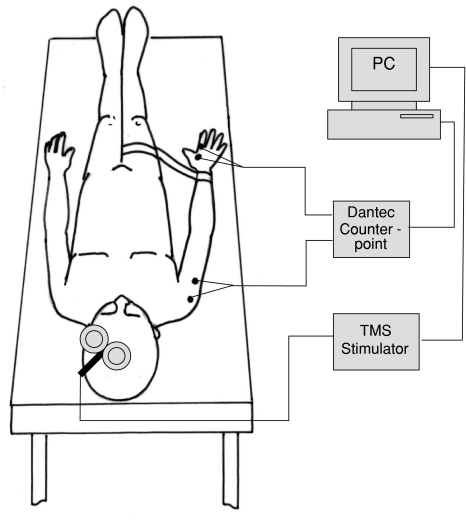
Materials and methods: This study investigated the corticospinal excitability of the DM to assess the effects of RCT on the central neuromuscular function of proximal upper limb muscles. The motor-evoked potentials (MEP) in response to transcranial magnetic stimulation of DM on both sides were obtained from patients with unilateral RCT and compared with healthy control subjects.
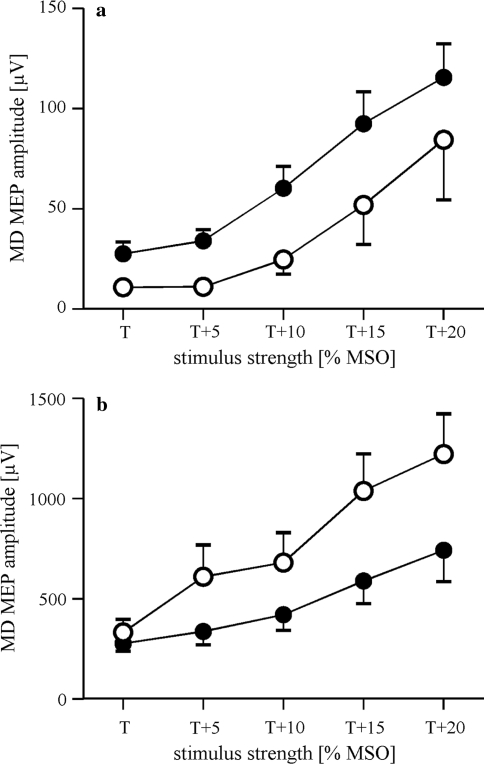
Results: In patients, stimulus response curves of DM demonstrated a bilateral hyperexcitability at rest and a hypoexcitability during voluntary activation (F = 3.82, P = 0.007).
Conclusions: The DM hyperexcitability may be related to alterations in the sensory output from the shoulder. The insufficient facilitation of the DM points toward a bilateral central activation deficit. These findings seem to be assigned to adaptive changes in the motor cortex as a consequence of chronic RCT, and the neuromuscular alteration of the DM should be considered when treating patients with RCT.
Figures
References
-
- {'text': '', 'ref_index': 1, 'ids': [{'type': 'DOI', 'value': '10.1007/s001320050534', 'is_inner': False, 'url': 'https://doi.org/10.1007/s001320050534'}, {'type': 'PubMed', 'value': '11142903', 'is_inner': True, 'url': 'https://pubmed.ncbi.nlm.nih.gov/11142903/'}]}
- Gohlke F (2000) Biomechanics of the shoulder. Orthopade 29:834–844 - PubMed
-
- {'text': '', 'ref_index': 1, 'ids': [{'type': 'PubMed', 'value': '2703509', 'is_inner': True, 'url': 'https://pubmed.ncbi.nlm.nih.gov/2703509/'}]}
- Norwood LA, Barrack R, Jacobson KE (1989) Clinical presentation of complete tears of the rotator cuff. J Bone Joint Surg Am 71:499–505 - PubMed
-
- {'text': '', 'ref_index': 1, 'ids': [{'type': 'DOI', 'value': '10.1016/S0140-6736(00)04161-1', 'is_inner': False, 'url': 'https://doi.org/10.1016/s0140-6736(00)04161-1'}, {'type': 'PubMed', 'value': '11253973', 'is_inner': True, 'url': 'https://pubmed.ncbi.nlm.nih.gov/11253973/'}]}
- Murrell GA, Walton JR (2001) Diagnosis of rotator cuff tears. Lancet 357:769–770 - PubMed
-
- {'text': '', 'ref_index': 1, 'ids': [{'type': 'PubMed', 'value': '10798229', 'is_inner': True, 'url': 'https://pubmed.ncbi.nlm.nih.gov/10798229/'}]}
- Habermeyer P, Lehmann L, Lichtenberg S (2000) Rotator cuff tears: diagnosis and therapy. Orthopade 29:196–208 - PubMed
-
- {'text': '', 'ref_index': 1, 'ids': [{'type': 'DOI', 'value': '10.1055/s-2002-24250', 'is_inner': False, 'url': 'https://doi.org/10.1055/s-2002-24250'}, {'type': 'PubMed', 'value': '11935482', 'is_inner': True, 'url': 'https://pubmed.ncbi.nlm.nih.gov/11935482/'}]}
- Dietz SO, Habermeyer P, Magosch P (2002) Current concepts in treatment of rotator cuff tears. Zentralbl Chir 127:194–202 - PubMed
Publication types
MeSH terms
LinkOut - more resources
Full Text Sources
Medical
