


Evolution and emergence of novel human infections
- PMID: 19692402
- PMCID: PMC2825776
- DOI: 10.1098/rspb.2009.1059
Evolution and emergence of novel human infections
Abstract
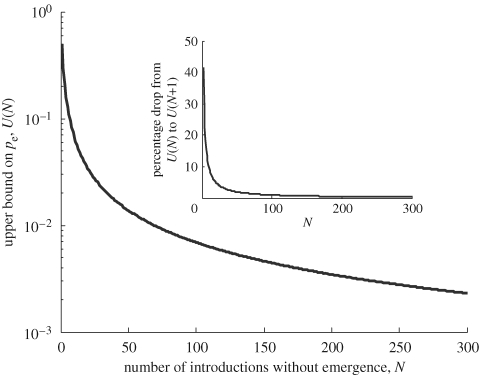
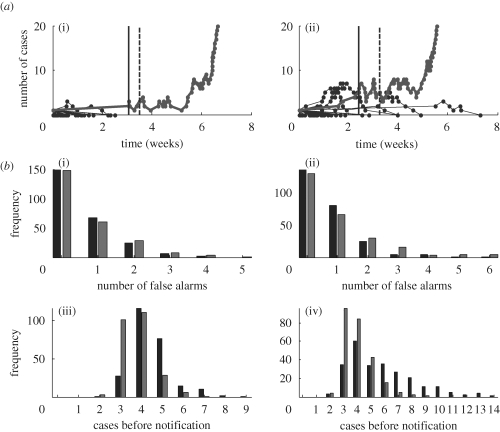
Some zoonotic pathogens cause sporadic infection in humans but rarely propagate further, while others have succeeded in overcoming the species barrier and becoming established in the human population. Adaptation, driven by selection pressure in human hosts, can play a significant role in allowing pathogens to cross this species barrier. Here we use a simple mathematical model to study potential epidemiological markers of adaptation. We ask: under what circumstances could ongoing adaptation be signalled by large clusters of human infection? If a pathogen has caused hundreds of cases but with little transmission, does this indicate that the species barrier cannot be crossed? Finally, how can case reports be monitored to detect an imminent emergence event? We distinguish evolutionary scenarios under which adaptation is likely to be signalled by large clusters of infection and under which emergence is likely to occur without any prior warning. Moreover, we show that a lack of transmission never rules out adaptability, regardless of how many zoonoses have occurred. Indeed, after the first 100 zoonotic cases, continuing sporadic zoonotic infections without onward, human-to-human transmission offer little extra information on pathogen adaptability. Finally, we present a simple method for monitoring outbreaks for signs of emergence and discuss public health implications.
Figures
References
-
- Anderson R. M., May R. M.1991Infectious diseases of humans: dynamics and control Oxford: Oxford University Press
-
- André J. B., Day T.2005The effect of disease life history on the evolutionary emergence of novel pathogens. Proc. R. Soc. B 272, 1949–1956 (doi:10.1098/rspb.2005.3170) - DOI - PMC - PubMed
-
- Antia R., Regoes R., Koella J., Bergstrom C.2003The role of evolution in the emergence of infectious diseases. Nature 426, 658–661 (doi:10.1038/nature02104) - DOI - PMC - PubMed
-
- Athreya K., Ney P.1972Branching processes Berlin, Germany: Springer
-
- Becker N.1974On parametric estimation for mortal branching processes. Biometrika 61, 393–399
Publication types
MeSH terms
LinkOut - more resources
Full Text Sources
Medical