. 2009 Sep 10;461(7261):263-6.
doi: 10.1038/nature08275. Epub 2009 Aug 19.

Changes of mind in decision-making

Affiliations

Changes of mind in decision-making

Arbora Resulaj et al. Nature. .

Abstract

A decision is a commitment to a proposition or plan of action based on evidence and the expected costs and benefits associated with the outcome. Progress in a variety of fields has led to a quantitative understanding of the mechanisms that evaluate evidence and reach a decision. Several formalisms propose that a representation of noisy evidence is evaluated against a criterion to produce a decision. Without additional evidence, however, these formalisms fail to explain why a decision-maker would change their mind. Here we extend a model, developed to account for both the timing and the accuracy of the initial decision, to explain subsequent changes of mind. Subjects made decisions about a noisy visual stimulus, which they indicated by moving a handle. Although they received no additional information after initiating their movement, their hand trajectories betrayed a change of mind in some trials. We propose that noisy evidence is accumulated over time until it reaches a criterion level, or bound, which determines the initial decision, and that the brain exploits information that is in the processing pipeline when the initial decision is made to subsequently either reverse or reaffirm the initial decision. The model explains both the frequency of changes of mind as well as their dependence on both task difficulty and whether the initial decision was accurate or erroneous. The theoretical and experimental findings advance the understanding of decision-making to the highly flexible and cognitive acts of vacillation and self-correction.


Figures
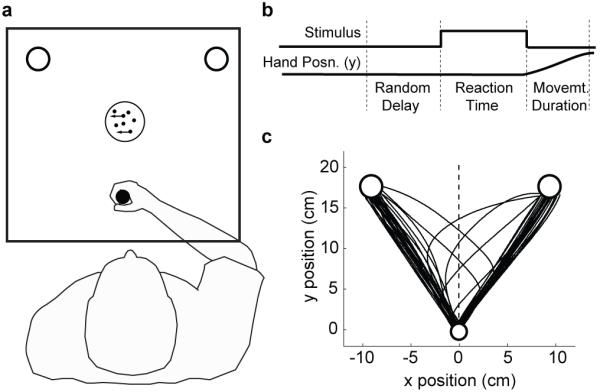
Figure 1
Figure 1
Experimental paradigm. a, Schematic of the visual display (rectangle). Subjects held the handle of a robotic interface (shown here in the home position, circle) and moved to either a left or right circular target depending on the perceived motion direction of a central random-dot display. A mirror system prevented subjects from seeing their arm. b, The time course of events that make up a trial. Each trial started when the subject’s hand was in the home position. After a random delay, the dots became visible and the subject could view the moving dot stimulus as long as they needed (up to 2 sec). Subjects indicated the direction of dot motion by moving to the left or right target. As soon as the subjects moved out of the home position, the motion stimulus vanished. The trial ended when the subject reached one of the two targets. c, Sample hand trajectories from one subject. Most trajectories are directly from the home position (bottom circle) to one of the choice targets. On a fraction of trials, the trajectories change course during the movement demonstrating a change of mind.
Figure 2
Figure 2
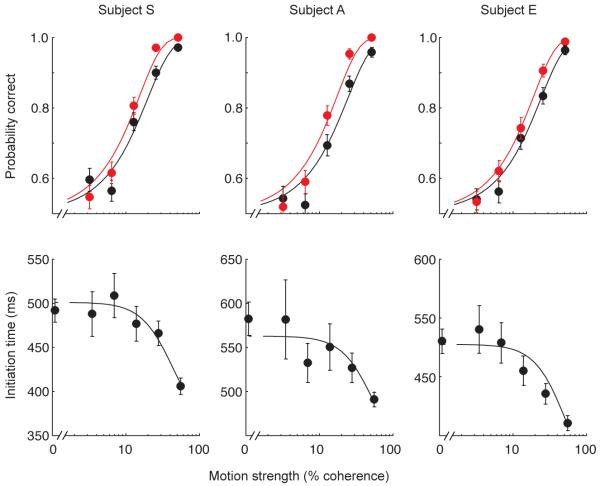
Accuracy improves through “changes of mind”. Data are from three subjects. The top row shows the probability of a correct decision at initiation (black) is lower that at termination (red) for almost all motion strengths. The bottom row shows initiation times are longer for weaker motion strengths. Solid curves are fits to the data of the bounded evidence accumulation model (R2 of fits for subjects S, A & E for initial decision 0.96, 0.95 & 0.98, for final decision 0.98, 0.96 & 0.99 and for reaction times 0.92, 0.74 & 0.87). In this model, processing after initial commitment leads to an improvement in performance during the post-initiation phase. Error bars are s.e.m.
Figure 3
Figure 3
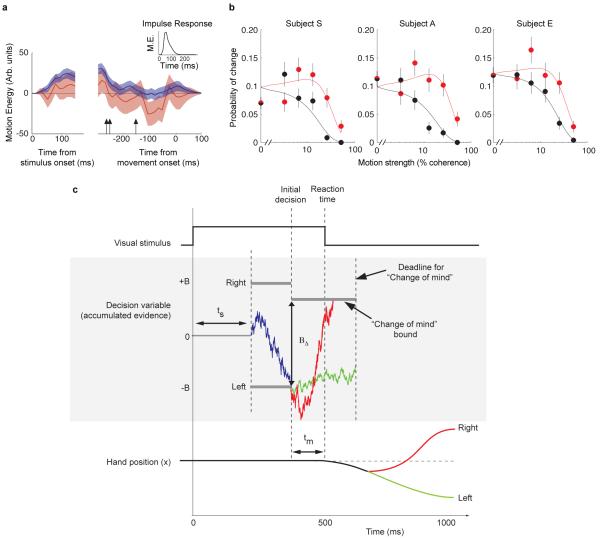
A bounded accumulation model of decision making with post-initiation processing explains change of mind. a, Influence of motion energy fluctuations on initial and final decisions. Data are shown for all the trials (blue) and the subset of trials with a change of mind (red) aligned at stimulus onset (left) and movement onset (right). Motion energy fluctuations were obtained by applying a filter to the sequence of random dots shown on each trial and subtracting off the mean for all trials sharing the same motion strength and direction (see Methods). The residual fluctuations are designated positive if they support the direction of the initial decision. Shading indicates s.e.m. Arrows indicate the time preceding movement initiation that the average motion energy fluctuations for each subject falls to within 1 s.e. of zero. The inset shows the impulse response for the filter used to calculate motion energy. b, The model explains the probability of changes of mind from incorrect to correct choices (model, red curves; data red symbols) and changes of mind from correct to incorrect choices (black curves; black symbols) as a function of stimulus coherence. Error bars are s.e.m. c, Information flow diagram showing visual stimulus and neural events leading to a decision and a possible change of mind. The example illustrates a rightward motion stimulus which gives rise to an initial incorrect leftward choice with reaction time around 500 ms. The visual stimulus gives rise to a decision variable (blue trace) that is the accumulation of noisy evidence. This governs the initial choice and decision time. Data from neural recordings, suggest that the delay from motion onset to the beginning of this accumulation (ts) is around 200 ms. The initial decision is complete when a ‘Right’ or ‘Left’ bound is crossed (i.e., ±B of evidence has accumulated). The example shows an initial decision for left. The time of the termination is around the mean decision time for the three subjects. Further accumulation takes place on the evidence still in the processing pipeline and if the accumulated evidence reaches the opposite “change of mind” bound then the decision is reversed (red), otherwise it is confirmed if the deadline is reached (green).

References

Methods references

    1. Howard IS, Ingram JN, Wolpert DM. A modular planar robotic manipulandum with end-point torque control. J Neurosci Methods. 2009;181(2):199–211. - PubMed
    1. Shadlen M, Hanks T, Churchland A, Kiani R, Yang T. The speed and accuracy of a simple perceptual decision: a mathematical primer. In: Doya K, et al., editors. Bayesian Brain: Probabilistic Approaches to Neural Coding. 2006. pp. 209–237.
    1. Kass RE, Wasserman L. A reference Bayesian test for nested hypotheses and its relationship to the Schwarz criterion. J. Am. Stat. Assoc. 1995;90(431):928–934.
    1. Karlin S, Taylor HM. A second course in stochastic processes. Academic Press; 1981.
    1. Efron B. The Jacknife, the Bootstrap and Other Resampling Plans. Society for Industrial and Applied Mathematics; Phildelphia, PA: 1982.

References

    1. Gold JI, Shadlen MN. The neural basis of decision making. Annu. Rev. Neurosci. 2007;30:535–574. - PubMed
    1. Sugrue LP, Corrado GS, Newsome WT. Choosing the greater of two goods: neural currencies for valuation and decision making. Nat. Rev. Neurosci. 2005;6(5):363–375. - PubMed
    1. Glimcher PW. Decisions, uncertainty, and the brain: the science of neuroeconomics. MIT Press; 2004.
    1. Green DM, Swets JA. Signal detection theory and psychophysics. Wiley; New York: 1966.
    1. Laming DRJ. Information theory of choice reaction time. Wiley; New York: 1968.

Publication types