


Complications of recombinant human BMP-2 for treating complex tibial plateau fractures: a preliminary report
- PMID: 19693635
- PMCID: PMC2772910
- DOI: 10.1007/s11999-009-1039-8
Complications of recombinant human BMP-2 for treating complex tibial plateau fractures: a preliminary report
Abstract
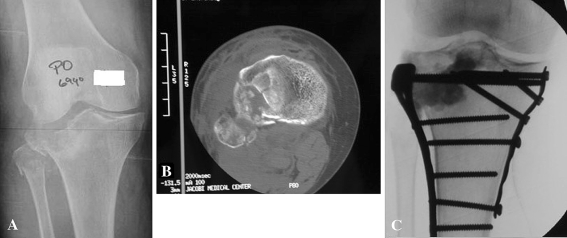
Bone morphogenic proteins (BMPs) are potent osteoinductive agents. Their use in fracture surgery is still being studied and the clinical indications are evolving. Heterotopic bone after BMP use in spine surgery is a known complication. While some literature describes the ability of BMP to enhance fracture healing, few articles describe complications of BMP. In tibial plateau fractures, after elevating the cartilage en mass, a subchondral void may be created in these fractures. Structural support provided by bone void-filling agents can be augmented with osteoinduction achieved by BMP. We asked whether heterotopic bone formation would occur more frequently with BMP-2 when used in tibial plateau fractures and whether BMP-2 enhanced the ability to maintain surgically restored subchondral bone integrity. Heterotopic bone developed more frequently in patients receiving BMP (10 of 17) than in patients not receiving BMP (one of 23). Four patients receiving BMP and no patients not receiving BMP underwent removal of heterotopic bone. Maintenance of subchondral bone integrity was similar without and with the use of BMP. BMP is a potent osteoinductive agent; however, when used for an off-label indication in periarticular situations, complications such as heterotopic bone are common and increase reoperation rates.
Level of evidence: Level IV, therapeutic study. See Guidelines for Authors for a complete description of levels of evidence.
Figures
References
-
- Apley AG. Fractures of the tibial plateau. Orthop Clin North Am. 1979;10:61–74. - PubMed
-
- Benglis D, Wang MY, Levi AD. A comprehensive review of the safety profile of bone morphogenetic protein in spine surgery. Neurosurgery. 2008;62(5 suppl 2):ONS423–ONS431; discussion ONS431. - PubMed
-
- Blokker CP, Rorabeck CH, Bourne RB. Tibial plateau fractures: an analysis of the results of treatment in 60 patients. Clin Orthop Relat Res. 1984;182:193–199. - PubMed
-
- Bouxsein ML, Turek TJ, Blake CA, D’Augusta D, Li X, Stevens M, Seeherman HJ, Wozney JM. Recombinant human bone morphogenetic protein-2 accelerates healing in a rabbit ulnar osteotomy model. J Bone Joint Surg Am. 2001;83:1219–1230. - PubMed
MeSH terms
Substances
LinkOut - more resources
Full Text Sources
Other Literature Sources
Medical
Research Materials
