. 2009 Oct;111(2):580-8.
doi: 10.1111/j.1471-4159.2009.06351.x. Epub 2009 Aug 19.

Essential involvement of the NMDA receptor in ethanol preconditioning-dependent neuroprotection from amyloid-betain vitro

Affiliations

Essential involvement of the NMDA receptor in ethanol preconditioning-dependent neuroprotection from amyloid-betain vitro

Robert M Mitchell et al. J Neurochem. 2009 Oct.

Abstract

In several epidemiological studies, moderate ethanol consumption has been associated with reduced risks of cognitive decline or Alzheimer's dementia. Of potential relevance is that brain cultures preconditioned with moderate ethanol concentrations are resistant to neurotoxic Alzheimer's amyloid-beta (Abeta) peptides. Using rat cerebellar mixed cultures we investigated whether certain membrane receptors were early 'sensors' in moderate ethanol preconditioning (MEP). In a 6-day MEP protocol (30 mM ethanol), neuroprotection from Abeta25-35 was undiminished by antagonism during the first 3 days of either adenosine A(1) or Galpha(i/o) protein-coupled receptors. However, similar cotreatment with memantine or DL-2-amino-5-phosphono-pentanoic acid (AP-5), antagonists of NMDA receptors (NMDAR), abolished neuroprotection, indicating key early involvement of this ionotropic glutamate receptor. Also in these cultures, directly activating NMDAR using subexcitotoxic NMDA preconditioning prevented Abeta neurotoxicity. By day 2 of MEP, we observed increased levels of NMDAR subunits NR1, NR2B, and NR2C that persisted through day 6. Interestingly, memantine co-exposure blocked elevations in the obligatory NR1 subunit. Furthermore, 2 days of MEP significantly increased two indicators of synaptic NMDAR localization, NR2B phospho-Tyr1472, and post-synaptic density 95 scaffolding protein. The results indicate that ethanol preconditioning-dependent neuroprotection is associated with early increases in NR subunits concomitant with enhancement of synaptic localization and activity of NMDAR.


Figures
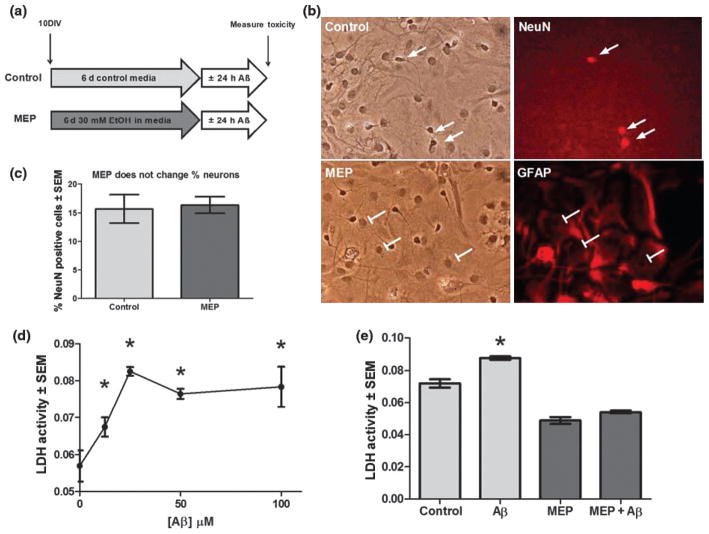
Fig. 1
Fig. 1
Dose-related Aβ neurotoxicity and neuroprotection by moderate ethanol preconditioning (MEP). (a) MEP protocol: cerebellar cultures (10 DIV) were treated with 30 mM EtOH or control media for 6 days, rinsed, and exposed for 24 h to 25 μM Aβ25–35 or vehicle. (b) Control (top row) and MEP-treated (bottom row) cerebellar cultures (16 DIV) were fixed and analyzed by immunocytochemistry for neural cell type markers [neuronal (NeuN+) and glial (GFAP+) cell types] and co-stained with Hoechst 33342, identifying all nuclei. (c) MEP did not alter neuronal composition of cerebellar cultures. Cerebellar cultures were treated as in b and the percent of total (Hoechst 33342-positive) cells that were positive for NeuN were quantified in MEP and control-treated cultures (n = 3 at least 100 cells counted per well). (d) Doserelated neurotoxicity of cerebellar cultures (16 DIV) to Aβ25–35 as measured by LDH release; *p < 0.05 versus no Aβ25–35 (n = 6). (e) Aβ neurotoxicity in cerebellar cultures was prevented by MEP. *p < 0.05 versus control; 1-way ANOVA with Scheffe post hoc test (n = 6).
Fig. 2
Fig. 2
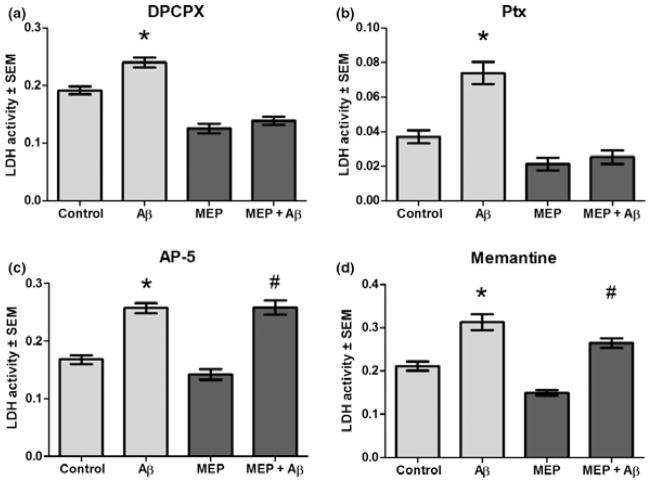
MEP-induced neuroprotection against Aβ: NMDAR antagonists abolished protection but antagonism of adenosine A1 receptors or Gi/o protein-coupled receptors had no effect. MEP of cerebellar cultures (as in Fig. 1) was performed with the respective receptor antagonists present for the first 3 days in a 6-day protocol, followed by 25 μM Aβ25–35 or vehicle for 24 h and media LDH assays. (a) dipropylxanthine (DPCPX) (100 nM), adenosine A1 receptor antagonist, did not prevent MEP neuroprotection. (b) Pertussis toxin (Ptx, 50 ng/mL), Gi/o protein-coupled receptor antagonist, also did not alter MEP neuroprotection. (c) AP-5 (45 μM), NMDAR antagonist, completely abolished MEP neuroprotection. (d) Memantine (50 μM), NMDAR antagonist, significantly inhibited MEP neuroprotection. *p < 0.001 versus control; #p < 0.001 versus MEP; 1-way ANOVA with Scheffe post hoc test (n = 6).
Fig. 3
Fig. 3
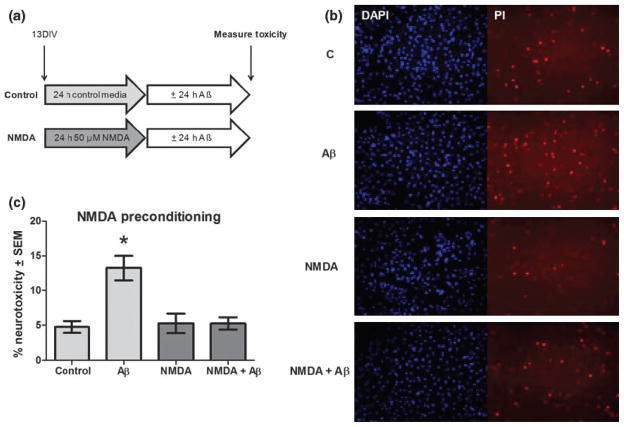
NMDA preconditioning protects against Aβ neurotoxicity as determined by dual fluorescence staining with Hoescht 33342 and PI. (a) Cerebellar cultures (13 DIV) were treated for 24 h with NMDA (50 μM) or control media followed by 24 h in 25 μM Aβ25–35. (b) Representative images of neurotoxicity assayed by live cell dual fluorescence staining. (c) Quantification of Aβ25–35 neurotoxicity (% Hoescht stained nuclei that are PI-positive) in NMDA-preconditioned or control cultures. *p < 0.001 versus control; 1-way ANOVA with Scheffe post hoc test (n = 6).
Fig. 4
Fig. 4
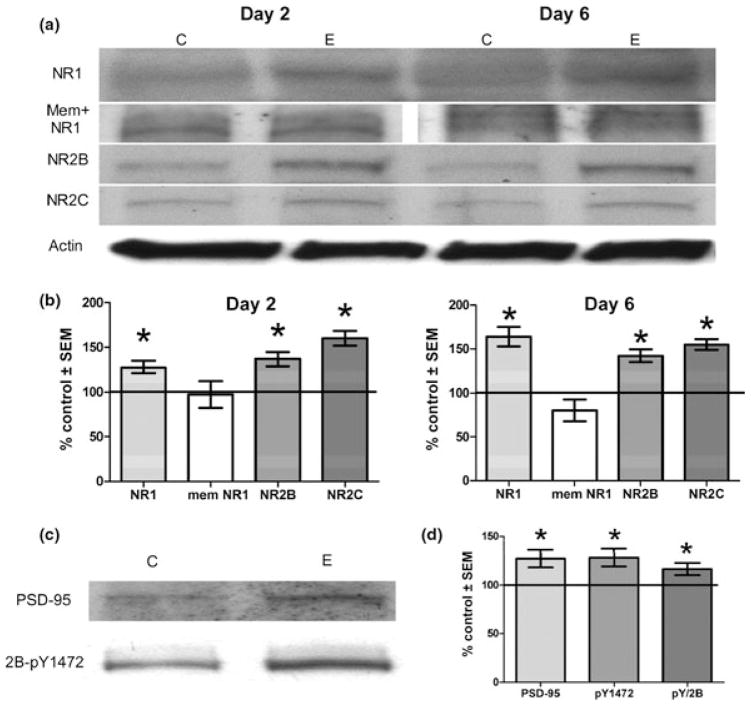
Increased protein levels of NMDAR subunits by day 2 of MEP persist through day 6 and correlate with indicators of synaptically localized complexes; memantine co-treatment blocks day 2 up-regulation of obligatory NR1 subunit. Cerebellar cultures (10 DIV) were treated with 30 mM ethanol or control media for 2 or 6 days, protein extracted and subjected to immunoblot analyses. (a) Representative immunoblots of NMDAR subunits NR1, NR1 with 45 μM memantine, NR2B, and NR2C after ethanol (E) or control (C) media. (b) Quantification of immunoblot analyses normalized to actin and the results expressed as % control. (c) Representative immunoblots of NMDAR subunit NR2B phosphorylated tyrosine 1472 (2B-pY1472) and synaptic scaffolding protein PSD-95. (d) Immunoblot quantification of PSD-95, 2B-pY1472 and the ratio of 2B-pY1472 to total NR2B expressed as % control. *p < 0.05 versus control by student’s t-test (n = 3–6).

References

    1. Allen JW, Eldadah BA, Faden AI. Beta/amyloid-induced apoptosis of cerebellar granule cells and cortical neurons: exacerbation by selective inhibition of group I metabotropic glutamate receptors. Neuropharmacology. 1999;38:1243–1252. - PubMed
    1. Bachis A, Major EO, Mocchetti I. Brain-derived neurotrophic factor inhibits human immunodeficiency virus-1/gp120-mediated cerebellar granule cell death by preventing gp120 internalization. J Neurosci. 2003;23:5715–5722. - PMC - PubMed
    1. Belmadani A, Zou JY, Schipma MJ, Neafsey EJ, Collins MA. Ethanol pre-exposure suppresses HIV-1 glycoprotein 120-induced neuronal degeneration by abrogating endogenous glutamate/Ca2+-mediated neurotoxicity. Neuroscience. 2001;104:769–781. - PubMed
    1. Belmadani A, Kumar S, Schipma M, Collins MA, Neafsey EJ. Inhibition of amyloid-beta-induced neurotoxicity and apoptosis by moderate ethanol preconditioning. Neuroreport. 2004;15:2093–2096. - PubMed
    1. Collins MA, Neafsey EJ, Zou JY. HIV-1 gp120 neurotoxicity in brain cultures is prevented by moderate ethanol pretreatment. Neuroreport. 2000;11:1219–1222. - PubMed

Publication types

MeSH terms