


Clinical implications for patients with long QT syndrome who experience a cardiac event during infancy
- PMID: 19695463
- PMCID: PMC3517782
- DOI: 10.1016/j.jacc.2009.05.029
Clinical implications for patients with long QT syndrome who experience a cardiac event during infancy
Abstract
Objectives: This study was designed to evaluate the clinical and prognostic aspects of long QT syndrome (LQTS)-related cardiac events that occur in the first year of life (infancy).
Background: The clinical implications for patients with long QT syndrome who experience cardiac events in infancy have not been studied previously.
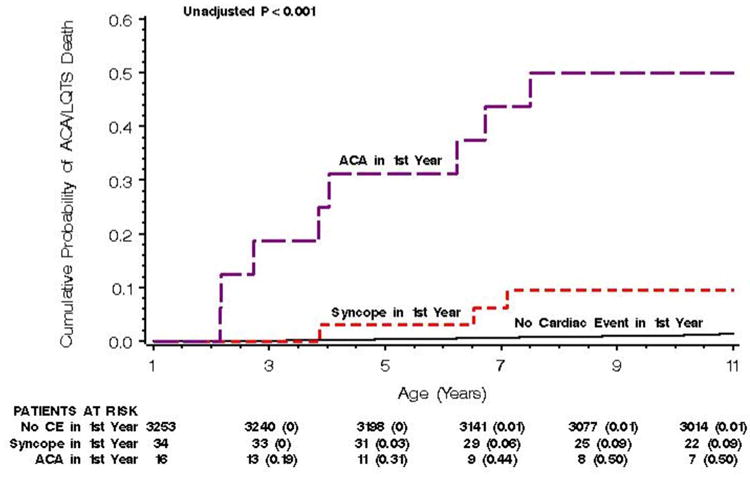
Methods: The study population of 3,323 patients with QT interval corrected for heart rate (QTc) > or =450 ms enrolled in the International LQTS Registry involved 20 patients with sudden cardiac death (SCD), 16 patients with aborted cardiac arrest (ACA), 34 patients with syncope, and 3,253 patients who were asymptomatic during the first year of life.
Results: The risk factors for a cardiac event among 212 patients who had an electrocardiogram recorded in the first year of life included QTc > or =500 ms, heart rate < or =100 beats/min, and female sex. An ACA before age 1 year was associated with a hazard ratio of 23.4 (p < 0.01) for ACA or SCD during ages 1 to 10 years. During the 10-year follow-up after infancy, beta-blocker therapy was associated with a significant reduction in ACA/SCD only in those with a syncopal episode within 2 years before ACA/SCD but not for those who survived ACA in infancy.
Conclusions: Patients with LQTS who experience ACA during the first year of life are at very high risk for subsequent ACA or death during their next 10 years of life, and beta-blockers might not be effective in preventing fatal or near-fatal cardiac events in this small but high-risk subset.
2009 by the American College of Cardiology Foundation
Conflict of interest statement
Dr. Michael J. Ackerman is a consultant to and has a license agreement/royalty arrangement with PGxHealth (New Haven, CT), a commercial genetic testing company that is division of Clinical Data, Inc. Dr. Kaufman has received research support from CardioDx and St. Jude Medical (no conflict of interest with current topic).
Figures
Comment in
-
The Meaning of Lethal Events in Infants With Long QT Syndrome.J Am Coll Cardiol. 2009 Aug 25;54(9):838-9. doi: 10.1016/j.jacc.2009.05.030. J Am Coll Cardiol. 2009. PMID: 19695464 No abstract available.
References
-
- Goldenberg I, Moss AJ. Long QT syndrome. J Am Coll Cardiol. 2008;51:2291–300. - PubMed
-
- Moss AJ. Long QT Syndrome. JAMA. 2003;289:2041–4. - PubMed
-
- Priori SG, Schwartz PJ, Napolitano C, et al. Risk stratification in the long-QT syndrome. N Engl J Med. 2003;348:1866–74. - PubMed
-
- Schwartz PJ, Priori SG, Spazzolini C, et al. Genotype-phenotype correlation in the long-QT syndrome: gene-specific triggers for life-threatening arrhythmias. Circulation. 2001;103:89–95. - PubMed
Publication types
MeSH terms
Grants and funding
LinkOut - more resources
Full Text Sources
Other Literature Sources
Medical
