. 2009 Sep 25;105(7):648-56.
doi: 10.1161/CIRCRESAHA.109.203109. Epub 2009 Aug 20.

iPS programmed without c-MYC yield proficient cardiogenesis for functional heart chimerism

Affiliations

iPS programmed without c-MYC yield proficient cardiogenesis for functional heart chimerism

Almudena Martinez-Fernandez et al. Circ Res. .

Abstract

Rationale: Induced pluripotent stem cells (iPS) allow derivation of pluripotent progenitors from somatic sources. Originally, iPS were induced by a stemness-related gene set that included the c-MYC oncogene.

Objective: Here, we determined from embryo to adult the cardiogenic proficiency of iPS programmed without c-MYC, a cardiogenicity-associated transcription factor.

Methods and results: Transgenic expression of 3 human stemness factors SOX2, OCT4, and KLF4 here reset murine fibroblasts to the pluripotent ground state. Transduction without c-MYC reversed cellular ultrastructure into a primitive archetype and induced stem cell markers generating 3-germ layers, all qualifiers of acquired pluripotency. Three-factor induced iPS (3F-iPS) clones reproducibly demonstrated cardiac differentiation properties characterized by vigorous beating activity of embryoid bodies and robust expression of cardiac Mef2c, alpha-actinin, connexin43, MLC2a, and troponin I. In vitro isolated iPS-derived cardiomyocytes demonstrated functional excitation-contraction coupling. Chimerism with 3F-iPS derived by morula-stage diploid aggregation was sustained during prenatal heart organogenesis and contributed in vivo to normal cardiac structure and overall performance in adult tumor-free offspring.

Conclusions: Thus, 3F-iPS bioengineered without c-MYC achieve highest stringency criteria for bona fide cardiogenesis enabling reprogrammed fibroblasts to yield de novo heart tissue compatible with native counterpart throughout embryological development and into adulthood.


Figures
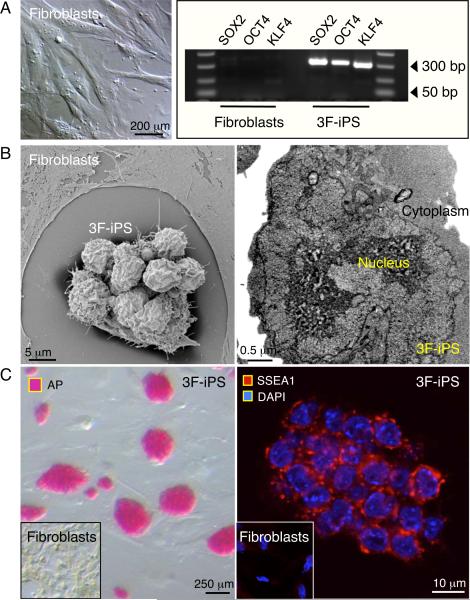
Figure 1
Figure 1
Bioengineered pluripotency in the absence of c-MYC transgene. A, Mouse embryonic fibroblasts (left) were transduced with three HIV-derived lentiviruses containing human genes SOX2, OCT4 and KLF4. Genomic integration of viral constructs was detected in transduced progeny but not in parental fibroblast (right). B, Within three weeks, expression of the gene triad (3F) induced a dramatic change from flat fusiform fibroblasts to a round and compact embryonic-stem-cell-like morphology (left) with reduced cytoplasm (right). C, Reprogrammed cells acquired pluripotency markers alkaline phosphatase (AP; left) and SSEA-1 (right), absent from parental fibroblasts (inset).
Figure 2
Figure 2
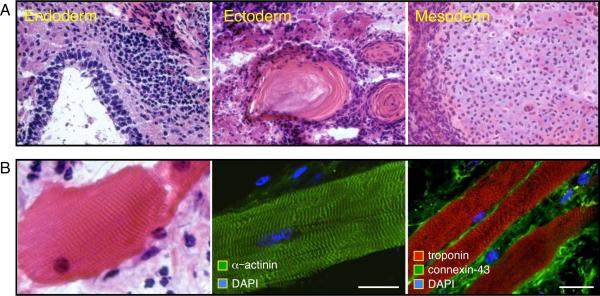
Validated pluripotency of iPS according to in vivo differentiation. A, Fulfilling increasing levels of pluripotent stringency, 3F-iPS generated teratoma when injected subcutaneously into immunodeficient host. Tissues from the three germinal layers were identified by hematoxylin-eosin staining (40x magnification) represented by glandular epithelium (endoderm), keratinized epidermal ectoderm (ectoderm) and connective tissue (mesoderm). B, Cardiac tissue was found in teratomas derived from 3F-iPS as characterized by hematoxylin-eosin stained striations (left) and immunostaining for cardiac proteins α-actinin (middle), and troponin-I with connexin 43 (right). bar 10 μm. DAPI: 4,6'-diamidino-2-phenylindole.
Figure 3
Figure 3
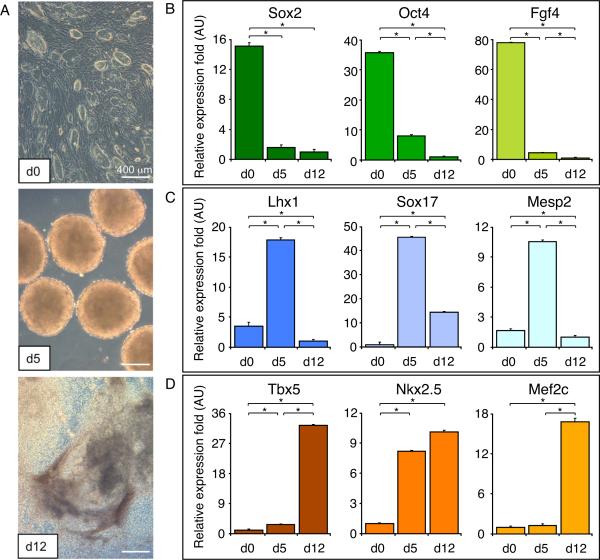
Kinetics of in vitro lineage derivation from iPS. 3F-iPS were differentiated using the hanging drop method followed by expansion of progeny on gelatinized plates. A, Cells were sampled from undifferentiated cultures at day 0 (top), floating embryoid bodies at day 5 (middle) and differentiating cultures at day 12 (bottom) for gene expression analysis. B, Pluripotency genes Sox2, Oct4 and Fgf4 immediately downregulated with initiation of differentiation. C, Gastrulation markers peaked at day 5, coinciding with three germ layer formation in embryoid bodies. D, Upregulation of cardiac transcription factors Tbx5, Nkx2.5 and Mef2c was observed at day 12 indicating that 3F-iPS are able to produce cardiac progenitors. *p<0.05
Figure 4
Figure 4
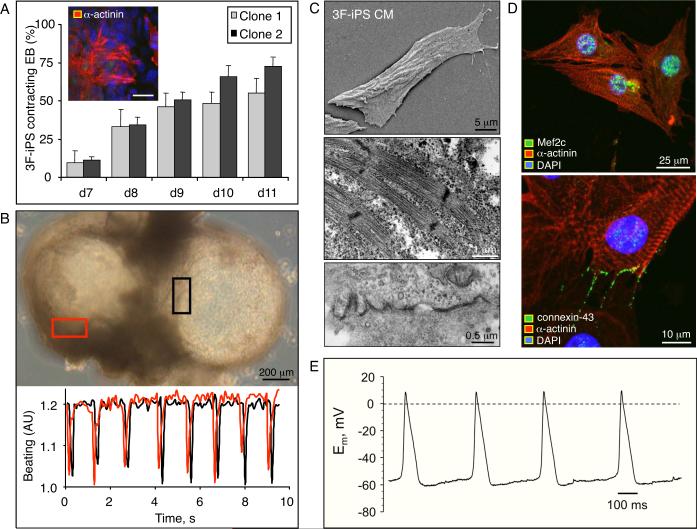
Functional cardiogenesis derived from 3F-iPS. A, Derived from two independently isolated clones, embryoid bodies (EB) increasingly demonstrated beating areas between day 7 and 11 of differentiation. The presence of area actively contracting coincided with positive immunostaining for cardiac protein α-actinin (inset, bar 10 μm). B, Synchronized contractile activity (rectangles; top) was detected within adjacent EB (bottom). C, Electron microscopy of 3F-iPS derived cardiomyocytes (CM) revealed morphological changes from compacted colonies to rod-shaped cardiomyocyte-like cells (top). High density contractile proteins were found in organizing sarcomeres (middle) as well as gap junction structures between adjacent cells (bottom). D, Immunostaining demonstrated presence of contractile protein alpha actinin in combination with cardiac transcription factor Mef2c (top), and gap junction-protein connexin 43 (bottom). E, Action potentials were recorded in beating cells using patch clamp in the current clamp mode. DAPI: 4,6'-diamidino-2-phenylindole.
Figure 5
Figure 5
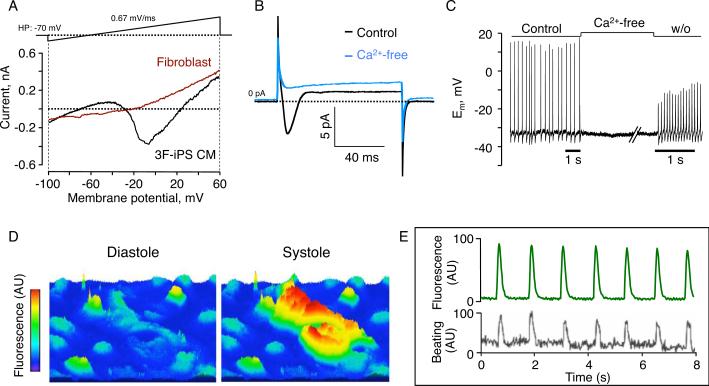
Calcium-dependent excitation-contraction coupling in 3F-iPS-derived cardiomyocytes. A, An inward current was detected in iPS-derived cardiomyocytes (3F-iPS CM, black line) absent from parental fibroblasts (red line). B, Reversal of extracellular calcium suppressed inward current. C, Spontaneous action potentials were reversibly arrested in zero calcium milieu. D, Fluo-4AM labeled iPS-derived cells demonstrated fluorescent dynamics consistent with calcium transients. E, Rhythmic calcium transients coincided with cell contractions.
Figure 6
Figure 6
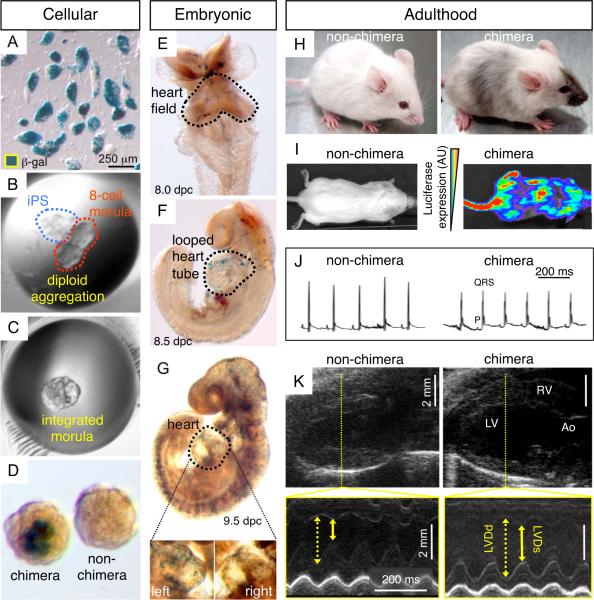
iPS bioengineered cardiac chimerism contributes to sustained heart function throughout development and lifespan. (A–B) LacZ labeled-iPS coincubated with diploid embryos. (C–D) Chimeras revealed the ability of 3F-iPS to integrate into host morulae. (E–G) Presence of iPS was sustained throughout embryonic development as shown for 8.0 through 9.5 dpc contributing to cardiac inflow and outflow tracts (G, inset). H, Other than mosaic coat color, adult chimeras were physically indistinguishable from non-chimeric littermates. I, Increasing levels of chimeric expressed luciferase distributed within tissues were detected according to molecular imaging with iPS-derived progeny. J, Cardiac electrocardiography was equivalent between non-chimera and chimera. K, Cardiac echocardiography demonstrated normal structure of heart, valves, and great-vessels with equivalent systolic and diastolic function between non-chimera and chimera. Ao: aorta, LV: left ventricle; LVDd: left ventricular diastolic diameter, LVDs: left ventricular systolic diameter, RV: right ventricle. bar 2 mm.

Comment in

References

    1. Yamanaka S. A fresh look at iPS cells. Cell. 2009;137:13–17. - PubMed
    1. Hochedlinger K, Plath K. Epigenetic reprogramming and induced pluripotency. Development. 2009;136:509–523. - PMC - PubMed
    1. Nishikawa S, Goldstein RA, Nierras CR. The promise of human induced pluripotent stem cells for research and therapy. Nat Rev Mol Cell Biol. 2008;9:725–729. - PubMed
    1. Takahashi K, Okita K, Nakagawa M, Yamanaka S. Induction of pluripotent stem cells from mouse embryonic and adult fibroblast cultures by defined factors. Cell. 2006;126:663–676. - PubMed
    1. Markoulaki S, Hanna J, Beard C, Carey BW, Cheng AW, Lengner CJ, Dausman JA, Fu D, Gao Q, Wu S, Cassady JP, Jaenisch R. Transgenic mice with defined combinations of drug-inducible reprogramming factors. Nat Biotechnol. 2009;27:169–171. - PMC - PubMed

Publication types

MeSH terms