


Biomaterial design strategies for the treatment of spinal cord injuries
- PMID: 19698073
- PMCID: PMC2924783
- DOI: 10.1089/neu.2009.0948
Biomaterial design strategies for the treatment of spinal cord injuries
Abstract
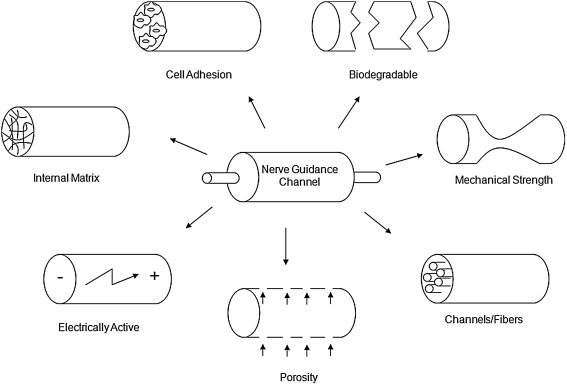
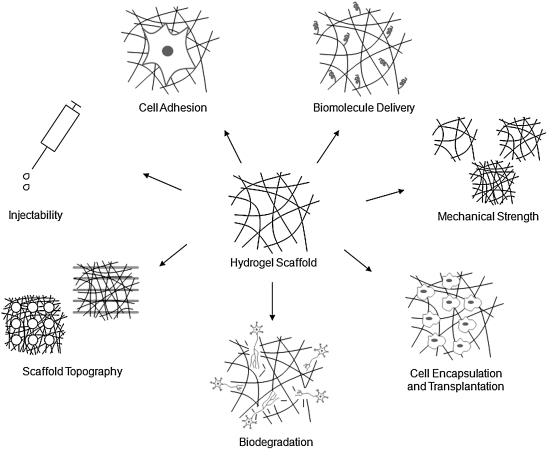
The highly debilitating nature of spinal cord injuries has provided much inspiration for the design of novel biomaterials that can stimulate cellular regeneration and functional recovery. Many experts agree that the greatest hope for treatment of spinal cord injuries will involve a combinatorial approach that integrates biomaterial scaffolds, cell transplantation, and molecule delivery. This manuscript presents a comprehensive review of biomaterial-scaffold design strategies currently being applied to the development of nerve guidance channels and hydrogels that more effectively stimulate spinal cord tissue regeneration. To enhance the regenerative capacity of these two scaffold types, researchers are focusing on optimizing the mechanical properties, cell-adhesivity, biodegradability, electrical activity, and topography of synthetic and natural materials, and are developing mechanisms to use these scaffolds to deliver cells and biomolecules. Developing scaffolds that address several of these key design parameters will lead to more successful therapies for the regeneration of spinal cord tissue.
Figures
References
-
- Ahmed M.R. Jayakumar R. Peripheral nerve regeneration in RGD peptide incorporated collagen tubes. Brain Res. 2003;993:208–216. - PubMed
-
- Ao Q. Wang A.J. Cao W.L. Zhang L. Kong L.J. He Q. Gong Y.D. Zhang X.F. Manufacture of multimicrotubule chitosan nerve conduits with novel molds and characterization in vitro. J. Biomed. Mater. Res. 2006;77A:11–18. - PubMed
-
- Avellino A.M. Hart D. Dailey A.T. Mackinnon M. Ellegala D. Kliot M. Differential macrophage responses in the peripheral and central nervous system during wallerian degeneration of axons. Exp. Neurol. 1995;136:183–198. - PubMed
-
- Bakshi A. Fisher O. Dagci T. Himes B.T. Fischer I. Lowman A. Mechanically engineered hydrogel scaffolds for axonal growth and angiogenesis after transplantation in spinal cord injury. J. Neurosurg. Spine. 2004;1:322–329. - PubMed
-
- Balgude A.P. Yu X. Szymanski A. Bellamkonda R.V. Agarose gel stiffness determines rate of DRG neurite extension in 3D cultures. Biomaterials. 2001;22:1077–1084. - PubMed
Publication types
MeSH terms
Substances
LinkOut - more resources
Full Text Sources
Other Literature Sources
Medical
