


Role of orexin/hypocretin in dependence and addiction
- PMID: 19699189
- PMCID: PMC2819591
- DOI: 10.1016/j.brainres.2009.08.028
Role of orexin/hypocretin in dependence and addiction
Abstract
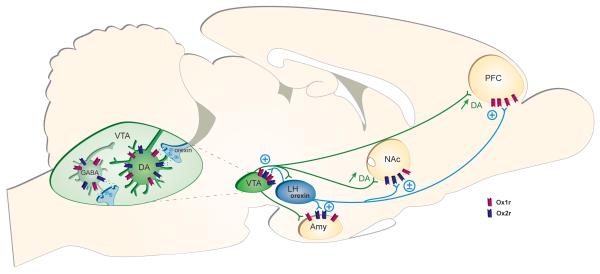
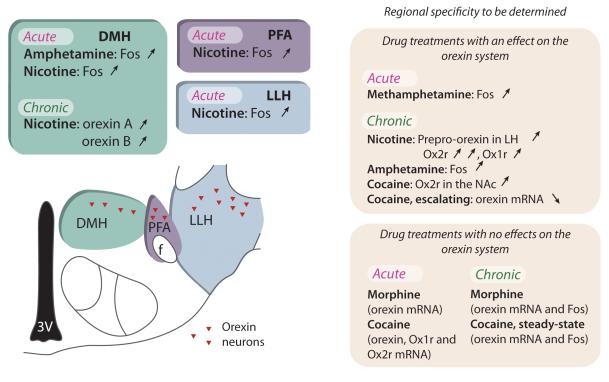
The orexins (or hypocretins) are hypothalamic neuropeptides that have been implicated in a variety of behaviors ranging from feeding to sleep and arousal. Evidence from animal models suggests a role for orexins in reward processing and drug addiction. In this review, we discuss orexin's interaction with the mesocorticolimbic reward pathway and the effects of drugs of abuse on the orexin system. We further review models of drug dependence and addiction and describe behavioral alterations that are seen when the orexin system is manipulated both pharmacologically and genetically. Based on the findings reported in the literature thus far, we posit that orexin functioning contributes to both drug reward and drug-related stress/aversive responsiveness; however, diverse anatomical substrates, and perhaps receptor specificity, contribute differentially to reward and stress components.
Copyright 2009 Elsevier B.V. All rights reserved.
Figures
References
-
- Balcita-Pedicino JJ, Sesack SR. Orexin axons in the rat ventral tegmental area synapse infrequently onto dopamine and gamma-aminobutyric acid neurons. J Comp Neurol. 2007;503:668–84. - PubMed
-
- Baldo BA, Daniel RA, Berridge CW, Kelley AE. Overlapping distributions of orexin/hypocretin- and dopamine-beta-hydroxylase immunoreactive fibers in rat brain regions mediating arousal, motivation, and stress. J Comp Neurol. 2003;464:220–37. - PubMed
-
- Bardo MT, Valone JM, Bevins RA. Locomotion and conditioned place preference produced by acute intravenous amphetamine: role of dopamine receptors and individual differences in amphetamine self-administration. Psychopharmacology (Berl) 1999;143:39–46. - PubMed
-
- Bardo MT, Bevins RA. Conditioned place preference: what does it add to our preclinical understanding of drug reward? Psychopharmacology (Berl) 2000;153:31–43. - PubMed
Publication types
MeSH terms
Substances
Grants and funding
LinkOut - more resources
Full Text Sources
Other Literature Sources
Medical
