Violence, suffering, and mental health in Afghanistan: a school-based survey
- PMID: 19699514
- PMCID: PMC2748901
- DOI: 10.1016/S0140-6736(09)61080-1
Violence, suffering, and mental health in Afghanistan: a school-based survey
Abstract
Background: Studies in Afghanistan have shown substantial mental health problems in adults. We did a survey of young people (11-16 years old) in the country to assess mental health, traumatic experiences, and social functioning.
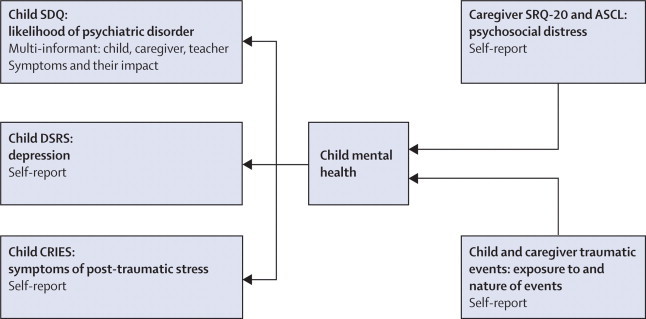
Methods: In 2006, we interviewed 1011 children, 1011 caregivers, and 358 teachers, who were randomly sampled in 25 government-operated schools within three purposively chosen areas (Kabul, Bamyan, and Mazar-e-Sharif municipalities). We assessed probable psychiatric disorder and social functioning in students with the Strength and Difficulties Questionnaire multi-informant (child, parent, teacher) ratings. We also used the Depression Self-Rating Scale and an Impact of Events Scale. We assessed caregiver mental health with both international and culturally-specific screening instruments (Self-Reported Questionnaire and Afghan Symptom Checklist). We implemented a checklist of traumatic events to examine the exposure to, and nature of, traumatic experiences. We analysed risk factors for mental health and reports of traumatic experiences.
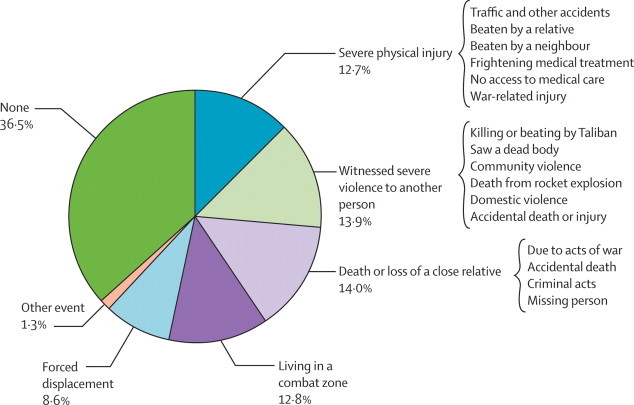
Findings: Trauma exposure and caregiver mental health were predictive across all child outcomes. Probable psychiatric ratings were associated with female gender (odds ratio [OR] 2.47, 95% CI 1.65-3.68), five or more traumatic events (2.58, 1.36-4.90), caregiver mental health (1.11, 1.08-1.14), and residence areas (0.29, 0.17-0.51 for Bamyan and 0.37, 0.23-0.57 for Mazar-e-Sharif vs Kabul). The same variables predicted symptoms of depression. Two thirds of children reported traumatic experiences. Symptoms of post-traumatic stress were associated with five or more traumatic events (3.07, 1.78-5.30), caregiver mental health (1.06, 1.02-1.09), and child age (1.19, 1.04-1.36). Children's most distressing traumatic experiences included accidents, medical treatment, domestic and community violence, and war-related events.
Interpretation: Young Afghans experience violence that is persistent and not confined to acts of war. Our study emphasises the value of school-based initiatives to address child mental health, and the importance of understanding trauma in the context of everyday forms of suffering, violence, and adversity.
Funding: Wellcome Trust.
Figures


Comment in
-
Children's mental health in Afghanistan.Lancet. 2009 Sep 5;374(9692):766-7. doi: 10.1016/S0140-6736(09)61501-4. Epub 2009 Aug 21. Lancet. 2009. PMID: 19699515 No abstract available.
References
-
- Patel V, Flisher AJ, Hetrick S, McGorry P. Mental health of young people: a global public-health challenge. Lancet. 2007;369:1302–1313. - PubMed
-
- Boyden J, de Berry J. Children and youth on the front line: ethnography, armed conflict and displacement. Berghahn Books; Oxford: 2004.
-
- Barenbaum J, Ruchkin V, Schwab-Stone M. The psychosocial aspects of children exposed to war: practice and policy initiatives. J Child Psych Psychiatry. 2004;45:41–62. - PubMed
-
- IASC guidelines on mental health and psychosocial support in emergency settings. Inter-agency Standing Committee; Geneva: 2007. - PubMed