


Validation of an Information-Motivation-Behavioral Skills model of diabetes self-care (IMB-DSC)
- PMID: 19699601
- PMCID: PMC3042801
- DOI: 10.1016/j.pec.2009.07.016
Validation of an Information-Motivation-Behavioral Skills model of diabetes self-care (IMB-DSC)
Abstract
Objective: Comprehensive behavior change frameworks are needed to provide guidance for the design, implementation, and evaluation of diabetes self-care programs in diverse populations. We applied the Information-Motivation-Behavioral Skills (IMB) model, a well-validated, comprehensive health behavior change framework, to diabetes self-care.
Methods: Patients with diabetes were recruited from an outpatient clinic. Information gathered pertained to demographics, diabetes knowledge (information); diabetes fatalism (personal motivation); social support (social motivation); and diabetes self-care (behavior). Hemoglobin A1C values were extracted from the patient medical record. Structural equation models tested the IMB framework.
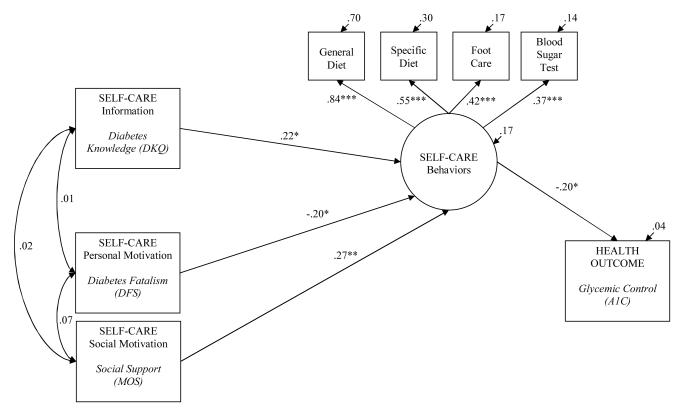
Results: More diabetes knowledge (r=0.22 p<0.05), less fatalistic attitudes (r=-0.20, p<0.05), and more social support (r=0.27, p<0.01) were independent, direct predictors of diabetes self-care behavior; and through behavior, were related to glycemic control (r=-0.20, p<0.05).
Conclusions: Consistent with the IMB model, having more information (more diabetes knowledge), personal motivation (less fatalistic attitudes), and social motivation (more social support) was associated with behavior; and behavior was the sole predictor of glycemic control.
Practice implications: The IMB model is an appropriate, comprehensive health behavior change framework for diabetes self-care. The findings indicate that in addition to knowledge, diabetes education programs should target personal and social motivation to effect behavior change.
2009 Elsevier Ireland Ltd. All rights reserved.
Figures
References
-
- U.S. Department of Health and Human Services, Centers for Disease Control and Prevention; Atlanta, GA: 2008. National diabetes fact sheet: general information and national estimates on diabetes in the United States, 2007.
-
- The effect of intensive treatment of diabetes on the development and progression of long-term complications in insulin-dependent diabetes mellitus. The Diabetes Control and Complications Trial Research Group. The New England journal of medicine. 1993;329(14):977–986. - PubMed
-
- Effect of intensive blood-glucose control with metformin on complications in overweight patients with type 2 diabetes (UKPDS 34). UK Prospective Diabetes Study (UKPDS) Group. Lancet. 1998;352(9131):854–865. - PubMed
-
- Intensive blood-glucose control with sulphonylureas or insulin compared with conventional treatment and risk of complications in patients with type 2 diabetes (UKPDS 33). UK Prospective Diabetes Study (UKPDS) Group. Lancet. 1998;352(9131):837–853. - PubMed
-
- Norris SL, Engelgau MM, Narayan KM. Effectiveness of self-management training in type 2 diabetes: a systematic review of randomized controlled trials. Diabetes care. 2001;24(3):561–587. - PubMed
Publication types
MeSH terms
Substances
Grants and funding
LinkOut - more resources
Full Text Sources
Medical
