


Heterogeneity of yield strain in low-density versus high-density human trabecular bone
- PMID: 19700162
- PMCID: PMC2891247
- DOI: 10.1016/j.jbiomech.2009.05.023
Heterogeneity of yield strain in low-density versus high-density human trabecular bone
Abstract
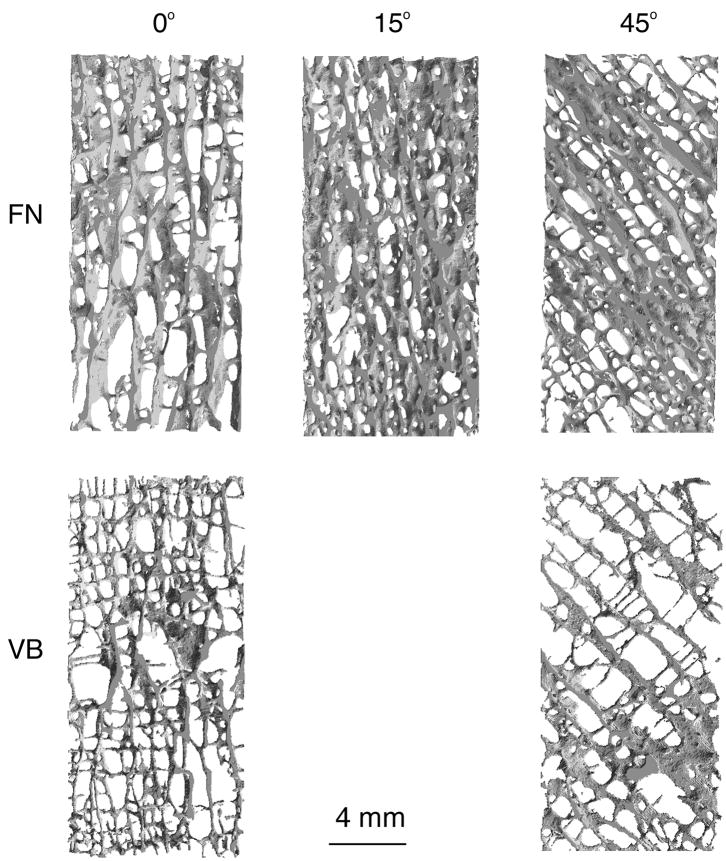
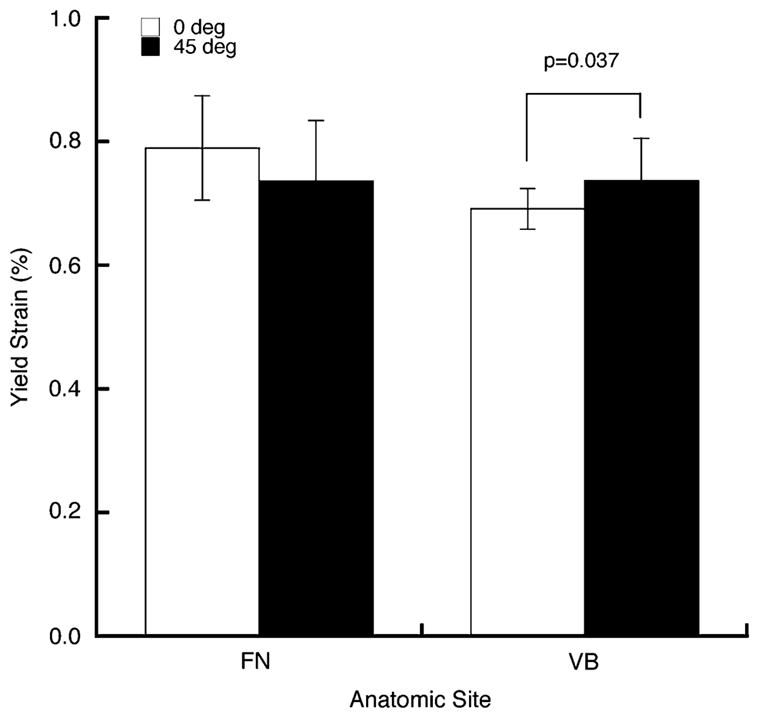
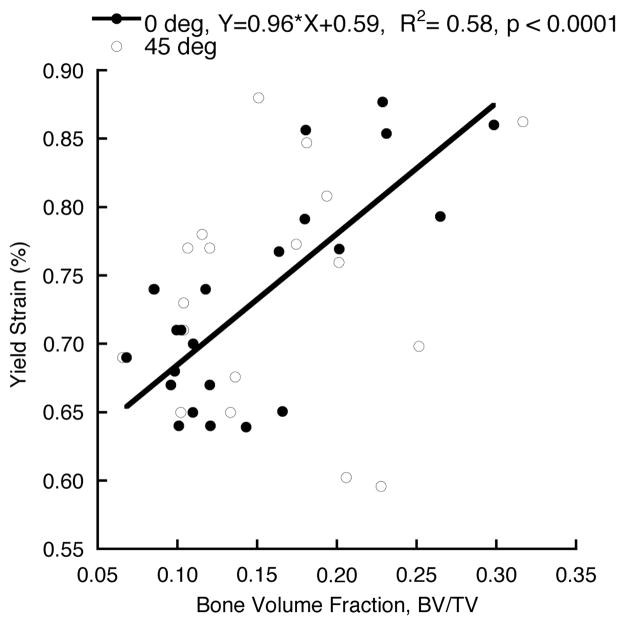
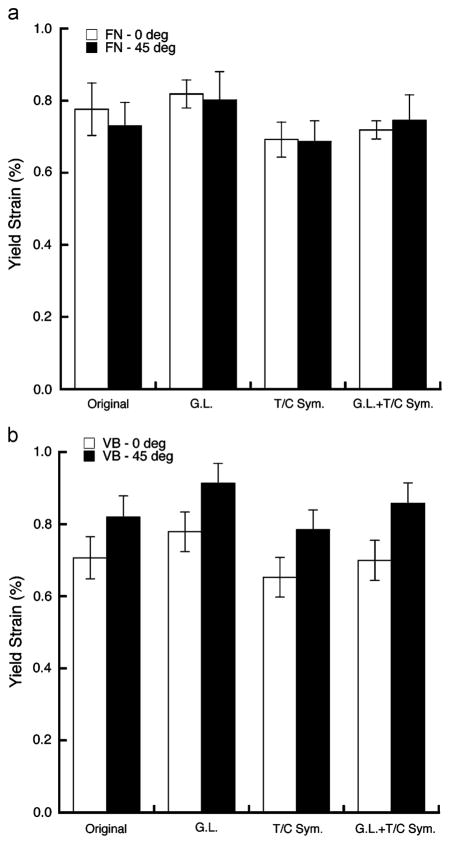
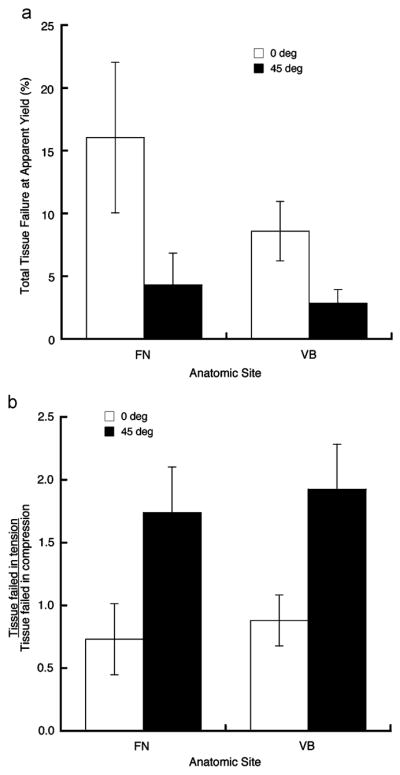
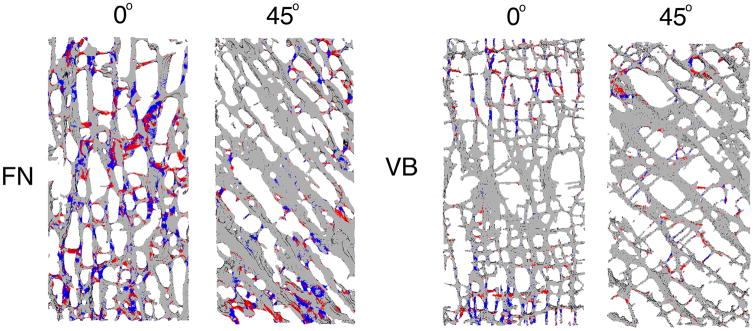
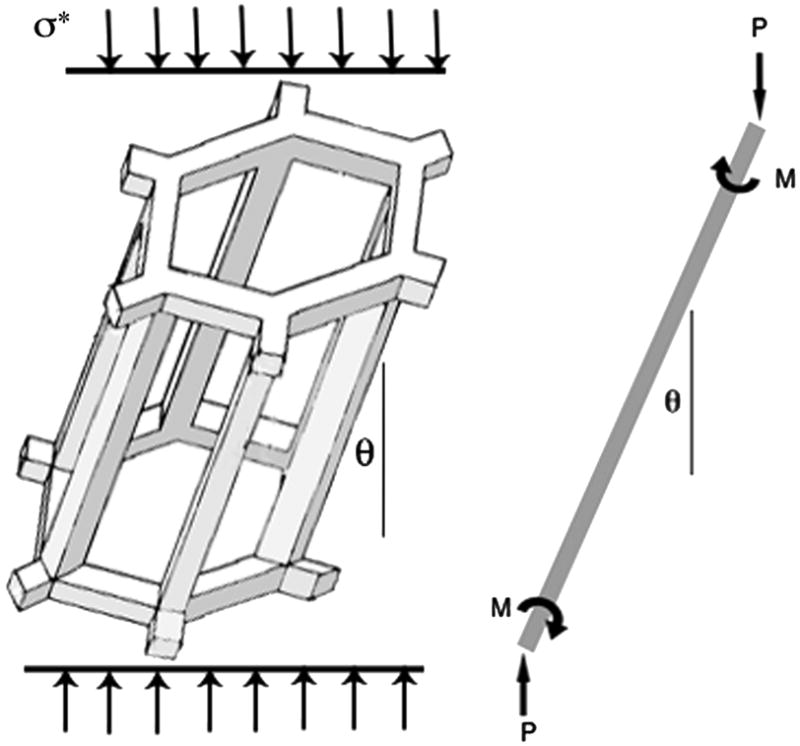
Understanding the off-axis behavior of trabecular yield strains may lend unique insight into the etiology of fractures since yield strains provide measures of failure independent of elastic behavior. We sought to address anisotropy of trabecular yield strains while accounting for variations in both density and anatomic site and to determine the mechanisms governing this behavior. Cylindrical specimens were cored from vertebral bodies (n=22, BV/TV=0.11+/-0.02) and femoral necks (n=28, BV/TV=0.22+/-0.06) with the principal trabecular orientation either aligned along the cylinder axis (on-axis, n=22) or at an oblique angle of 15 degrees or 45 degrees (off-axis, n=28). Each specimen was scanned with micro-CT, mechanically compressed to failure, and analysed with nonlinear micro-CT-based finite element analysis. Yield strains depended on anatomic site (p=0.03, ANOVA), and the effect of off-axis loading was different for the two sites (p=0.04)-yield strains increased for off-axis loading of the vertebral bone (p=0.04), but were isotropic for the femoral bone (p=0.66). With sites pooled together, yield strains were positively correlated with BV/TV for on-axis loading (R(2)=58%, p<0.0001), but no such correlation existed for off-axis loading (p=0.79). Analysis of the modulus-BV/TV and strength-BV/TV relationships indicated that, for the femoral bone, the reduction in strength associated with off-axis loading was greater than that for modulus, while the opposite trend occurred for the vertebral bone. The micro-FE analyses indicated that these trends were due to different failure mechanisms for the two types of bone and the different loading modes. Taken together, these results provide unique insight into the failure behavior of human trabecular bone and highlight the need for a multiaxial failure criterion that accounts for anatomic site and bone volume fraction.
Figures
References
-
- Bayraktar HH, Gupta A, Kwon RY, Papadopoulos P, Keaveny TM. The modified super-ellipsoid yield criterion for human trabecular bone. Journal of Biomechanical Engineering. 2004a;126(6):677–684. - PubMed
-
- Bayraktar HH, Keaveny TM. Mechanisms of uniformity of yield strains for trabecular bone. Journal of Biomechanics. 2004b;37(11):1671–1678. - PubMed
-
- Bevill G, Eswaran SK, Gupta A, Papadopoulos P, Keaveny TM. Influence of bone volume fraction and architecture on computed large-deformation failure mechanisms in human trabecular bone. Bone. 2006;39(6):1218–1225. - PubMed
-
- Bevill G. PhD Thesis. University of California; Berkeley: 2008. Micromechanical Modeling of Failure in Trabecular Bone.
-
- Brown TD, Ferguson AB. Mechanical property distributions in the cancellous bone of the human proximal femur. Acta Orthop Scand. 1980;51(3):429–437. - PubMed
Publication types
MeSH terms
Grants and funding
LinkOut - more resources
Full Text Sources
Medical
