


Large particle penetration through N95 respirator filters and facepiece leaks with cyclic flow
- PMID: 19700488
- PMCID: PMC6768069
- DOI: 10.1093/annhyg/mep062
Large particle penetration through N95 respirator filters and facepiece leaks with cyclic flow
Abstract
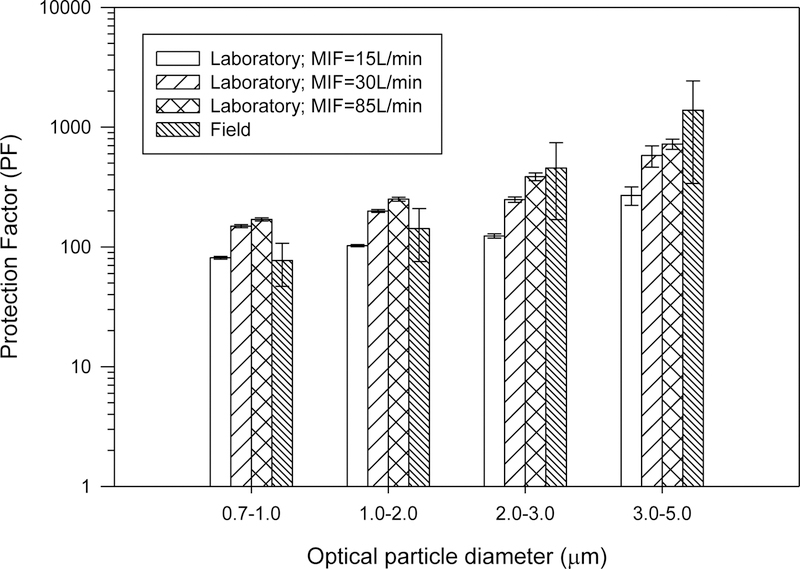
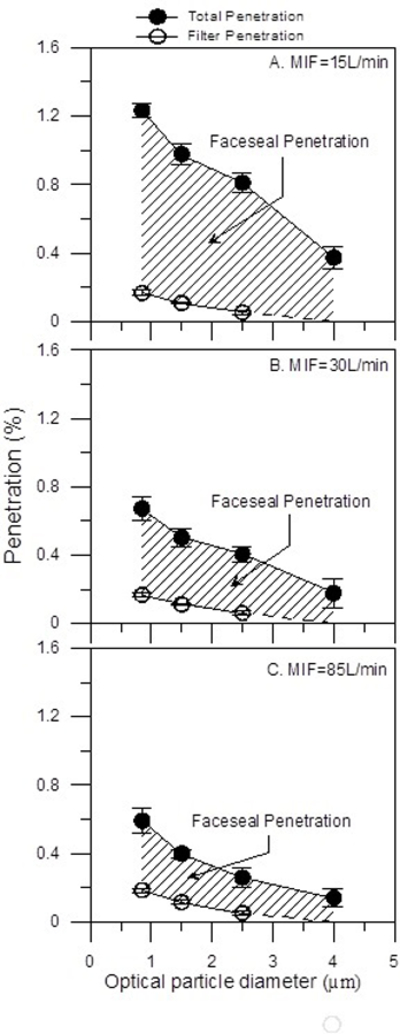
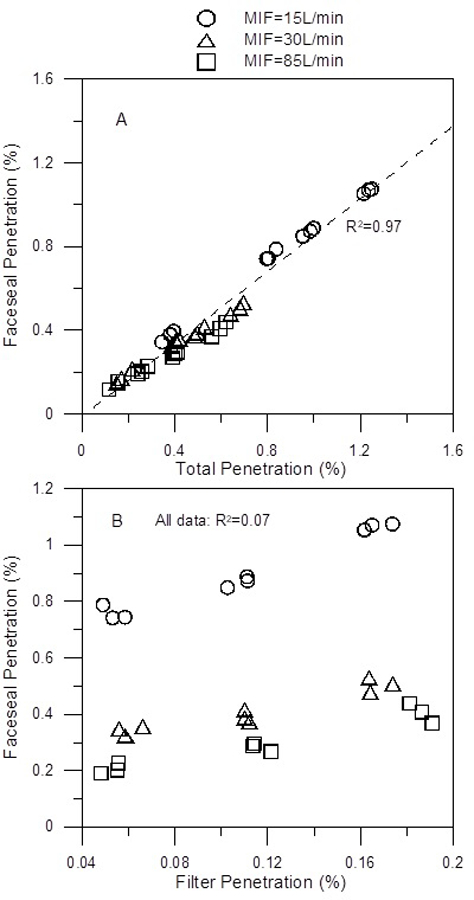
The aim of this study was to investigate respirator filter and faceseal penetration of particles representing bacterial and fungal spore size ranges (0.7-4 mum). First, field experiments were conducted to determine workplace protection factors (WPFs) for a typical N95 filtering facepiece respirator (FFR). These data (average WPF = 515) were then used to position the FFR on a manikin to simulate realistic donning conditions for laboratory experiments. Filter penetration was also measured after the FFR was fully sealed on the manikin face. This value was deducted from the total penetration (obtained from tests with the partially sealed FFR) to determine the faceseal penetration. All manikin experiments were repeated using three sinusoidal breathing flow patterns corresponding to mean inspiratory flow rates of 15, 30, and 85 l min(-1). The faceseal penetration varied from 0.1 to 1.1% and decreased with increasing particle size (P < 0.001) and breathing rate (P < 0.001). The fractions of aerosols penetrating through the faceseal leakage varied from 0.66 to 0.94. In conclusion, even for a well-fitting FFR respirator, most particle penetration occurs through faceseal leakage, which varies with breathing flow rate and particle size.
Figures


References
-
- Balazy A, Toivola M, Reponen T, Podg, Oacute, Rski A, Zimmer A and Grinshpun SA, (2006). Manikin-Based Performance Evaluation of N95 Filtering-Facepiece Respirators Challenged with Nanoparticles. Annals of Occupational Hygiene, 50(3): 259–269. - PubMed
-
- Brosseau LM, Ellenbecker MJ and Evans JS, (1990). Collection of Silica and Asbestos Aerosols by Respirators at Steady and Cyclic Flow. American Industrial Hygiene Association Journal, 51(8): 420–426. - PubMed
-
- Chen C-C and Huang S-H, (1998). The Effects of Particle Charge on the Performance of a Filtering Facepiece. American Industrial Hygiene Association Journal, 59(4): 227–233. - PubMed
-
- Chen CC, Ruuskanen J, Pilacinski W and Willeke K, (1990). Filter and Leak Penetration Characteristics of a Dust and Mist Filtering Facepiece. American Industrial Hygiene Association Journal, 51(12): 632–639. - PubMed
-
- Coffey CC, Zhuang Z, Campbell DL and Myers WR, (1998). Quantitative fit testing of N95 respirators: part II - results, effect of filter penetration, fit test, and pass/fail criteria. Journal of the International Society for Respiratory Protection, 16(1–4): 25–36.
Publication types
MeSH terms
Substances
Grants and funding
LinkOut - more resources
Full Text Sources
Miscellaneous
