


doi: 10.1128/AEM.00639-09.
Epub 2009 Aug 21.
Cloning of Salmonella enterica serovar Enteritidis fimbrial protein SefA as a surface protein in Escherichia coli confers the ability to attach to eukaryotic cell lines
Affiliations
- PMID: 19700549
- PMCID: PMC2765155
- DOI: 10.1128/AEM.00639-09
Item in Clipboard
Cloning of Salmonella enterica serovar Enteritidis fimbrial protein SefA as a surface protein in Escherichia coli confers the ability to attach to eukaryotic cell lines
Appl Environ Microbiol.
2009 Oct.
Abstract
The gene for the Salmonella enterica serovar Enteritidis fimbrial protein SefA was cloned into an Escherichia coli surface expression vector and confirmed by Western blot assay. E. coli clones expressing SefA attached to avian ovary granulosa cells and HEp-2 cells, providing evidence for the involvement of SefA in the ability of Salmonella to attach to eukaryotic cells.
Figures
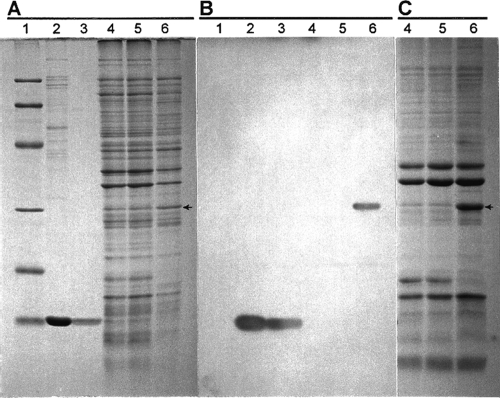
SDS-PAGE and Western blot of SefA samples using SefA monoclonal antibodies. (A) SDS-PAGE of total membrane fractions collected from cells grown at 37°C. (B) Western blot of SDS-PAGE gel shown in panel A using monoclonal mouse antibodies 69/25 as an immunoprobe for SefA. (C) SDS-PAGE of outer membrane fractions collected from cells grown at 25°C. Lanes: 1, molecular mass standards (99.4, 66.2, 45, 31, 21.5, and 14.4 kDa); 2, crude SefA; 3, purified SefA; 4, E. coli JM109; 5, E. coli JM109(pTX101); 6, E. coli JM109(pDUG3A). Arrows indicate Lpp-OmpA-SefA fusion protein at ∼31 kDa.
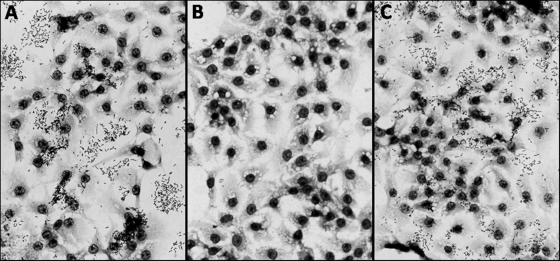
Attachment of indicated bacterial cells to avian ovary granulosa cells: S. Enteritidis CDC9 (A), E. coli JM109(pTX101) (B), and E. coli JM109(pDUG3A) (C). Cells were stained with 10% Giemsa stain and photographed with a light microscope at ×400 magnification.
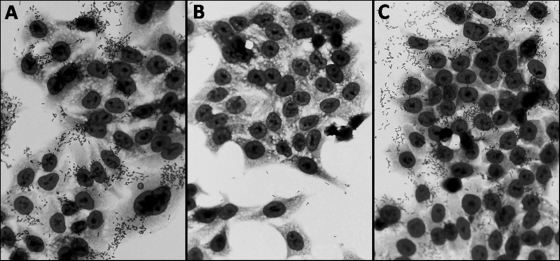
Attachment of indicated bacterial cells to HEp-2 cells: S. Enteritidis CDC9 (A), E. coli JM109(pTX101) (B), and E. coli JM109(pDUG3A) (C). Cells were stained with 10% Giemsa stain and photographed with a light microscope at ×400 magnification.
References
-
- Anonymous. 1995. Blotting, hybridization and detection: an S & S laboratory manual, 6th ed. Whatman/Schleicher & Schuell Biosciences, Inc., Sanford, ME.
-
- Austin, J. W., G. Sanders, W. W. Kay, and S. K. Collinson. 1998. Thin aggregative fimbriae enhance Salmonella enteritidis biofilm formation. FEMS Microbiol. Lett. 162:295-301. - PubMed
-
- Bertram, E. M., S. R. Attridge, and I. Kotlarski. 1994. Immunogenicity of the Escherichia coli fimbrial antigen K99 when expressed by Salmonella enteritidis 11RX. Vaccine 12:1372-1378. - PubMed
-
- Centers for Disease Control and Prevention. 1996. Outbreaks of Salmonella serotype enteritidis infection associated with consumption of raw shell eggs—United States, 1994-1995. MMWR Morb. Mortal. Wkly. Rep. 45:737-742. - PubMed
-
- Centers for Disease Control and Prevention. 2007. Preliminary FoodNet data on the incidence of infection with pathogens transmitted commonly through food—10 states, 2007. MMWR Morb. Mortal. Wkly. Rep. 54:352-356. - PubMed
MeSH terms
Substances
LinkOut - more resources
Full Text Sources
