. 2009 Oct;151(2):869-81.
doi: 10.1104/pp.109.144261. Epub 2009 Aug 21.

At4g24160, a soluble acyl-coenzyme A-dependent lysophosphatidic acid acyltransferase

Affiliations

At4g24160, a soluble acyl-coenzyme A-dependent lysophosphatidic acid acyltransferase

Ananda K Ghosh et al. Plant Physiol. 2009 Oct.

Abstract

Human CGI-58 (for comparative gene identification-58) and YLR099c, encoding Ict1p in Saccharomyces cerevisiae, have recently been identified as acyl-CoA-dependent lysophosphatidic acid acyltransferases. Sequence database searches for CGI-58 like proteins in Arabidopsis (Arabidopsis thaliana) revealed 24 proteins with At4g24160, a member of the alpha/beta-hydrolase family of proteins being the closest homolog. At4g24160 contains three motifs that are conserved across the plant species: a GXSXG lipase motif, a HX(4)D acyltransferase motif, and V(X)(3)HGF, a probable lipid binding motif. Dendrogram analysis of yeast ICT1, CGI-58, and At4g24160 placed these three polypeptides in the same group. Here, we describe and characterize At4g24160 as, to our knowledge, the first soluble lysophosphatidic acid acyltransferase in plants. A lipidomics approach revealed that At4g24160 has additional triacylglycerol lipase and phosphatidylcholine hydrolyzing enzymatic activities. These data establish At4g24160, a protein with a previously unknown function, as an enzyme that might play a pivotal role in maintaining the lipid homeostasis in plants by regulating both phospholipid and neutral lipid levels.


Figures
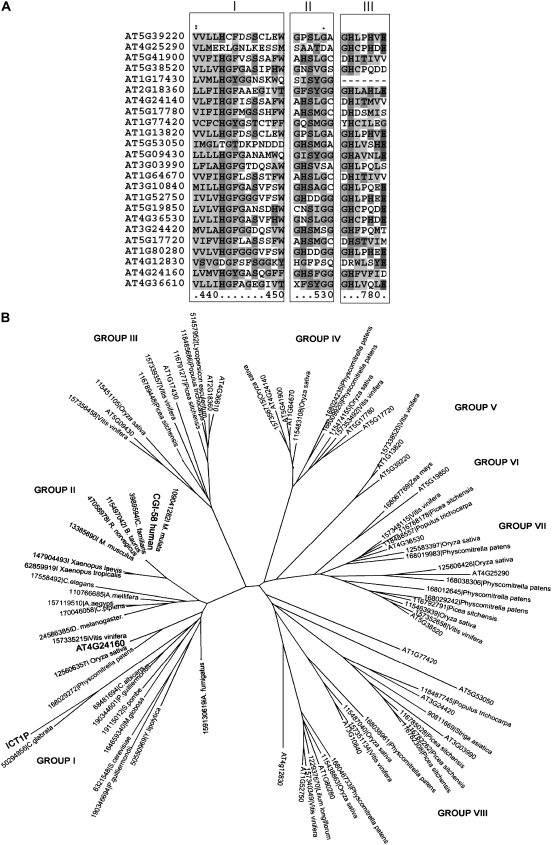
Figure 1.
Figure 1.
Phylogenetic analysis of CGI-58 and its homologs in yeast, plants, and animals. A, BLAST search was performed using amino acid sequence of CGI-58 followed by ClustalW alignment of the close homologs. B, The evolutionary history was inferred using the neighbor-joining method. The bootstrap consensus tree inferred from 500 replicates is taken to represent the evolutionary history of the taxa analyzed. Branches corresponding to partitions reproduced in <50% bootstrap replicates are collapsed. The percentage of replicate trees in which the associated taxa clustered together in the bootstrap tests (500 replicates) is shown next to the branches. The evolutionary distances were computed using the Poisson correction method and are in the units of the number of amino acid substitutions per site. All positions containing gaps and missing data were eliminated from the data set (complete deletion option). There were a total of 183 positions in the final data set. Phylogenetic analyses were conducted in MEGA4.
Figure 2.
Figure 2.
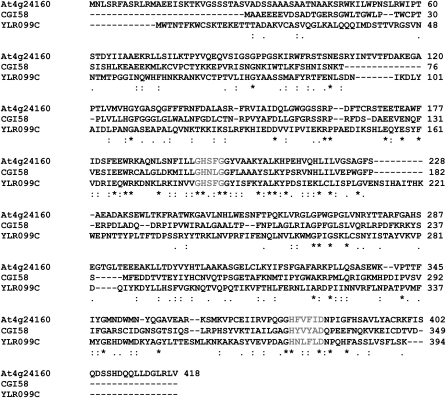
At4g24160 is a homolog of ICT1 and CGI-58. BLAST analysis of human CGI-58 with nonredundant protein database available at NCBI was performed. Multiple sequence alignment of proteins homologous to human CGI-58 was carried out using sequences from representative organisms, such as Arabidopsis and yeast. Accession numbers are as follows: NP_057090.2 for Homo sapiens, NP_974605.1 for Arabidopsis, and NP_013200.1 for S. cerevisiae. The conserved H(X)4D and GXNXG motifs are indicated in bold.
Figure 3.
Figure 3.
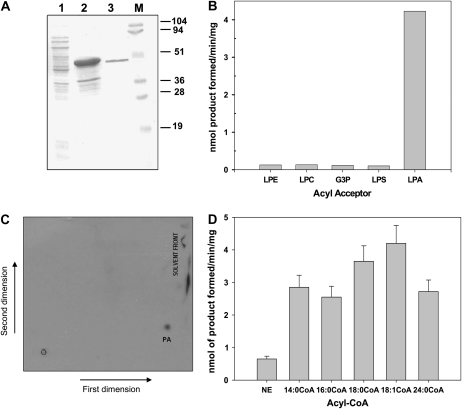
Purification of the recombinant At4g24160. A, At4g24160 from E. coli BL21 (DE3) was purified using Ni2+-NTA affinity column chromatography. Proteins were resolved on a 12% SDS-PAGE and stained with Coomassie Brilliant Blue. Lane 1, supernatant of induced lysate; lane 2, pellet of induced lysate; lane 3, the purified At4g24160. M, Molecular mass standard. B, Specificity for cosubstrate (lyso)phospholipids on the acyltransferase activity of purified At4g24160. Values are average of two independent experiments. C, Two-dimensional TLC showing PA as the product formed after the enzymatic acylation of LPA by the purified recombinant At4g24160. First-dimensional solvent system is chloroform:methanol:ammonia (65:35:5, v/v), and the second-dimensional solvent system is chloroform:methanol:acetic acid:water (40:20:5:0.5, v/v). D, Acyl-CoA-dependent formation of PA catalyzed by the purified recombinant At4g24160. Assay was performed with 50 μm [3H]LPA (0.25 μCi/tube), 10 μm acyl-CoA donors, and 5 μg enzyme in a final volume of 100 μL. The reaction was carried out for 20 min. Values are means (±sd) for four independent determinations.
Figure 4.
Figure 4.
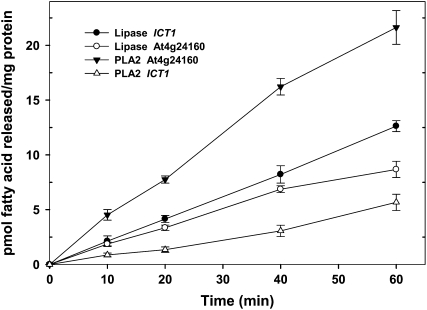
Time-dependent hydrolysis of TG and PC by the purified recombinant At4g24160. Lipase assay was performed in a reaction buffer containing 50 mm Tris-HCl, pH 7.5, 100 μm sodium taurocholate, and 10 μg enzyme for various time intervals at 30°C in the presence of sonicated suspension of 100 μm [9,10-3H]triolein. Reaction mixtures used for phospholipase A2 assays consisted of 100 μm sonicated vesicles of [2-palmitoyl-9,10-3H]phosphatidylcholine and 10 μg enzyme in total volume of 100 μL. The reaction was carried out at 30°C for various time periods. The activity was assessed as described in “Materials and Methods.” Values are means (±sd) for three independent determinations, and each experiment was done in duplicate.
Figure 5.
Figure 5.
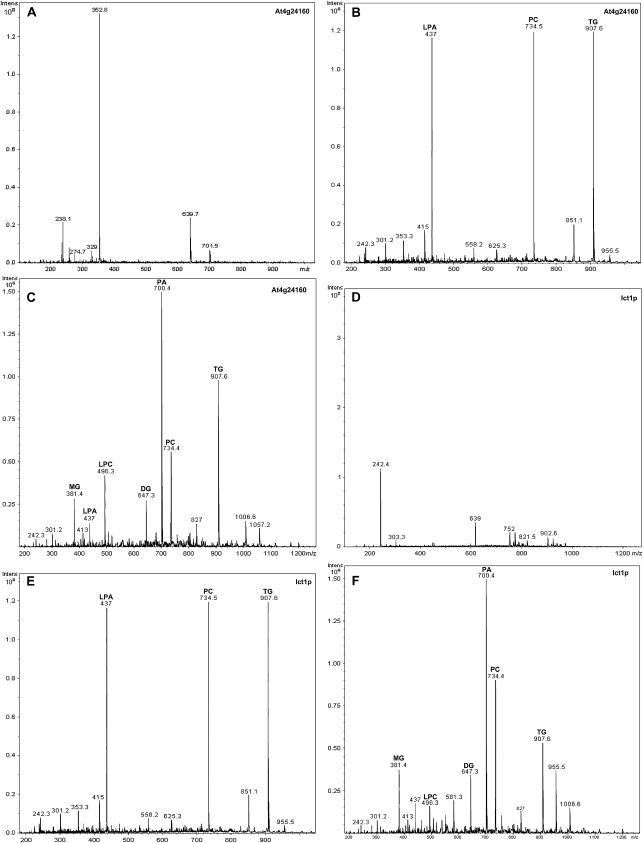
ESI-MS analysis of LPAAT, lipase, and phospholipase activities (cocktail assay). A, Control reaction (without substrate) was performed with assay buffer and 10 μg At4g24160 enzyme in a final reaction volume of 100 μL. The reaction was carried out for 40 min at 30°C. The lipids were extracted with butanol, dried, and analyzed by ESI-MS. The ESI analysis was done in a positive mode. The control reaction clearly reveals that the products formed are not contaminants from the enzyme source. B, Control reaction (without enzyme) was performed with assay buffer, 1 mm LPA (1-oleoyl), 10 μm oleoyl-CoA, 1 mm PC (dipalmitate), and 1 mm triolein in a final reaction volume of 100 μL. The reaction was carried out for 40 min at 30°C. The lipids were extracted with butanol, dried, and analyzed by ESI-MS. The ESI analysis was done in a positive mode. The neutral lipid molecules were sodiated. The control reaction clearly reveals that the products formed are not contaminants from the substrate. C, A cocktail assay was performed with assay buffer and 10 μg purified recombinant At4g24160 enzyme and three substrates, i.e. 1 mm LPA (1-oleoyl), 10 μm oleoyl-CoA, 1 mm PC (dipalmitate), and 1 mm triolein, in a final reaction volume of 100 μL. The reaction was carried out for 40 min at 30°C. The ESI analysis was done in positive mode and the neutral lipids were sodiated. The added LPA was acylated to PA in the presence of oleoyl-CoA. TG was hydrolyzed to diacylglycerol (DG) and monoacylglycerol (MG), whereas LPC was formed from the hydrolysis of PC. The LPAAT activity of the purified At4g2160 was the most pronounced followed by its PLA2 activity. The TG lipase activity was found to be the least. D, Control reaction (without substrate) was performed with assay buffer and 10 μg Ict1p enzyme in a final reaction volume of 100 μL. The reaction was carried out for 40 min at 30°C. The lipids were extracted with butanol, dried, and analyzed by ESI-MS. The ESI analysis was done in a positive mode. This control clearly reveals that the products formed are not contaminants from the enzyme source. E, Control reaction (without enzyme) was performed with assay buffer, 10 μm oleoyl-CoA, 1 mm LPA (1-oleoyl), 1 mm PC (dipalmitate), and 1 mm triolein in a final reaction volume of 100 μL. The reaction was carried out for 40 min at 30°C. The lipids were extracted with butanol, dried, and analyzed by ESI-MS. The ESI analysis was done in a positive mode. The neutral lipid molecules were sodiated. The control reaction clearly reveals that the products formed are not contaminants from the substrate. F, A cocktail assay was performed with assay buffer and 10 μg Ict1p enzyme and three substrates, i.e. 10 μm oleoyl-CoA, I mm LPA (1-oleoyl), 1 mm PC (dipalmitate), and 1 mm triolein, in a final reaction volume of 100 μL. The reaction was carried out for 40 min at 30°C. The ESI analysis was done in positive mode, and the neutral lipids were sodiated. The LPA provided was acylated to PA in the presence of oleoyl-CoA. TG was hydrolyzed to diacylglycerol and monoacylglycerol, whereas as LPC was formed from the hydrolysis of PC. The LPAAT activity of the purified Ict1p was the most pronounced followed by its TG lipase activity. The PLA2 activity was found to be the least.
Figure 6.
Figure 6.
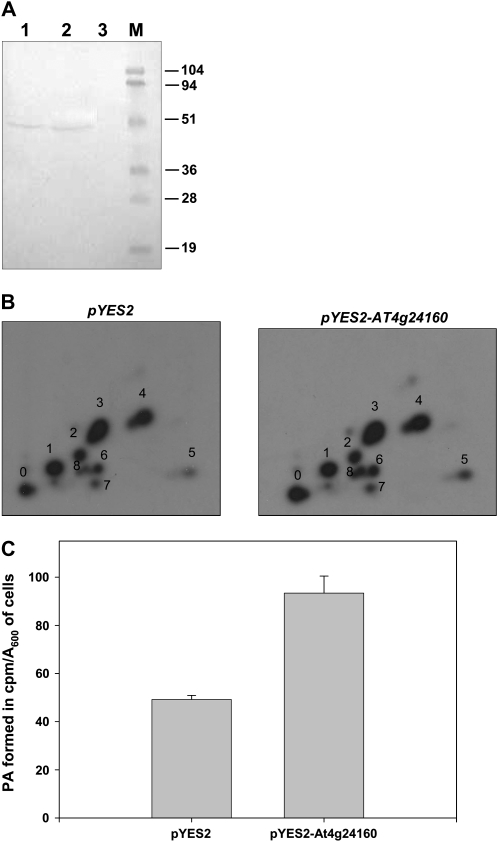
Heterologous expression of At4g24160 in S. cerevisiae enhances the phosphatidic acid level and TG hydrolysis. A, pRSETA-At4g24160 (lane 1) transformed E. coli BL21 (DE3) as a control to check that the protein expressed (At4g24160) in yeast is the same as that in bacteria and is not an isoform expressed under protein overexpression or stress conditions. pYES2-At4g24160 (lane 2) transformed yeast and pYES2 (lane 3) vector were grown overnight in the presence of Gal, and cells (A600 = 5) were lysed using glass beads. The proteins were separated by 12% SDS-PAGE, and immunoblotting was performed using anti-Ict1p antibodies at a dilution of 1:1,000 (v/v). M, Molecular mass standard. B, Yeast cells overexpressing At4g24160 and the vector control were grown for 24 h in Gal media in the presence of 200 μCi of [32P]orthophosphate. Lipids were extracted from cells (A600=25) and resolved on two-dimensional silica-TLC using chloroform:methanol:ammonia (65:35:5, v/v) as first-dimensional and chloroform:methanol:acetone:acetic acid:water (50:10:20:15:5, v/v) as second-dimensional solvent systems. Lipids are indicated as 1, phosphatidylinositol; 2, phosphatidylserine; 3, PC; 4, phosphatidylethanolamine; 5, PA; and 6 to 8, unknown. 0 indicates the origin. C, The amount of [32P]orthophosphate incorporated into PA is represented as the cpm per A600 of cells per 24 h of labeling.

References

    1. Altschul SF, Gish W, Miller W, Myers EW, Lipman DJ (1990) Basic local alignment search tool. J Mol Biol 215: 403–410 - PubMed
    1. Altschul SF, Madden TL, Schaffer AA, Zhang J, Zhang Z, Miller W, Lipman DJ (1997) Gapped BLAST and PSI-BLAST: a new generation of protein database search programs. Nucleic Acids Res 25: 3389–3402 - PMC - PubMed
    1. Anthony RG, Henriques R, Helfer A, Meszaros T, Rios G, Testerink C, Munnik T, Deak M, Koncz C, Bogre L (2004) A protein kinase target of a PDK1 signalling pathway is involved in root hair growth in Arabidopsis. EMBO J 23: 572–581 - PMC - PubMed
    1. Bateman A, Birney E, Durbin R, Eddy SR, Howe KL, Sonnhammer EL (2000) The Pfam protein families database. Nucleic Acids Res 28: 263–266 - PMC - PubMed
    1. Bhardwaj K, Raju A, Rajasekharan R (2001) Identification, purification, and characterization of a thermally stable lipase from rice bran. A new member of the (phospho) lipase family. Plant Physiol 127: 1728–1738 - PMC - PubMed

Publication types

MeSH terms