


Endothelial dysfunction and specific inflammation in obesity hypoventilation syndrome
- PMID: 19701463
- PMCID: PMC2726948
- DOI: 10.1371/journal.pone.0006733
Endothelial dysfunction and specific inflammation in obesity hypoventilation syndrome
Abstract
Background: Obesity hypoventilation syndrome (OHS) is associated with increased cardiovascular morbidity. What moderate chronic hypoventilation adds to obesity on systemic inflammation and endothelial dysfunction remains unknown.
Question: To compare inflammatory status and endothelial function in OHS versus eucapnic obese patients.
Methodology: 14 OHS and 39 eucapnic obese patients matched for BMI and age were compared. Diurnal blood gazes, overnight polysomnography and endothelial function, measured by reactive hyperemia peripheral arterial tonometry (RH-PAT), were assessed. Inflammatory (Leptin, RANTES, MCP-1, IL-6, IL-8, TNFalpha, Resistin) and anti-inflammatory (adiponectin, IL-1Ra) cytokines were measured by multiplex beads immunoassays.
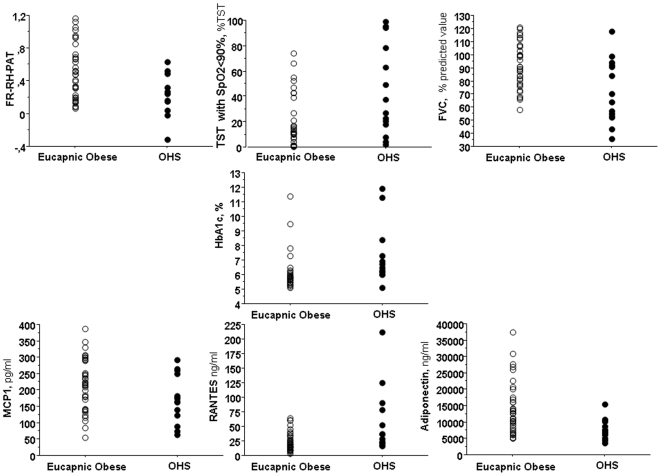
Principal findings: OHS exhibited a higher PaCO(2), a lower forced vital capacity (FVC) and tended to have a lower PaO(2) than eucapnic obese patients. (HS)-CRP, RANTES levels and glycated haemoglobin (HbA1c) were significantly increased in OHS (respectively 11.1+/-10.9 vs. 5.7+/-5.5 mg x l(-1) for (HS)-CRP, 55.9+/-55.3 vs 23.3+/-15.8 ng/ml for RANTES and 7.3+/-4.3 vs 6.1+/-1.7 for HbA1c). Serum adiponectin was reduced in OHS (7606+/-2977 vs 13,660+/-7854 ng/ml). Endothelial function was significantly more impaired in OHS (RH-PAT index: 0.22+/-0.06 vs 0.51+/-0.11).
Conclusions: Compared to eucapnic obesity, OHS is associated with a specific increase in the pro-atherosclerotic RANTES chemokine, a decrease in the anti-inflammatory adipokine adiponectin and impaired endothelial function. These three conditions are known to be strongly associated with an increased cardiovascular risk.
Trial registration: ClinicalTrials.gov NCT00603096.
Conflict of interest statement
Figures
References
-
- Kaw R, Hernandez AV, Walker E, Aboussouan L, Mokhlesi B. Determinants of Hypercapnia in Obese Patients With Obstructive Sleep Apnea. A Systematic Review and Metaanalysis of Cohort Studies. Chest. 2009 June 30 [Epub ahead of print], DOI 10.1378/chest.09-0615. - PubMed
-
- Mokhlesi B, Tulaimat A. Recent advances in obesity hypoventilation syndrome. Chest. 2007;132:1322–1336. - PubMed
-
- Olson AL, Zwillich C. The obesity hypoventilation syndrome. Am J Med. 2005;118:948–956. - PubMed
-
- Berg G, Delaive K, Manfreda J, Walld R, Kryger MH. The use of health-care resources in obesity-hypoventilation syndrome. Chest. 2001;120:377–383. - PubMed
-
- Perez de Llano LA, Golpe R, Ortiz Piquer M, Veres Racamonde A, Vazquez Caruncho M, et al. Short-term and long-term effects of nasal intermittent positive pressure ventilation in patients with obesity-hypoventilation syndrome. Chest. 2005;128:587–594. - PubMed
Publication types
MeSH terms
Associated data
LinkOut - more resources
Full Text Sources
Medical
Research Materials
Miscellaneous
