Intergenerational continuity in parenting behavior: mediating pathways and child effects
- PMID: 19702389
- PMCID: PMC2748920
- DOI: 10.1037/a0014850
Intergenerational continuity in parenting behavior: mediating pathways and child effects
Abstract
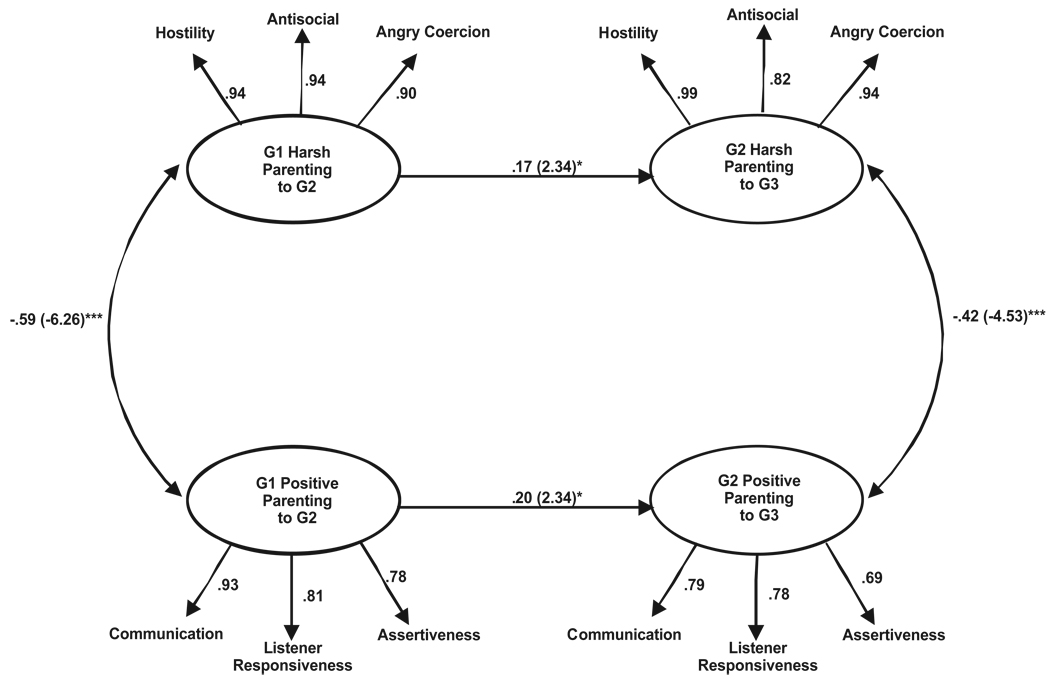
This prospective, longitudinal investigation examined mechanisms proposed to explain continuities in parenting behavior across 2 generations (G1, G2). Data came from 187 G2 adults, their mothers (G1), and their children (G3). Prospective information regarding G2 was collected both during adolescence and early adulthood. G1 data were collected during G2's adolescence, and G3 data were generated during the preschool years. Assessments included both observational and self-report measures. The results indicated a direct relationship between G1 and G2 harsh parenting, and between G1 and G2 positive parenting. As predicted, specific mediators accounted for intergenerational continuity in particular types of parenting behavior. G2 externalizing behavior mediated the relationship between G1 and G2 harsh parenting, whereas G2 academic attainment mediated the relationship between G1 and G2 positive parenting. In addition, the hypothesized mediating pathways remained statistically significant after taking into account possible G2 effects on G1 parenting and G3 effects on G2 parenting.
Figures




Comment in
-
The intergenerational transmission of parenting: closing comments for the special section.Dev Psychol. 2009 Sep;45(5):1276-83. doi: 10.1037/a0016911. Dev Psychol. 2009. PMID: 19702391
References
-
- Allison PD. Missing data techniques for structural equation modeling. Journal of Abnormal Psychology. 2003;112:545–557. - PubMed
-
- Ambert AM. The effect of children on parents. New York: The Haworth Press; 1992.
-
- Arbuckle JL. AMOS user’s guide version 3.6. Chicago: Small Waters; 1997.
-
- Arbuckle JL. AMOS 5.0 update to the AMOS user’s guide. Chicago: Small Waters; 2003.
-
- Bank L, Forgatch M, Patterson G, Fetrow R. Parenting practices of single mothers: Mediators of negative contextual factors. Journal of Marriage and Family. 1993;55:371–385.
Publication types
MeSH terms
Grants and funding
- R01 MH062989/MH/NIMH NIH HHS/United States
- MH051361/MH/NIMH NIH HHS/United States
- HD047573/HD/NICHD NIH HHS/United States
- DA05347/DA/NIDA NIH HHS/United States
- MH59355/MH/NIMH NIH HHS/United States
- MH19734/MH/NIMH NIH HHS/United States
- R01 HD047573/HD/NICHD NIH HHS/United States
- MH48165/MH/NIMH NIH HHS/United States
- R01 HD051746/HD/NICHD NIH HHS/United States
- HD051746/HD/NICHD NIH HHS/United States
- HD027724/HD/NICHD NIH HHS/United States
- R01 MH043270/MH/NIMH NIH HHS/United States
- R01 MH051361/MH/NIMH NIH HHS/United States
- MH62989/MH/NIMH NIH HHS/United States
- MH43270/MH/NIMH NIH HHS/United States
- T32 MH019734/MH/NIMH NIH HHS/United States
- K05 MH000567/MH/NIMH NIH HHS/United States
- MH00567/MH/NIMH NIH HHS/United States
LinkOut - more resources
Full Text Sources
Medical
Research Materials