Associations of postural knowledge and basic motor skill with dyspraxia in autism: implication for abnormalities in distributed connectivity and motor learning
- PMID: 19702410
- PMCID: PMC2740626
- DOI: 10.1037/a0015640
Associations of postural knowledge and basic motor skill with dyspraxia in autism: implication for abnormalities in distributed connectivity and motor learning
Abstract
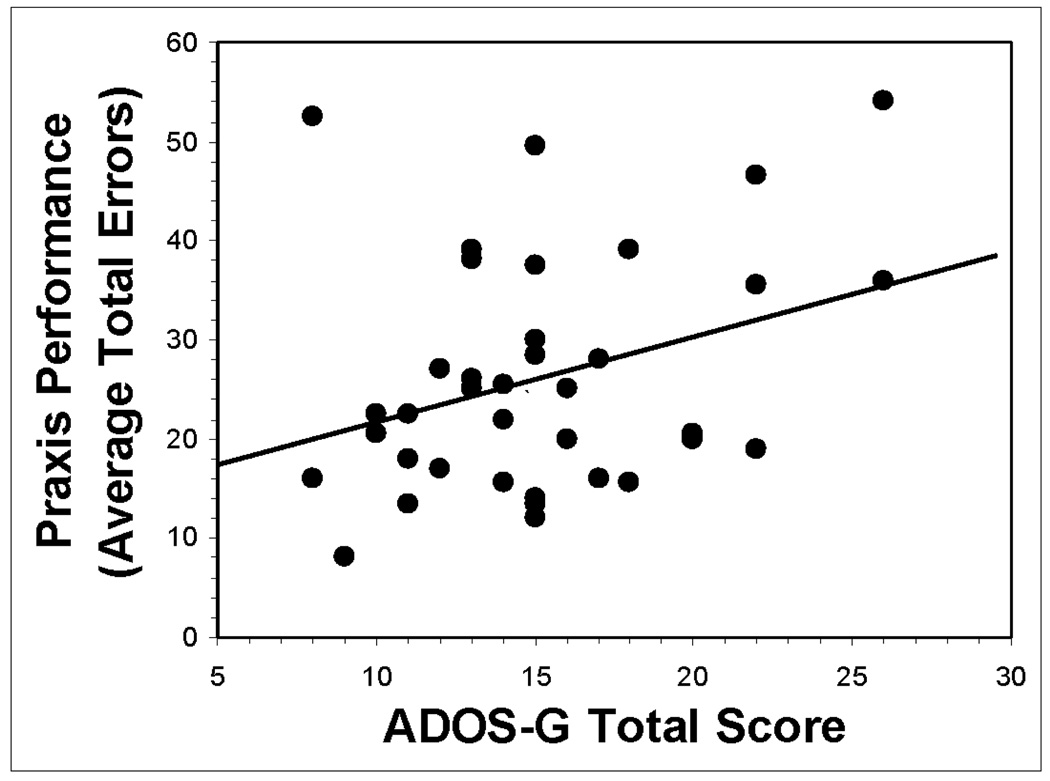
Children with autism often have difficulty performing skilled movements. Praxis performance requires basic motor skill, knowledge of representations of the movement (mediated by parietal regions), and transcoding of these representations into movement plans (mediated by premotor circuits). The goals of this study were (a) to determine whether dyspraxia in autism is associated with impaired representational ("postural") knowledge and (b) to examine the contributions of postural knowledge and basic motor skill to dyspraxia in autism. Thirty-seven children with autism spectrum disorder (ASD) and 50 typically developing (TD) children, ages 8-13, completed (a) an examination of basic motor skills, (b) a postural knowledge test assessing praxis discrimination, and (c) a praxis examination. Children with ASD showed worse basic motor skill and postural knowledge than did controls. The ASD group continued to show significantly poorer praxis than did controls after accounting for age, IQ, basic motor skill, and postural knowledge. Dyspraxia in autism appears to be associated with impaired formation of spatial representations, as well as transcoding and execution. Distributed abnormality across parietal, premotor, and motor circuitry, as well as anomalous connectivity, may be implicated.
Figures
References
-
- American Psychiatric Association. Diagnostic and statistical manual of mental disorders. 4th ed., text revision. Washington, DC: American Psychiatric Association; 2000.
-
- Blake R, Turner LM, Smoski MJ, Pozdol SL, Stone WL. Visual recognition of biological motion is impaired in children with autism. Psychological Science. 2003;14(2):151–157. - PubMed
-
- Brian J, Bryson SE, Garon N, Roberts W, Smith IM, Szatmari P, et al. Clinical assessment of autism in high-risk 18-month-olds. Autism. 2008;12(5):433–456. - PubMed
-
- Buxbaum LJ, Kyle K, Grossman M, Coslett HB. Left inferior parietal representations for skilled hand-object interactions: Evidence from stroke and corticobasal degeneration. Cortex. 2007;43(3):411–423. - PubMed
-
- Casanova MF, Buxhoeveden DP, Switala AE, Roy E. Minicolumnar pathology in autism. Neurology. 2002;58:428–432. - PubMed