


Association between bone mineral density and lifestyle factors or vitamin D receptor gene polymorphism in adult male workers: a cross-sectional study
- PMID: 19705233
- PMCID: PMC2767497
- DOI: 10.1007/s12199-009-0104-y
Association between bone mineral density and lifestyle factors or vitamin D receptor gene polymorphism in adult male workers: a cross-sectional study
Abstract
Objectives: The aim of this cross-sectional study was to investigate the association between bone mineral density (BMD) and lifestyle factors, as well as the influence of vitamin D receptor (VDR) gene polymorphism, in adult male workers.
Methods: The subjects were 524 male employees aged 23-49 years (37.3 +/- 5.4 years, mean +/- standard deviation) working at a large-scale integrated manufacturing facility in Japan. BMD was measured at the nondominant radius by dual-energy X-ray absorptiometry. Lifestyle information was obtained by a questionnaire at the same time, and genomic DNA was isolated from peripheral leukocytes.
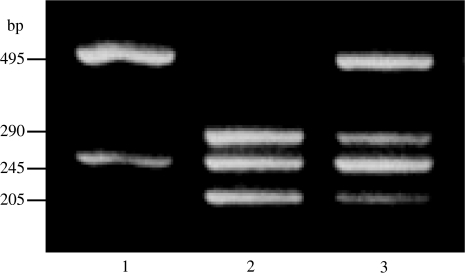
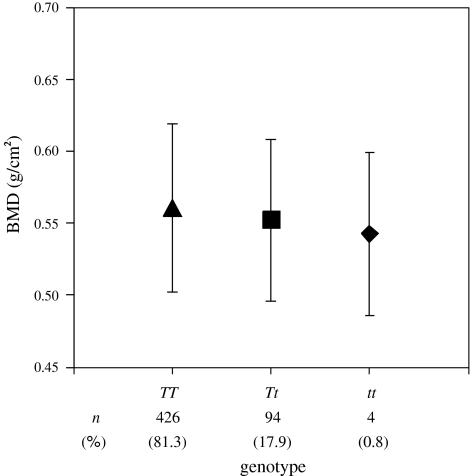
Results: The genotype frequencies of VDR gene polymorphism detected by Taq I digestion were 81.3%, 17.9%, and 0.8% for TT, Tt, and tt, respectively. BMD was 0.56 +/- 0.06 g/cm(2). Analysis of covariance with adjustment for age and body mass index (BMI) revealed that subjects who had a past history of exercise, current exercise from 3 to 7 days a week or daily alcohol intake showed significantly higher BMD than subjects without these features (0.56 +/- 0.06 versus 0.54 +/- 0.06, 0.58 +/- 0.06 versus 0.55 +/- 0.06, and 0.57 +/- 0.06 versus 0.55 +/- 0.06, respectively) (P < 0.05). Subjects who ate only 2 meals a day or smoked >/=21 cigarettes a day showed significantly lower BMD if they had the Tt or tt genotype than if they had the TT genotype (0.51 +/- 0.04 versus 0.56 +/- 0.06 and 0.51 +/- 0.05 versus 0.57 +/- 0.06, respectively) (P < 0.05).
Conclusions: These findings suggest that the influence of lifestyle on BMD differs according to VDR gene polymorphism in adult male workers.
Figures
References
-
- {'text': '', 'ref_index': 1, 'ids': [{'type': 'PubMed', 'value': '7976495', 'is_inner': True, 'url': 'https://pubmed.ncbi.nlm.nih.gov/7976495/'}]}
- Kanis JA, Melton LJ 3rd, Christiansen C, Johnston CC, Khaltaev N. The diagnosis of osteoporosis. J Bone Miner Res. 1994;9:1137–41. - PubMed
-
- {'text': '', 'ref_index': 1, 'ids': [{'type': 'DOI', 'value': '10.1016/S0140-6736(98)09075-8', 'is_inner': False, 'url': 'https://doi.org/10.1016/s0140-6736(98)09075-8'}, {'type': 'PubMed', 'value': '10093980', 'is_inner': True, 'url': 'https://pubmed.ncbi.nlm.nih.gov/10093980/'}]}
- Center JR, Nguyen TV, Schneider D, Sambrook PN, Eisman JA. Mortality after all major types of osteoporotic fracture in men and women: an observational study. Lancet. 1999;353:878–82. - PubMed
-
- {'text': '', 'ref_index': 1, 'ids': [{'type': 'PubMed', 'value': '8320473', 'is_inner': True, 'url': 'https://pubmed.ncbi.nlm.nih.gov/8320473/'}]}
- Nakamura T. Epidemiological study on hip fractures in Tottori Prefecture. Nippon Seikeigeka Gakkai Zasshi. 1993;67:189–200. (in Japanese). - PubMed
-
- {'text': '', 'ref_index': 1, 'ids': [{'type': 'DOI', 'value': '10.1097/00005131-199704000-00004', 'is_inner': False, 'url': 'https://doi.org/10.1097/00005131-199704000-00004'}, {'type': 'PubMed', 'value': '9181497', 'is_inner': True, 'url': 'https://pubmed.ncbi.nlm.nih.gov/9181497/'}]}
- Aharonoff GB, Koval KJ, Skovron ML, Zuckerman JD. Hip fractures in the elderly: predictors of one year mortality. J Orthop Trauma. 1997;11:162–5. - PubMed
-
- {'text': '', 'ref_index': 1, 'ids': [{'type': 'PubMed', 'value': '18458281', 'is_inner': True, 'url': 'https://pubmed.ncbi.nlm.nih.gov/18458281/'}]}
- Qaseem A, Snow V, Shekelle P, Hopkins R Jr, Forciea MA, Owens DK, et al. Screening for osteoporosis in men: a clinical practice guideline from the American College of Physicians. Ann Int Med. 2008;148:680–4. - PubMed
LinkOut - more resources
Full Text Sources
Research Materials
Miscellaneous