. 2010 Feb;24(1):297-309.
doi: 10.1016/j.tiv.2009.08.009. Epub 2009 Aug 23.

Use of cassette dosing in sandwich-cultured rat and human hepatocytes to identify drugs that inhibit bile acid transport

Affiliations

Use of cassette dosing in sandwich-cultured rat and human hepatocytes to identify drugs that inhibit bile acid transport

Kristina K Wolf et al. Toxicol In Vitro. 2010 Feb.

Abstract

Hepatocellular accumulation of bile acids due to inhibition of the canalicular bile salt export pump (BSEP/ABCB11) is one proposed mechanism of drug-induced liver injury (DILI). Some hepatotoxic compounds also are potent inhibitors of bile acid uptake by Na(+)-dependent taurocholate cotransporting polypeptide (NTCP/SLC10A1). This study used a cassette dosing approach in rat and human sandwich-cultured hepatocytes (SCH) to determine whether known or suspected hepatotoxic drugs inhibit bile acid transport individually or in combination. [(3)H]-Taurocholate served as the NTCP/BSEP probe substrate. Individually, cyclosporin A and rifampin decreased taurocholate in vitro biliary clearance (Cl(biliary)) and biliary excretion index (BEI) by more than 20% in rat SCH, suggesting that these drugs primarily inhibited canalicular efflux. In contrast, ampicillin, carbenicillin, cloxacillin, nafcillin, oxacillin, carbamazepine, pioglitazone, and troglitazone decreased the in vitro Cl(biliary) by more than 20% with no notable change in BEI, suggesting that these drugs primarily inhibited taurocholate uptake. Cassette dosing (n=2-4 compounds per cassette) in rat SCH yielded similar findings, and results in human SCH were consistent with rat SCH. In summary, cassette dosing in SCH is a useful in vitro approach to identify compounds that inhibit the hepatic uptake and/or excretion of bile acids, which may cause DILI.


Conflict of interest statement

CONFLICT OF INTEREST

K.L.R.B. is a co-founder and Chair of the Scientific Advisory Board of Qualyst, Inc. Qualyst, Inc. has exclusively licensed the sandwich-cultured hepatocyte technology for quantification of biliary excretion (B-CLEAR®).

Figures
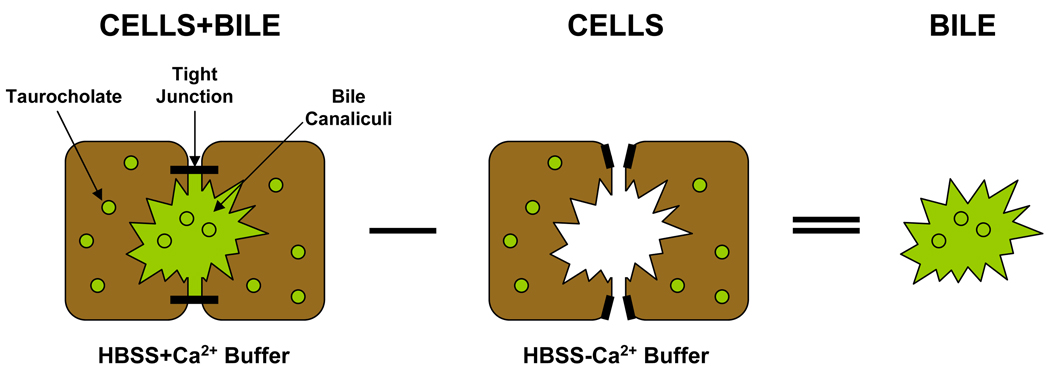
Figure 1
Figure 1. Schematic depicting method of calculating taurocholate accumulation in hepatocytes and bile canaliculi in SCH
SCH were preincubated in HBSS+Ca2+ buffer (standard buffer), or HBSS-Ca2+ buffer (Ca2+-free buffer) to disrupt tight junctions sealing the bile canalicular space (Liu et al., 1999b). Subsequently, cultures were rinsed and SCH were incubated in standard buffer with substrate for 10 min. In SCH preincubated with standard buffer, [3H]taurocholate (circles) was taken up into SCH and excreted into the bile canaliculi; substrate accumulation (cells+bile) was determined at 10 min. In adjacent wells where SCH were preincubated with HBSS-Ca2+ buffer to open tight junctions, [3H]taurocholate excreted into the bile compartment was released into the medium; substrate accumulation (cells) was determined at 10 min. The mass of [3H]taurocholate excreted into the bile during the 10-min incubation was estimated as the difference in accumulation in SCH with intact and disrupted tight junctions [(cells+bile) minus cells].
Figure 2
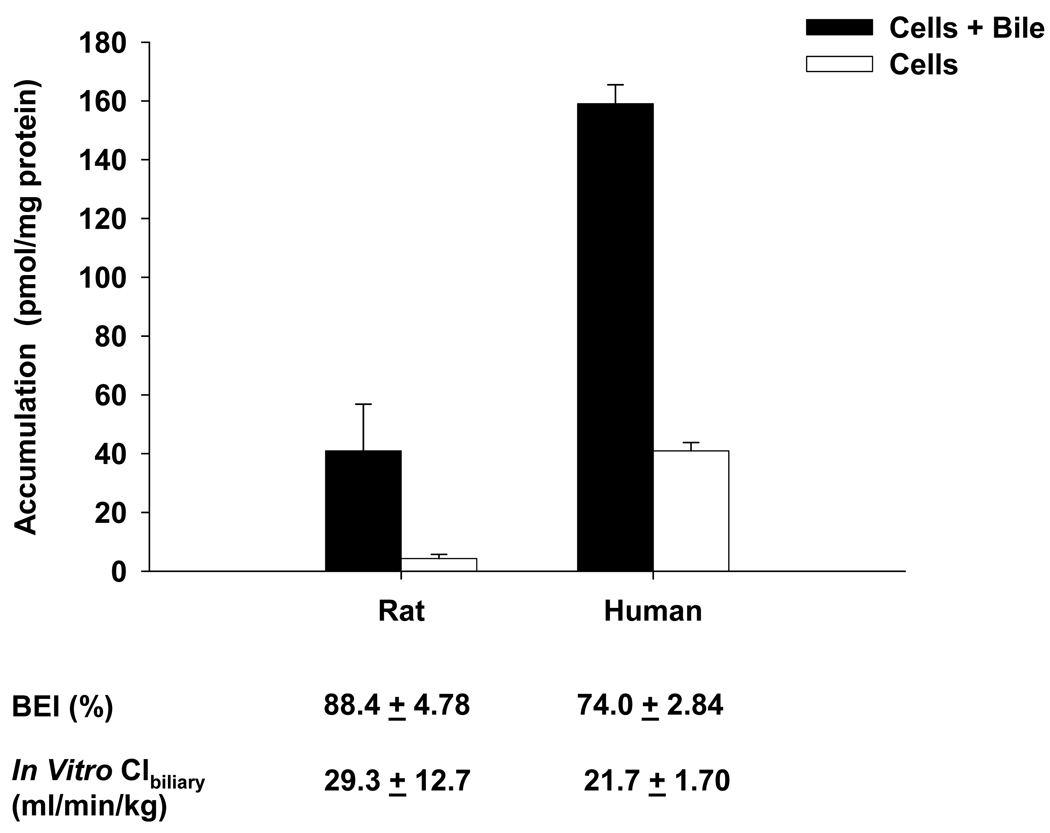
Figure 2. Hepatobiliary disposition of taurocholate in vitro
Rat and human SCH were incubated with [3H]-taurocholate (1 µM) for 10 min following incubation in either standard or Ca2+-free buffer. Solid bars represent accumulation in hepatocytes and bile canaliculi (cells+bile). Open bars represent accumulation in hepatocytes (cells). BEI and in vitro Clbiliary were calculated as described in Materials and Methods. Data are presented as mean ± SD for n=9 livers in triplicate for rat SCH, and mean ± ½ of the range for n=2 livers in triplicate for human SCH.
Figure 3
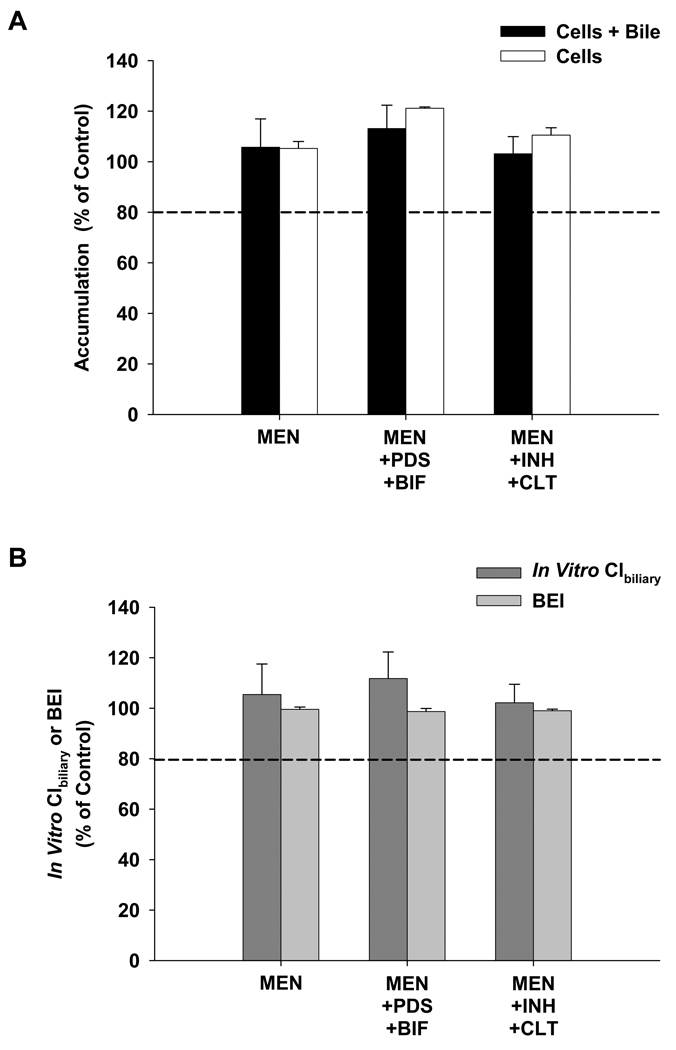
Figure 3. Effect of menadione-containing cassettes on the hepatobiliary disposition of taurocholate in rat SCH
Rat SCH were incubated with menadione (MEN) alone or in cassette with prednisone (PDS) and bifonazole (BIF), or isoniazid (INH) and clotrimazole (CLT), in either standard or Ca2+-free buffer for 10 min, followed by an additional 10-min incubation with [3H]-taurocholate (1 µM) and the drug(s) of interest. (A) Taurocholate accumulation. Solid bars represent accumulation in hepatocytes and bile canaliculi (cells+bile). Open bars represent accumulation in hepatocytes (cells). (B) BEI and in vitro Clbiliary were calculated as described in Materials and Methods. Data are presented as mean ± ½ of the range for n=2 livers in duplicate. Data for treatment with menadione alone also were presented in Table 3 and serve as a reference in this figure.
Figure 4
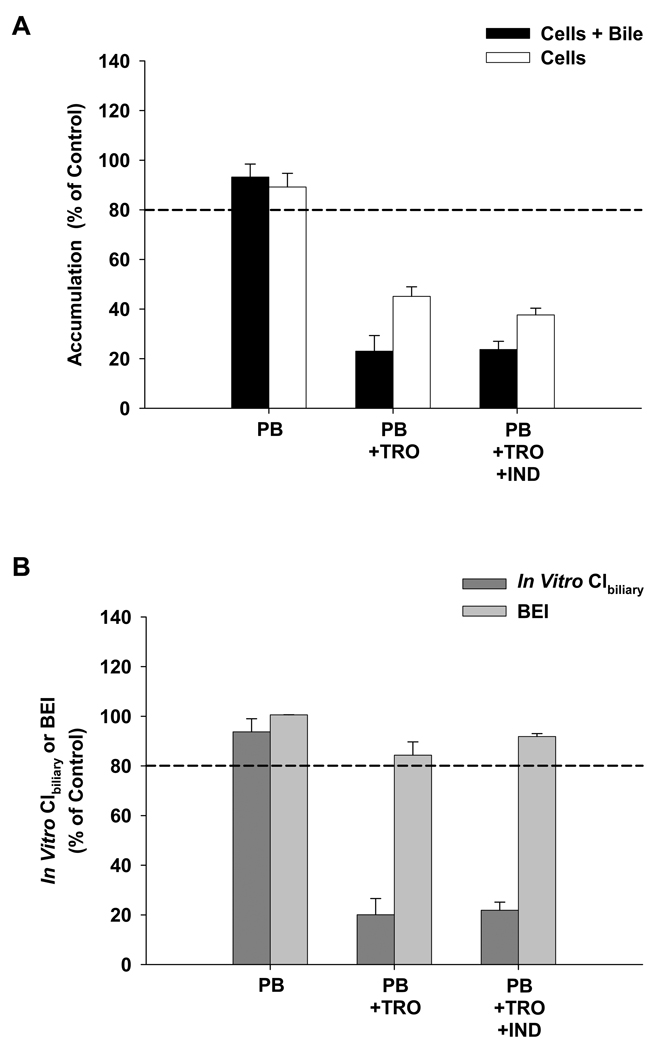
Figure 4. Effect of phenobarbital-containing cassettes on the hepatobiliary disposition of taurocholate in rat SCH
Rat SCH were incubated with phenobarbital (PB) alone or in cassette with troglitazone (TRO) with or without indomethacin (IND) in either standard or Ca2+-free buffer for 10 min, followed by an additional 10-min incubation with [3H]-taurocholate (1 µM) and the drug(s) of interest. (A) Taurocholate accumulation. Solid bars represent accumulation in hepatocytes and bile canaliculi (cells+bile). Open bars represent accumulation in hepatocytes (cells). (B) BEI and in vitro Clbiliary were calculated as described in Materials and Methods. Data are presented as mean ± ½ of the range for n=2 livers in duplicate. Data for treatment with phenobarbital alone also were presented in Table 3 and serve as a reference in this figure.
Figure 5
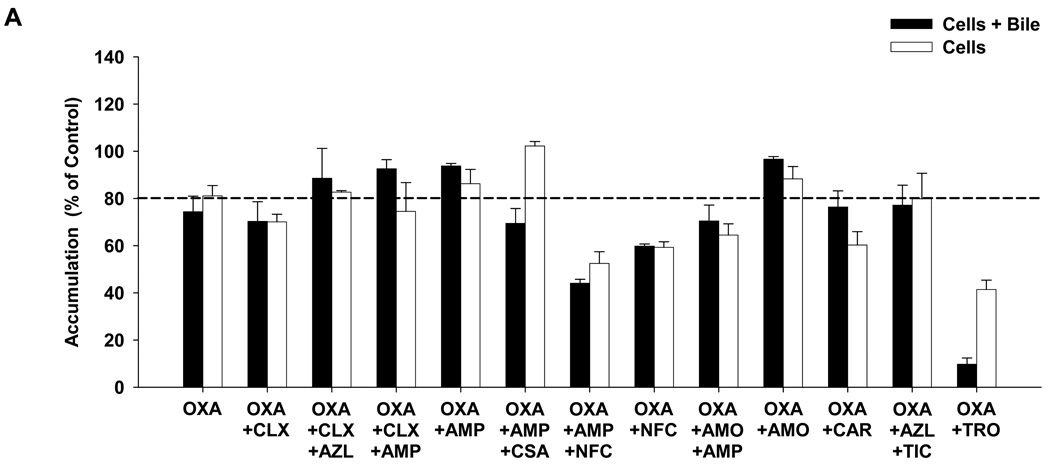
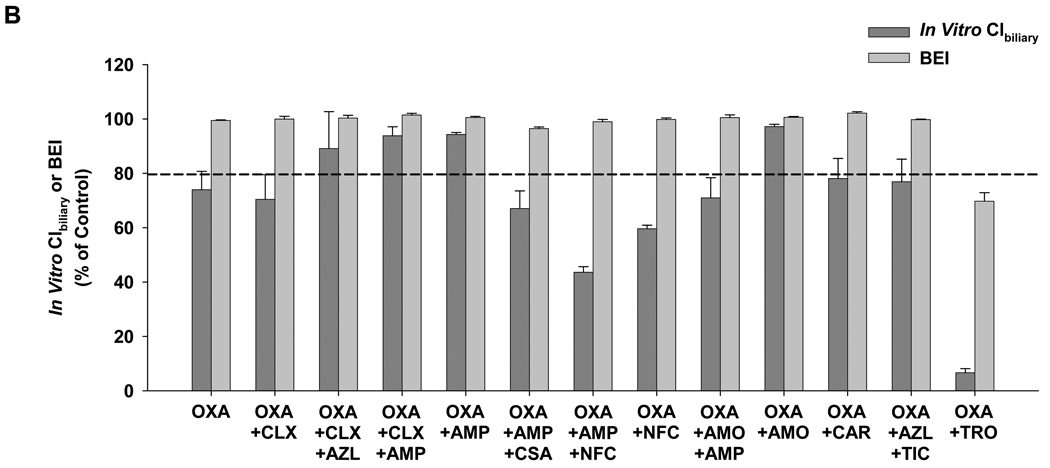
Figure 5. Effect of oxacillin-containing cassettes on the hepatobiliary disposition of taurocholate in rat SCH
Rat SCH were incubated with oxacillin (OXA) alone or in cassette with cloxacillin (CLX), azlocillin (AZL), ampicillin (AMP), cyclosporin A (CSA), nafcillin (NFC), carbenicillin (CAR), amoxicillin (AMO), ticarcillin (TIC), and/or troglitazone (TRO) in either standard or Ca2+-free buffer for 10 min, followed by an additional 10-min incubation with [3H]-taurocholate (1 µM) and the drug(s) of interest. (A) Taurocholate accumulation. Solid bars represent accumulation in hepatocytes and bile canaliculi (cells+bile). Open bars represent accumulation in hepatocytes (cells). (B) BEI and in vitro Clbiliary were calculated as described in Materials and Methods. Data are presented as mean ± ½ of the range for n=2 livers in duplicate. Data for treatment with oxacillin alone also were presented in Table 3 and serve as a reference in this figure.
Figure 5
Figure 5. Effect of oxacillin-containing cassettes on the hepatobiliary disposition of taurocholate in rat SCH
Rat SCH were incubated with oxacillin (OXA) alone or in cassette with cloxacillin (CLX), azlocillin (AZL), ampicillin (AMP), cyclosporin A (CSA), nafcillin (NFC), carbenicillin (CAR), amoxicillin (AMO), ticarcillin (TIC), and/or troglitazone (TRO) in either standard or Ca2+-free buffer for 10 min, followed by an additional 10-min incubation with [3H]-taurocholate (1 µM) and the drug(s) of interest. (A) Taurocholate accumulation. Solid bars represent accumulation in hepatocytes and bile canaliculi (cells+bile). Open bars represent accumulation in hepatocytes (cells). (B) BEI and in vitro Clbiliary were calculated as described in Materials and Methods. Data are presented as mean ± ½ of the range for n=2 livers in duplicate. Data for treatment with oxacillin alone also were presented in Table 3 and serve as a reference in this figure.
Figure 6
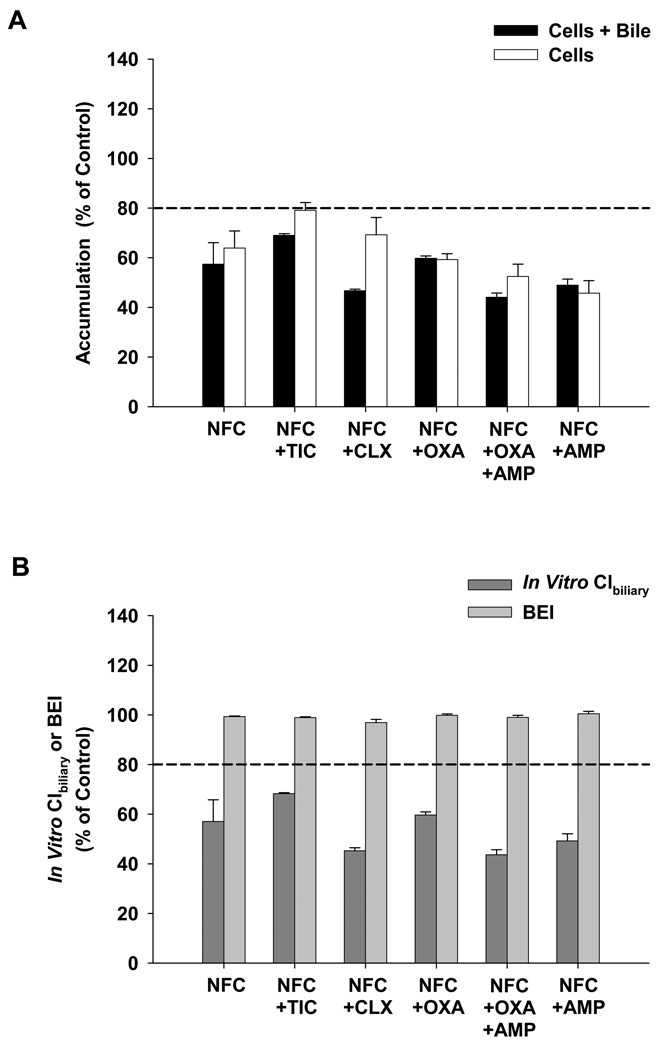
Figure 6. Effect of nafcillin-containing cassettes on the hepatobiliary disposition of taurocholate in rat SCH
Rat SCH were incubated with nafcillin (NFC) alone or in cassette with ticarcillin (TIC), cloxacillin (CLX), oxacillin (OXA), and/or ampicillin (AMP) in either standard or Ca2+-free buffer for 10 min, followed by an additional 10-min incubation with [3H]-taurocholate (1 µM) and the drug(s) of interest. (A) Taurocholate accumulation. Solid bars represent accumulation in hepatocytes and bile canaliculi (cells+bile). Open bars represent accumulation in hepatocytes (cells). (B) BEI and in vitro Clbiliary were calculated as described in Materials and Methods. Data are presented as mean ± ½ of the range for n=2 livers in duplicate. Data for treatment with nafcillin alone also were presented in Table 3 and serve as a reference in this figure. Data for treatment of nafcillin in cassette with oxacillin with or without ampicillin also were presented in Figure 4 for comparison to treatment with oxacillin alone.
Figure 7
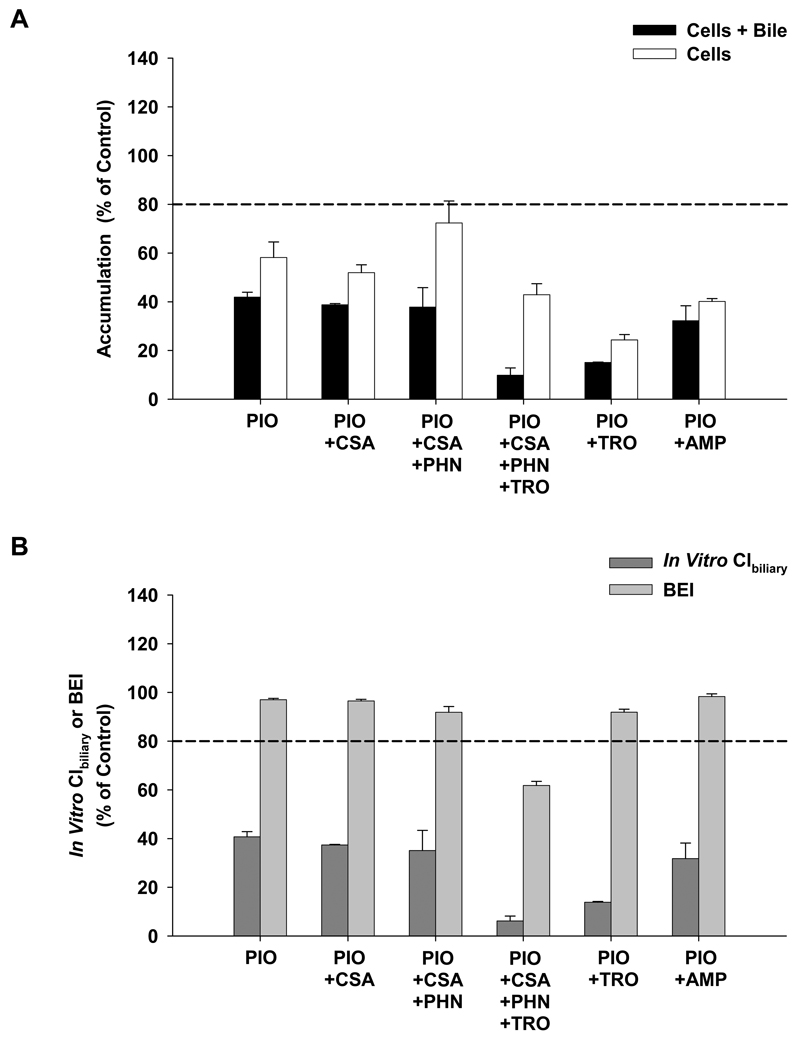
Figure 7. Effect of pioglitazone-containing cassettes on the hepatobiliary disposition of taurocholate in rat SCH
Rat SCH were incubated with pioglitazone (PIO) alone or in cassette with cyclosporin A (CSA), phenytoin (PHN), troglitazone (TRO), and/or ampicillin (AMP) in either standard or Ca2+-free buffer for 10 min, followed by an additional 10-min incubation with [3H]-taurocholate (1 µM) and the drug(s) of interest. (A) Taurocholate accumulation. Solid bars represent accumulation in hepatocytes and bile canaliculi (cells+bile). Open bars represent accumulation in hepatocytes (cells). (B) BEI and in vitro Clbiliary were calculated as described in Materials and Methods. Data are presented as mean ± ½ of the range for n=2 livers in duplicate. Data for treatment with pioglitazone alone also were presented in Table 3 and serve as a reference in this figure.
Figure 8
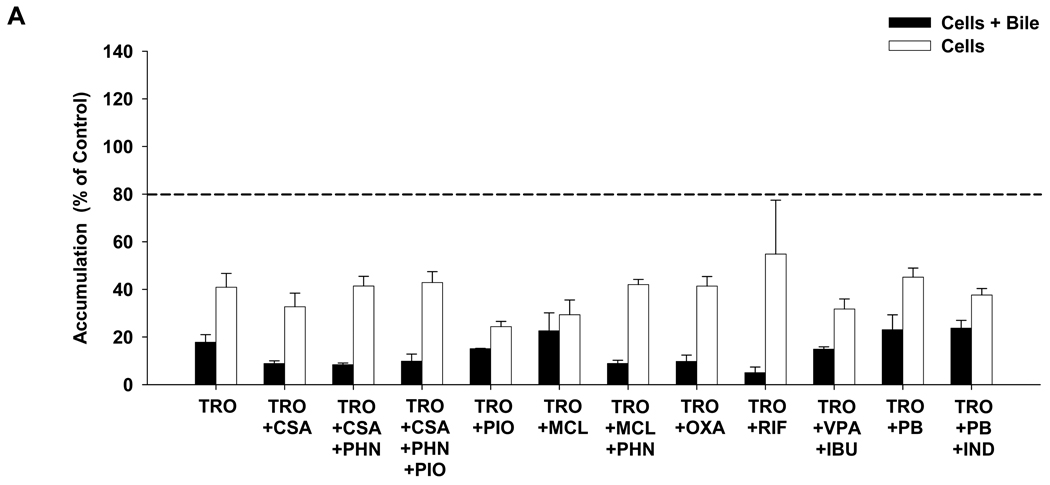
Figure 8. Effect of troglitazone-containing cassettes on the hepatobiliary disposition of taurocholate in rat SCH
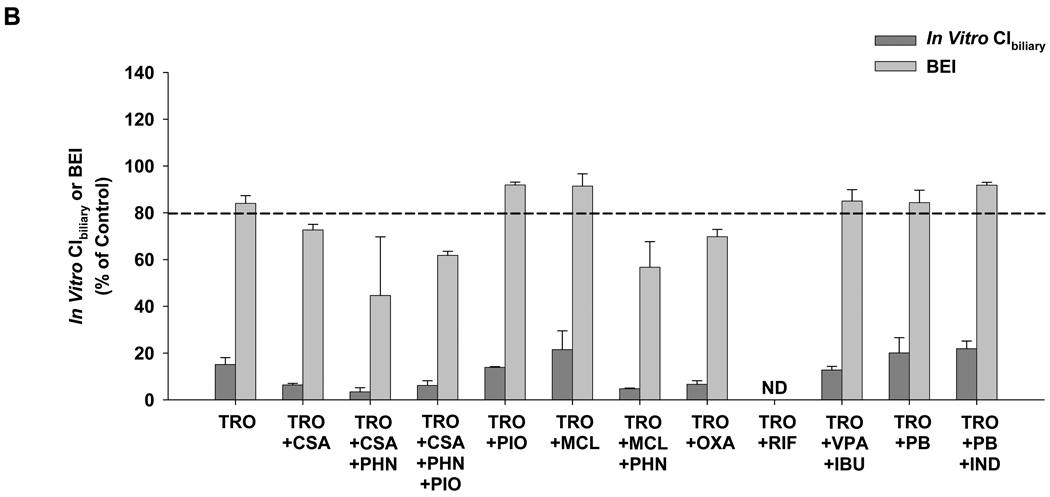
Rat SCH were incubated with troglitazone (TRO) alone or in cassette with cyclosporin A (CSA), phenytoin (PHN), pioglitazone (PIO), minocycline (MCL), oxacillin (OXA), rifampin (RIF), valproic acid (VPA), ibuprofen (IBU), phenobarbital (PB), and/or indomethacin (IND) in either standard or Ca2+-free buffer for 10 min, followed by an additional 10-min incubation with [3H]-taurocholate (1 µM) and the drug(s) of interest. (A) Taurocholate accumulation. Solid bars represent accumulation in hepatocytes and bile canaliculi (cells+bile). Open bars represent accumulation in hepatocytes (cells). (B) BEI and in vitro Clbiliary were calculated as described in Materials and Methods. Data are presented as mean ± ½ of the range for n=2 livers in duplicate, except for troglitazone (mean ± SD for n=3 livers in duplicate). Data for treatment with troglitazone alone also were presented in Table 3 and serve as a reference in this figure. Data for treatment of troglitazone in cassette with phenobarbital with or without indomethacin also were presented in Figure 3 for comparison to treatment with phenobarbital alone. Data for treatment of troglitazone in cassette with oxacillin also were presented in Figure 4 for comparison to treatment with oxacillin alone. Data for treatment of troglitazone in cassette with cyclosporin A, phenytoin, and/or pioglitazone also were presented in Figure 6 for comparison to treatment with pioglitazone alone.
Figure 8
Figure 8. Effect of troglitazone-containing cassettes on the hepatobiliary disposition of taurocholate in rat SCH
Rat SCH were incubated with troglitazone (TRO) alone or in cassette with cyclosporin A (CSA), phenytoin (PHN), pioglitazone (PIO), minocycline (MCL), oxacillin (OXA), rifampin (RIF), valproic acid (VPA), ibuprofen (IBU), phenobarbital (PB), and/or indomethacin (IND) in either standard or Ca2+-free buffer for 10 min, followed by an additional 10-min incubation with [3H]-taurocholate (1 µM) and the drug(s) of interest. (A) Taurocholate accumulation. Solid bars represent accumulation in hepatocytes and bile canaliculi (cells+bile). Open bars represent accumulation in hepatocytes (cells). (B) BEI and in vitro Clbiliary were calculated as described in Materials and Methods. Data are presented as mean ± ½ of the range for n=2 livers in duplicate, except for troglitazone (mean ± SD for n=3 livers in duplicate). Data for treatment with troglitazone alone also were presented in Table 3 and serve as a reference in this figure. Data for treatment of troglitazone in cassette with phenobarbital with or without indomethacin also were presented in Figure 3 for comparison to treatment with phenobarbital alone. Data for treatment of troglitazone in cassette with oxacillin also were presented in Figure 4 for comparison to treatment with oxacillin alone. Data for treatment of troglitazone in cassette with cyclosporin A, phenytoin, and/or pioglitazone also were presented in Figure 6 for comparison to treatment with pioglitazone alone.
Figure 9
Figure 9. Effect of cyclosporin A-containing cassettes on the hepatobiliary disposition of taurocholate in rat SCH
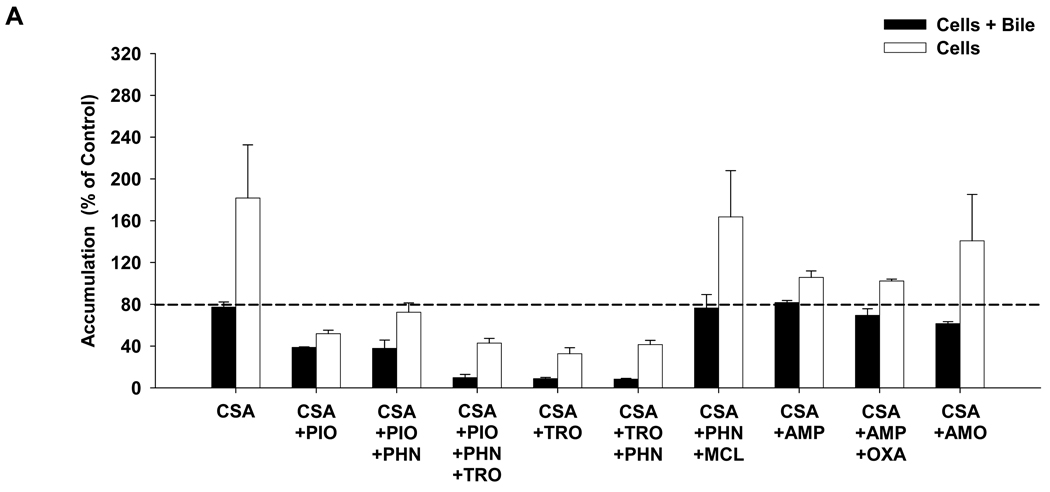
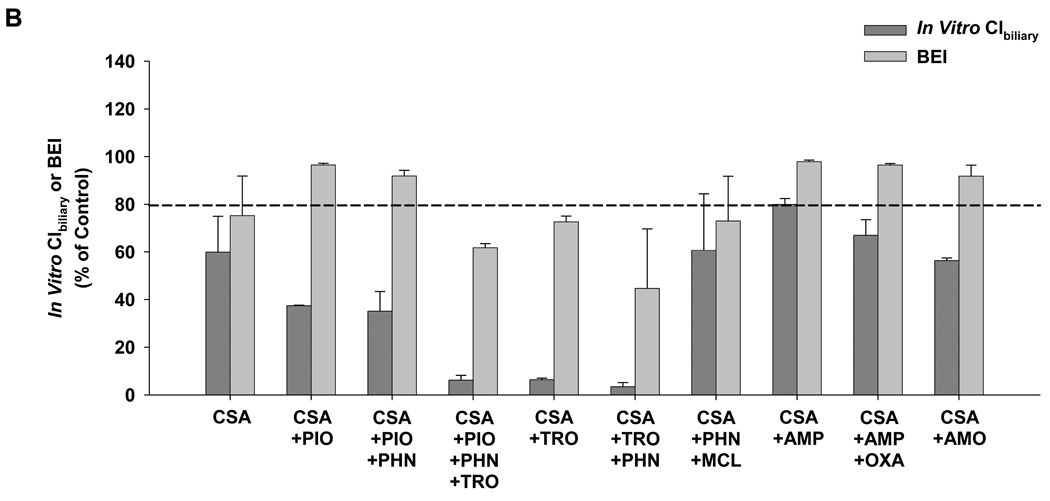
Rat SCH were incubated with cyclosporin A (CSA) alone or in cassette with pioglitazone (PIO), phenytoin (PHN), troglitazone (TRO), minocycline (MCL), ampicillin (AMP), oxacillin (OXA), and/or amoxicillin (AMO) in either standard or Ca2+-free buffer for 10 min, followed by an additional 10-min incubation with [3H]-taurocholate (1 µM) and the drug(s) of interest. (A) Taurocholate accumulation. Solid bars represent accumulation in hepatocytes and bile canaliculi (cells+bile). Open bars represent accumulation in hepatocytes (cells). (B) BEI and in vitro Clbiliary were calculated as described in Materials and Methods. Data are presented as mean ± ½ of the range for n=2 livers in duplicate, except for cyclosporin A (mean ± SD for n=3 livers in duplicate). Data for treatment with cyclosporin A alone also were presented in Table 3 and serve as a reference in this figure. Data for treatment of cyclosporin A in cassette with oxacillin and ampicillin also were presented in Figure 4 for comparison to treatment with oxacillin alone. Data for treatment of cyclosporin A in cassette with pioglitazone, phenytoin, and/or troglitazone also were presented in Figure 6 and Figure 7 for comparison to treatment with pioglitazone or troglitazone alone, respectively.
Figure 9
Figure 9. Effect of cyclosporin A-containing cassettes on the hepatobiliary disposition of taurocholate in rat SCH
Rat SCH were incubated with cyclosporin A (CSA) alone or in cassette with pioglitazone (PIO), phenytoin (PHN), troglitazone (TRO), minocycline (MCL), ampicillin (AMP), oxacillin (OXA), and/or amoxicillin (AMO) in either standard or Ca2+-free buffer for 10 min, followed by an additional 10-min incubation with [3H]-taurocholate (1 µM) and the drug(s) of interest. (A) Taurocholate accumulation. Solid bars represent accumulation in hepatocytes and bile canaliculi (cells+bile). Open bars represent accumulation in hepatocytes (cells). (B) BEI and in vitro Clbiliary were calculated as described in Materials and Methods. Data are presented as mean ± ½ of the range for n=2 livers in duplicate, except for cyclosporin A (mean ± SD for n=3 livers in duplicate). Data for treatment with cyclosporin A alone also were presented in Table 3 and serve as a reference in this figure. Data for treatment of cyclosporin A in cassette with oxacillin and ampicillin also were presented in Figure 4 for comparison to treatment with oxacillin alone. Data for treatment of cyclosporin A in cassette with pioglitazone, phenytoin, and/or troglitazone also were presented in Figure 6 and Figure 7 for comparison to treatment with pioglitazone or troglitazone alone, respectively.
Figure 10
Figure 10. Effect of hepatotoxic compounds on the hepatobiliary disposition of taurocholate in human SCH
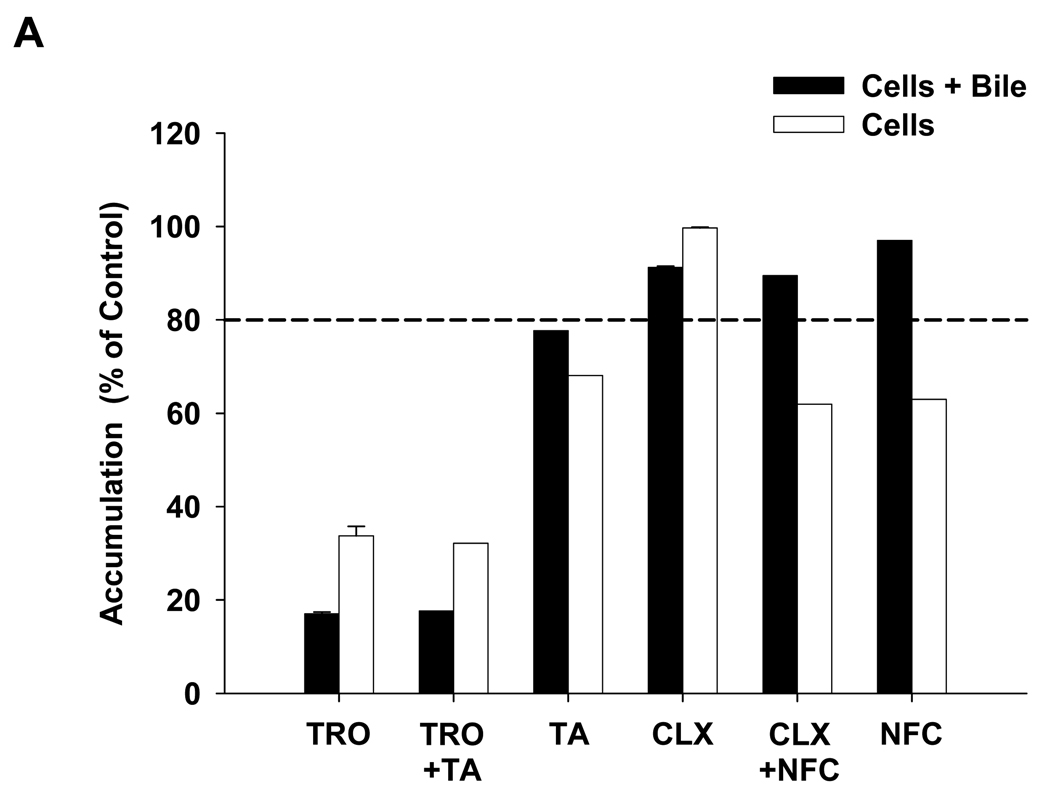
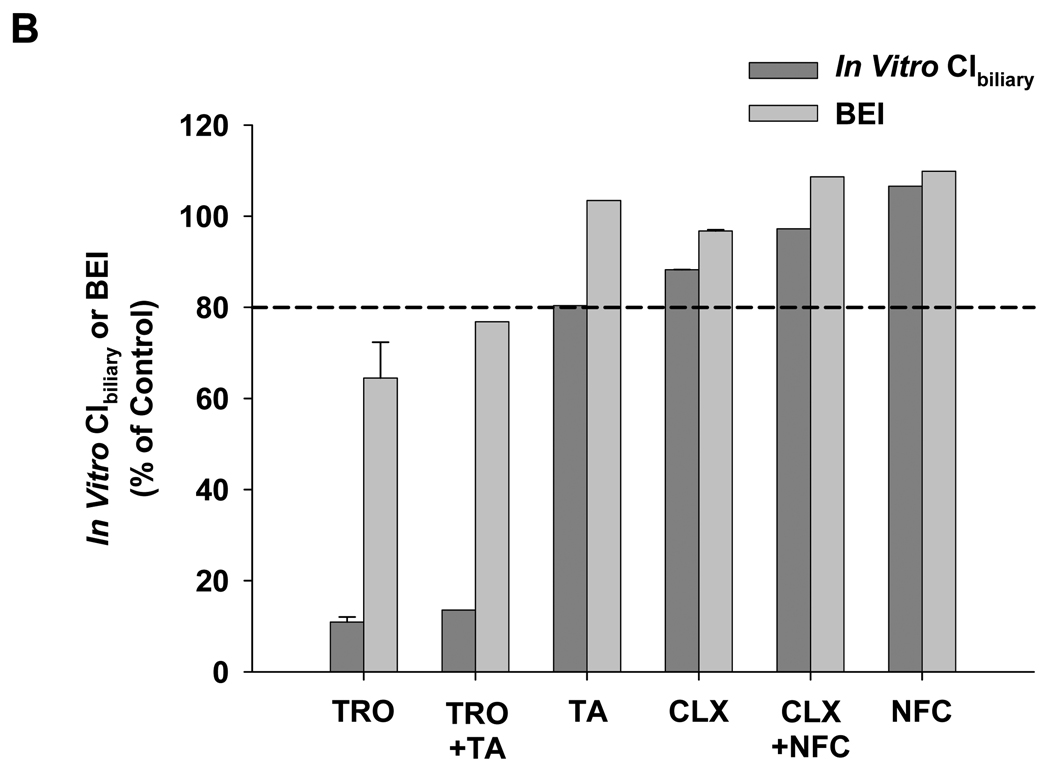
Human SCH were incubated with [3H]-taurocholate and the hepatotoxic compound(s) of interest for 10 min following a 10-min incubation in standard or Ca2+-free buffer containing the same hepatotoxic compound(s). (A) Taurocholate accumulation. Solid bars represent accumulation in hepatocytes and bile canaliculi (cells+bile). Open bars represent accumulation in hepatocytes (cells). (B) BEI and in vitro Clbiliary were calculated as described in Materials and Methods. Data are presented as the mean for n=1 liver in duplicate, except for troglitazone and cloxacillin (mean ± ½ of the range for n=2 livers in duplicate). TRO, troglitazone; TA, tienilic acid (3.00 µM); CLX, cloxacillin; NFC, nafcillin. Data for treatment with troglitazone, cloxacillin, and nafcillin alone also were presented in Table 3 and serve as a reference in this figure.
Figure 10
Figure 10. Effect of hepatotoxic compounds on the hepatobiliary disposition of taurocholate in human SCH
Human SCH were incubated with [3H]-taurocholate and the hepatotoxic compound(s) of interest for 10 min following a 10-min incubation in standard or Ca2+-free buffer containing the same hepatotoxic compound(s). (A) Taurocholate accumulation. Solid bars represent accumulation in hepatocytes and bile canaliculi (cells+bile). Open bars represent accumulation in hepatocytes (cells). (B) BEI and in vitro Clbiliary were calculated as described in Materials and Methods. Data are presented as the mean for n=1 liver in duplicate, except for troglitazone and cloxacillin (mean ± ½ of the range for n=2 livers in duplicate). TRO, troglitazone; TA, tienilic acid (3.00 µM); CLX, cloxacillin; NFC, nafcillin. Data for treatment with troglitazone, cloxacillin, and nafcillin alone also were presented in Table 3 and serve as a reference in this figure.

References

    1. Bakke OM, Manocchia M, de Abajo F, Kaitin KI, Lasagna L. Drug safety discontinuations in the United Kingdom, the United States, and Spain from 1974 through 1993: a regulatory perspective. Clinical Pharmacology and Therapeutics. 1995;58:108–117. - PubMed
    1. Bénichou C. Criteria of drug-induced liver disorders. Report of an international consensus meeting. Journal of Hepatology. 1990;11:272–276. - PubMed
    1. Crocenzi FA, Sisti A, Pellegrino JM, Roma MG. Role of bile salts in colchicine-induced hepatotoxicity. Implications for hepatocellular integrity and function. Toxicology. 1997;121:127–142. - PubMed
    1. Davies B, Morris T. Physiological parameters in laboratory animals and humans. Pharmaceutical Research. 1993;10:1093–1095. - PubMed
    1. EMEA. Non-clinical guideline on drug-induced hepatotoxicity. 2008 Available at: http://www.emea.europa.eu/pdfs/human/swp/15011506en.pdf.

Publication types

MeSH terms