. 2009 Sep 8;106(36):15507-12.
doi: 10.1073/pnas.0903752106. Epub 2009 Aug 24.

Altered Na+ transport after an intracellular alpha-subunit deletion reveals strict external sequential release of Na+ from the Na/K pump

Affiliations

Altered Na+ transport after an intracellular alpha-subunit deletion reveals strict external sequential release of Na+ from the Na/K pump

Siddhartha Yaragatupalli et al. Proc Natl Acad Sci U S A. .

Abstract

The Na/K pump actively exports 3 Na(+) in exchange for 2 K(+) across the plasmalemma of animal cells. As in other P-type ATPases, pump function is more effective when the relative affinity for transported ions is altered as the ion binding sites alternate between opposite sides of the membrane. Deletion of the five C-terminal residues from the alpha-subunit diminishes internal Na(+) (Na(i)(+)) affinity approximately 25-fold [Morth et al. (2007) Nature 450:1043-1049]. Because external Na(+) (Na(o)(+)) binding is voltage-dependent, we studied the reactions involving this process by using two-electrode and inside-out patch voltage clamp in normal and truncated (DeltaKESYY) Xenopus-alpha1 pumps expressed in oocytes. We observed that DeltaKESYY (i) decreased both Na(o)(+) and Na(i)(+) apparent affinities in the absence of K(o)(+), and (ii) did not affect apparent Na(o)(+) affinity at high K(o)(+). These results support a model of strict sequential external release of Na(+) ions, where the Na(+)-exclusive site releases Na(+) before the sites shared with K(+) and the DeltaKESYY deletion only reduces Na(o)(+) affinity at the shared sites. Moreover, at nonsaturating K(o)(+), DeltaKESYY induced an inward flow of Na(+) through Na/K pumps at negative potentials. Guanidinium(+) can also permeate truncated pumps, whereas N-methyl-D-glucamine cannot. Because guanidinium(o)(+) can also traverse normal Na/K pumps in the absence of both Na(o)(+) and K(o)(+) and can also inhibit Na/K pump currents in a Na(+)-like voltage-dependent manner, we conclude that the normal pathway transited by the first externally released Na(+) is large enough to accommodate guanidinium(+).


Conflict of interest statement

The authors declare no conflict of interest.

Figures
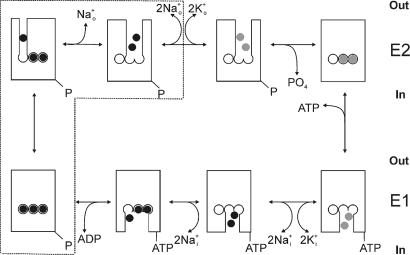
Fig. 1.
Fig. 1.
Albers-Post kinetic scheme of the Na/K pump shown superimposed with a cartoon representation of transitions involving binding and release of ions. Na+ ions (black), K+ ions (gray). The box encloses states involved in Na+-dependent charge movement.
Fig. 2.
Fig. 2.
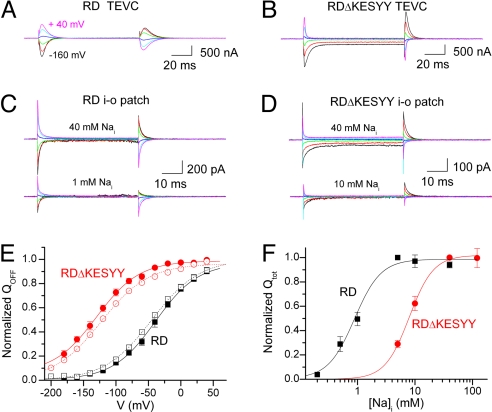
Transient charge movement in the presence of Nao+ and absence of Ko+. (A and B) Ouabain-sensitive (10 mM) currents were measured in 125 mM Na+ solution via TEVC from Na+-loaded oocytes injected with RD-α1 cRNA (A) and RDΔKESYY-α1 cRNA (B) two days postinjection. Currents elicited by 100-ms pulses from Vh = −50 mV to voltages ranging from −160 mV to +40 mV in 40-mV increments. Endogenous pumps were inhibited by preincubation with 10 μM ouabain (see Methods). The speed of the clamp was slower (τ = 340 μs) for the experiment in A than for that in B (τ = 150 μs). (C and D) Nai+-induced currents were measured in giant inside-out patches. All measurements were performed in presence of 4 mM MgATP at 4–6 days postinjection with either RD-α1 cRNA (C) or RDΔKESYY-α1 cRNA (D). The 125 mM Nao+ (intrapipette) solution contained 1 μM ouabain to inhibit endogenous pumps. Traces are the difference between currents observed in the absence and presence of the indicated [Nai+]. (E) Voltage dependence of normalized QOFF from ouabain-sensitive currents in TEVC or 40 mM Nai+-induced currents in patches. Data from whole oocytes injected with RD (n = 6) (black open squares) or RDΔKESYY (n = 8) (red open circles) were fitted to a Boltzmann distribution (dotted lines). RD parameters were: V1/2 = −39 mV, kB = 33 mV, with a Qtot = 8.6 ± 1.7 nC and I3K,NMG = 135 ± 24 nA (i.e., current activated by 3 mM K in NMG). RDΔKESYY parameters were: V1/2 = −130 mV, kB = 33 mV, with a Qtot = 14.8 ± 2.6 nC and I3K,NMG = 195 ± 30 nA. Data from inside-out patches from oocytes expressing RD (black filled squares; n = 8) or RDΔKESYY (red filled circles; n = 7) pumps were also fitted to Boltzmann distribution (solid lines). RD parameters were: V1/2 = −41 mV, kB = 32 mV, with a Qtot = 491 ± 136 fC. RDΔKESYY parameters were: V1/2 = −135 mV and kB = 33 ± 2 mV, with a Qtot = 442 ± 70 fC. (F) Qtot was calculated from the Boltzmann fit to the Q–V curves at different Nai+, normalized to the value at 5 mM Nai+ (RD), or 40 mM (RDΔKESYY), and plotted as a function of [Nai+]. Data were fitted to the Hill equation with parameters in Results.
Fig. 3.
Fig. 3.
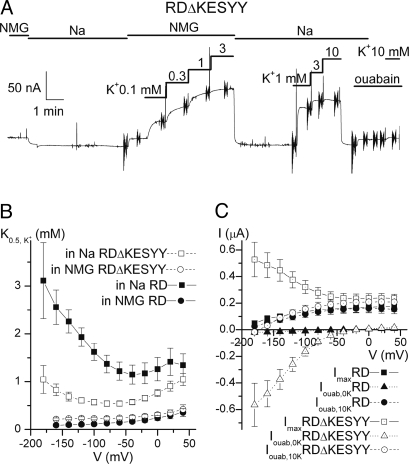
Steady-state Na/K pump-related currents. (A) Continuous TEVC trace from a Na+-loaded oocyte (Vh = −50 mV, 3 days postinjection) expressing RDΔKESYY. Increasing [Ko+] induced an outward current, both in the presence and absence of 125 mM Nao+ (replaced with 125 mM NMGo+). Vertical deflections correspond to 50-ms square voltage pulses, where the average current during the last 5 ms was measured. Ko+-induced currents (i.e., difference between Ko+ and no Ko+) at each voltage were plotted as a function of [Ko+] and fitted with a Hill equation to obtain K0.5app values. (B) K0.5 vs. voltage curves from RD injected oocytes in NMGo+ (filled circles) and Nao+ (filled squares), and from RDΔKESYY injected ooctyes in NMGo+ (open circles) and Nao+ (open squares). The Hill coefficients for the fits were: RD nH = 1.2 ± 0.2 in NMGo+, nH = 1.4 ± 0.1 in Nao+; RDΔKESYY, nH = 1.2 ± 0.04 in NMGo+, nH = 1.5 ± 0.1 in Nao+. (C) Current-voltage relationships measured in 125 mM Nao+. Normalized maximum Ko+-induced current from Hill fits (Imax, squares), together with ouabain-sensitive currents at 10 mM Ko+ (Iouab,10K, circles) and 0 mM Ko+ (Iouab,0K, triangles) are shown from oocytes injected with RD (filled symbols) and RDΔKESYY pumps (open symbols). In all cases endogenous pumps were inhibited by application of 10 μM ouabain in the Na+-loading solution (see Methods).
Fig. 4.
Fig. 4.
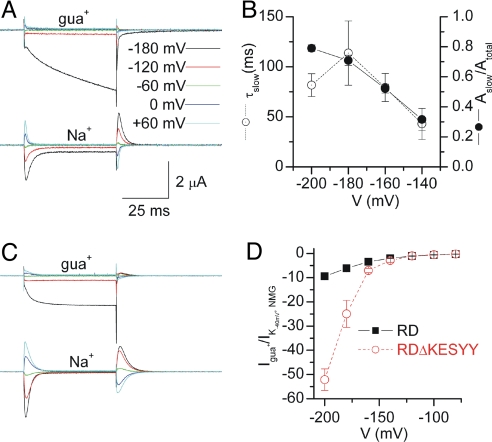
Ouabain-sensitive guanidinium+-dependent currents. (A) Ouabain-sensitive currents elicited by indicated voltage pulses, from Vh = −50 mV. TEVC traces are from an oocyte injected with RDΔKESYY in 120 mM guao+ (Upper) or 120 mM Nao+ (Lower). (B) Voltage dependence of the relative amplitude (filled circles) and τ (open circles) of the slow component from biexponential fits to the traces in 120 mM guao+. (C) Same as in A but from an RD-injected oocyte. (D) Steady-state current (normalized to the 3 mM Ko+-induced current at −50 mV in NMGo+) measured from RD (filled black squares) and RDΔKESYY (open red circles, estimated from biexponential fits) expressing oocytes in 120 mM guao+.
Fig. 5.
Fig. 5.
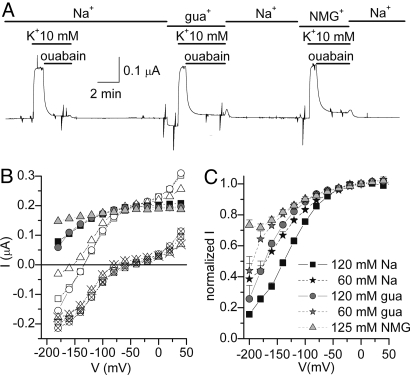
Voltage-dependent inhibition of Na/K pump current by guanidiniumo+ in RD pumps. (A) Continuous TEVC trace from a Na+-loaded oocyte at Vh = −50 mV. Ko+-induced outward currents and ouabain inhibited Na/K pump current. To prevent Nai+ depletion because of diffusion, the long recovery following pump inhibition was made in Nao+ solution. (B) Steady-state I–V relationships obtained in 10 mM Ko+, in the absence (open symbols) or presence (open crossed symbols) of 10 mM ouabain with either 120 mM Nao+ solution (squares), 120 mM guao+ solution (circles), or 125 mM NMGo+ (triangles). The ouabain-sensitive currents are presented as filled symbols. (C) IP (ouabain-sensitive currents in 10 mM Ko+) vs. voltage plot, normalized to the current observed at 0 mV with five different external ionic conditions: 120 mM Nao+ (black squares), 120 mM guao+ (gray circles), 60 mM Nao+ (black stars), 60 mM guao+ (gray stars), and 125 mM NMG (light gray triangles).

References

    1. Post RL, Sen AK, Rosenthal AS. A phosphorylated intermediate in adenosine triphosphate-dependent sodium and potassium transport across kidney membranes. J Biol Chem. 1965;240:1437–1445. - PubMed
    1. Albers RW. Biochemical aspects of active transport. Annu Rev Biochem. 1967;36:727–756. - PubMed
    1. Morth JP, et al. Crystal structure of the sodium-potassium pump. Nature. 2007;450:1043–1049. - PubMed
    1. Geering K, et al. FXYD proteins: New tissue- and isoform-specific regulators of Na,K-ATPase. Ann NY Acad Sci. 2003;986:388–394. - PubMed
    1. Ogawa H, Toyoshima Cn. Homology modeling of the cation binding sites of Na+K+-ATPase. Proc Natl Acad Sci USA. 2002;99:15977–15982. - PMC - PubMed

Publication types