. 2009 Sep 22;106(38):16057-62.
doi: 10.1073/pnas.0903341106. Epub 2009 Aug 17.

Out of Africa: modern human origins special feature: explaining worldwide patterns of human genetic variation using a coalescent-based serial founder model of migration outward from Africa

Affiliations

Out of Africa: modern human origins special feature: explaining worldwide patterns of human genetic variation using a coalescent-based serial founder model of migration outward from Africa

Michael DeGiorgio et al. Proc Natl Acad Sci U S A. .

Abstract

Studies of worldwide human variation have discovered three trends in summary statistics as a function of increasing geographic distance from East Africa: a decrease in heterozygosity, an increase in linkage disequilibrium (LD), and a decrease in the slope of the ancestral allele frequency spectrum. Forward simulations of unlinked loci have shown that the decline in heterozygosity can be described by a serial founder model, in which populations migrate outward from Africa through a process where each of a series of populations is formed from a subset of the previous population in the outward expansion. Here, we extend this approach by developing a retrospective coalescent-based serial founder model that incorporates linked loci. Our model both recovers the observed decline in heterozygosity with increasing distance from Africa and produces the patterns observed in LD and the ancestral allele frequency spectrum. Surprisingly, although migration between neighboring populations and limited admixture between modern and archaic humans can be accommodated in the model while continuing to explain the three trends, a competing model in which a wave of outward modern human migration expands into a series of preexisting archaic populations produces nearly opposite patterns to those observed in the data. We conclude by developing a simpler model to illustrate that the feature that permits the serial founder model but not the archaic persistence model to explain the three trends observed with increasing distance from Africa is its incorporation of a cumulative effect of genetic drift as humans colonized the world.


Conflict of interest statement

The authors declare no conflict of interest.

Figures
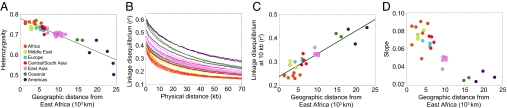
Fig. 1.
Fig. 1.
Patterns of heterozygosity, LD, and the ancestral allele frequency spectrum observed in human population-genetic data. (A) Heterozygosity as a function of distance from East Africa (redrawn from ref. as in figure 7C of ref. 32). (B) LD measured by r2 as a function of physical distance in kb (redrawn from supplemental figure 4 of ref. 16). (C) LD at 10 kb measured by r2 as a function of distance from East Africa (based on data in supplemental figure 4 of ref. 16). (D) Slope of the ancestral allele frequency spectrum in the range of 20% to 80% ancestral allele frequency as a function of distance from East Africa (modified from figure 4B of ref. using a resampling technique and the allele frequencies in Fig. S4).
Fig. 2.
Fig. 2.
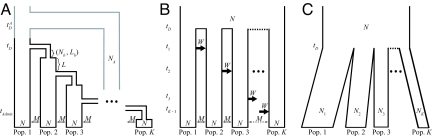
Models. (A) Serial founder model with population size N diploid individuals in each of K populations, time tD of the first divergence from the founding population, bottleneck size Nb, bottleneck length Lb, time interval L between successive bottlenecks, and symmetric migration rate M between neighboring populations. An extension of the model that allows admixture with archaic humans has additional parameters for the population size for archaic humans (NA), divergence time between modern and archaic humans (tDA), and time of admixture between a specific modern population and the archaic population (tAdmix). (B) Archaic persistence model with population size N diploid individuals in each of K populations, time tD of the divergence of archaic populations, symmetric migration rate M between neighboring populations, and migration rate W for the migration wave from population k to population k + 1 at time tk. (C) Instantaneous divergence model with population sizes Nk for populations k = 1, 2, …, K, population size N for the ancestral population, and divergence time tD.
Fig. 3.
Fig. 3.
Patterns of heterozygosity, LD, and the ancestral allele frequency spectrum in simulations of the basic serial founder model. (A) Heterozygosity as a function of colony number. (B) LD measured by r2 as a function of physical distance in kilobases. (C) LD at 10 kb measured by r2 as a function of colony number. (D) Slope of the ancestral allele frequency spectrum in the range of 20% to 80% ancestral allele frequency as a function of colony number.
Fig. 4.
Fig. 4.
Patterns of heterozygosity, LD, and the ancestral allele frequency spectrum in simulations of the serial founder model with symmetric migration at rate M = 40 between neighboring populations. All other parameters are the same as in Fig. 3.
Fig. 5.
Fig. 5.
Patterns of heterozygosity, LD, and the ancestral allele frequency spectrum in simulations of the serial founder model with archaic admixture. The model incorporates archaic admixture with an admixture fraction γ = 0.05 of population 25 deriving from the archaic population. All other parameters are the same as in Fig. 3.
Fig. 6.
Fig. 6.
Patterns of heterozygosity, LD, and the ancestral allele frequency spectrum in simulations of the archaic persistence model. (A) Heterozygosity as a function of colony number. (B) LD measured by r2 as a function of physical distance in kilobases. (C) LD at 10 kb measured by r2 as a function of colony number. (D) Slope of the ancestral allele frequency spectrum in the range of 20% to 80% ancestral allele frequency as a function of colony number.
Fig. 7.
Fig. 7.
Patterns of heterozygosity, LD, and the ancestral allele frequency spectrum in simulations of the instantaneous divergence model. (A) Heterozygosity as a function of colony number. (B) LD measured by r2 as a function of physical distance in kilobases. (C) LD at 10 kb measured by r2 as a function of colony number. (D) Slope of the ancestral allele frequency spectrum in the range of 20% to 80% ancestral allele frequency as a function of colony number.

References

    1. Wolpoff MH, Hawks J, Caspari R. Multiregional, not multiple origins. Am J Phys Anthropol. 2000;112:129–136. - PubMed
    1. Stringer C. Modern human origins: Progress and prospects. Phil Trans R Soc Lond B. 2002;357:563–579. - PMC - PubMed
    1. Cavalli-Sforza LL, Feldman MW. The application of molecular genetic approaches to the study of human evolution. Nat Genet. 2003;33:266–275. - PubMed
    1. Klein RG. Out of Africa and the evolution of human behavior. Evol Anthropol. 2008;17:267–281.
    1. Relethford JH. Genetic evidence and the modern human origins debate. Heredity. 2008;100:555–563. - PubMed

Publication types