


Do audio-guided decision aids improve outcomes? A randomized controlled trial of an audio-guided decision aid compared with a booklet decision aid for Australian women considering labour analgesia
- PMID: 19709317
- PMCID: PMC5060509
- DOI: 10.1111/j.1369-7625.2009.00553.x
Do audio-guided decision aids improve outcomes? A randomized controlled trial of an audio-guided decision aid compared with a booklet decision aid for Australian women considering labour analgesia
Abstract
Objective: To assess the effectiveness of an audio-guided component: an audio-guided decision aid vs. a stand-alone booklet decision aid.
Background: Despite extensive evaluation of decision aids in clinical settings the presentation style has not been properly assessed, and audio-guided decision aids are widely used although not supported by evidence-based research.
Design: Randomized controlled trial.
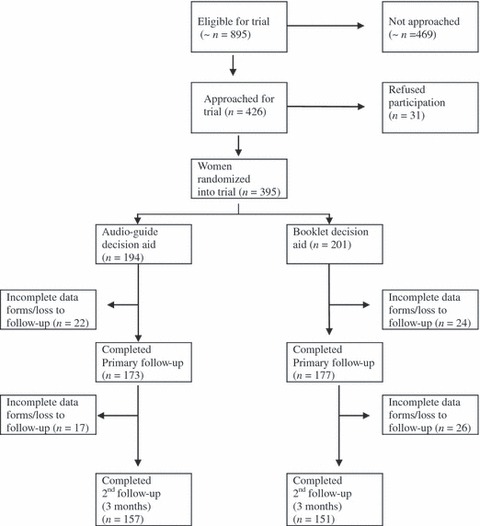
Setting and participants: Two obstetric hospitals in Sydney, Australia. A total of 395 pregnant women having their first baby and approximately > or =36 weeks of gestation, planning a vaginal birth of a single infant and with self-assessed English sufficiency to read and listen to English-presented material.
Intervention: A decision aid for labour and childbirth analgesia that was presented in two ways: an audio-guided decision aid compared with a booklet only style decision aid.
Main outcome measures: Decisional conflict, knowledge and anxiety.
Results: Although both groups improved their knowledge scores and decreased their decisional conflict there were no significant differences between groups: mean knowledge score - audio-guided group, 65.9 vs. booklet group, 64.3; mean difference, 1.7; 95% CI (-7.5, 4.2); mean decisional conflict score - audio-guided group, 23.6 vs. booklet group, 24.3; mean difference, 0.7; 95% CI (-1.4, 2.9). Acceptability and compliance were high.
Discussion and conclusions: This evaluation highlights the lack of additional benefit in using audio-guided formats for presenting health information to consumers who are from a general English-speaking population. These results considered together with the increase in costs and work involved in producing audio components suggests that written and pictorial methods may be sufficient for decision aids aimed at a general audience.
Figures
References
-
- O’Connor AM, Bennett CL, Stacey D et al. Decision aids for people facing health treatment or screening decisions. Cochrane Database of Systematic Reviews 2009, Issue 3. Art. No.: CD001431. DOI: DOI: 10.1002/14651858.CD001431. Pub 2. - DOI - PubMed
-
- Iredale R, Rapport F, Sivell S et al. Exploring the requirements for a decision aid on familial breast cancer in the UK context: a qualitative study with patients referred to a cancer genetics service. Journal of Evaluation in Clinical Practice, 2008; 14: 110–115. - PubMed
-
- Nassar N, Roberts C, Raynes‐Greenow C, Barratt A, Peat B, Decision Aid for Breech Presentation Trial Collaborators . Evaluation of a decision aid for women with breech presentation at term: a randomised controlled trial [ISRCTN14570598]. BJOG: An International Journal of Obstetrics and Gynaecology, 2007; 114: 325–333. - PMC - PubMed
-
- Trevena L, Irwig L, Barratt A. Randomized trial of a self‐administered decision aid for colorectal cancer screening. Journal of Medical Screening, 2008; 15: 76–82. - PubMed
-
- Ranta P, Spalding M, Kangas‐Saarela T et al. Maternal expectations and experiences of labour pain – options of 1091 Finnish parturients. Acta Anaesthesiologica Scandinavica, 1995; 39: 60–66. - PubMed
Publication types
MeSH terms
LinkOut - more resources
Full Text Sources
Medical
