A double-blind, randomized controlled trial of ethyl-eicosapentaenoate for major depressive disorder
- PMID: 19709502
- PMCID: PMC2918427
- DOI: 10.4088/JCP.08m04603
A double-blind, randomized controlled trial of ethyl-eicosapentaenoate for major depressive disorder
Abstract
Objective: To examine the efficacy and tolerability of ethyl-eicosapentaenoate (EPA-E) monotherapy for major depressive disorder (MDD).
Method: Fifty-seven adults with DSM-IV MDD were randomly assigned from January 2003 until June 2006 to receive 1 g/d of eicosapentaenoic acid (EPA) or placebo for 8 weeks in a double-blind, randomized, controlled pilot study. Response criteria were on the basis of the 17-item Hamilton Depression Rating Scale (HDRS-17). Subjects' plasma lipid profiles were examined by gas chromatography.
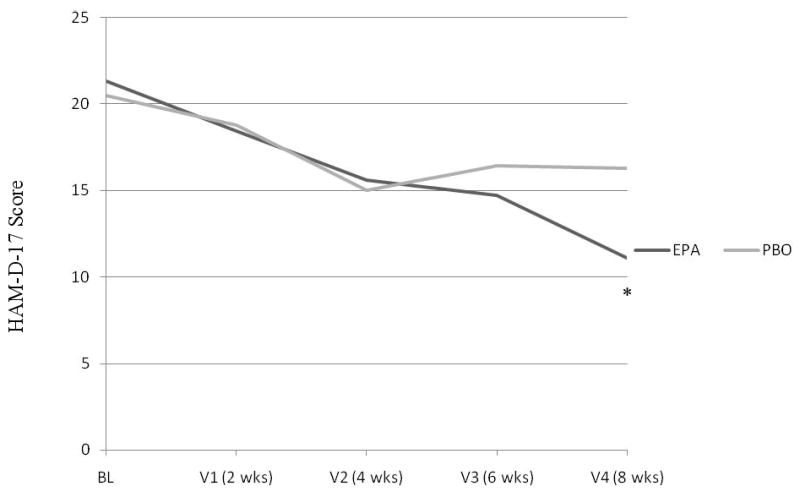
Results: Thirty-five subjects (63% female; mean +/- SD age = 45 +/- 13 years) were eligible for the intent-to-treat (ITT) analysis. In the ITT sample, mean +/- SD HDRS-17 scores decreased from 21.6 +/- 2.7 to 13.9 +/- 8.9 for the EPA group (n = 16) and from 20.5 +/- 3.6 to 17.5 +/- 7.5 for the placebo group (n = 19) (P = .123); the effect size for EPA was 0.55. ITT response rates were 38% (6/16) for EPA, and 21% (4/19) for placebo (P = .45). Among the 24 study completers, mean +/- SD HDRS-17 scores decreased from 21.3 +/- 3.0 to 11.1 +/- 8.1 for the EPA group and from 20.5 +/- 3.8 to 16.3 +/- 6.9 for the placebo group (P = .087); the effect size for EPA was 0.73. Completer response rates were 45% (5/11) for EPA, and 23% (3/13) for placebo (P = .39). Among EPA subjects, baseline n-6/n-3 ratio was associated with decrease in HDRS-17 score (r = -0.686, P = .030) and with treatment response (P = .032); change in n-6/n-3 ratio was associated with change in HDRS-17 score (r = .784, P = .032). Side effects, reported in 2 EPA subjects and 5 placebo subjects, were exclusively gastrointestinal, mild, and not associated with discontinuation.
Conclusions: EPA demonstrated an advantage over placebo that did not reach statistical significance, possibly due to the small sample and low completer rates, which were the major study limitations.
Trial registration: clinicaltrials.gov Identifier: NCT00096798.
Copyright 2009 Physicians Postgraduate Press, Inc.
Conflict of interest statement
All other authors declare that they have no conflicts of interest.
Figures

Comment in
-
The impact of omega-3 fatty acids on depressive disorders and suicidality: can we reconcile 2 studies with seemingly contradictory results?J Clin Psychiatry. 2011 Dec;72(12):1574-6. doi: 10.4088/JCP.11com07463. J Clin Psychiatry. 2011. PMID: 22244020 Free PMC article. No abstract available.
References
-
- Cross- National Collaborative Group. The changing rate of major depression: cross national comparisons. JAMA. 1992;268:3098–3105. - PubMed
-
- Hibbeln JR, Salem N. Dietary polyunsaturated fatty acids and depression: when cholesterol does not satisfy. Am J Clin Nutr. 1995;62:1–9. - PubMed
-
- Adams PB, Lawson S, Sanigorski A, Sinclair AJ. Arachidonic acid to eicosapentaenoic acid ration in blood correlates positively with clinical symptoms of depression. Lipids. 1996;31:157–161. - PubMed
-
- Hibbeln JR. Fish consumption and major depression. Lancet. 1998;351:1213. Letter. - PubMed
-
- Hibbeln JR. Long-chain polyunsaturated fatty acids in depression and related conditions. In: Peet M, Glen I, Horrobin DF, editors. Phospholipid Spectrum Disorder in Psychiatry. Marius Press; Carnforth, England: pp. 195–210.
Publication types
MeSH terms
Substances
Associated data
Grants and funding
LinkOut - more resources
Full Text Sources
Other Literature Sources
Medical
Research Materials