


Human immunodeficiency virus type 1 envelope gp120-induced partial T-cell receptor signaling creates an F-actin-depleted zone in the virological synapse
- PMID: 19710135
- PMCID: PMC2772796
- DOI: 10.1128/JVI.01440-09
Human immunodeficiency virus type 1 envelope gp120-induced partial T-cell receptor signaling creates an F-actin-depleted zone in the virological synapse
Abstract
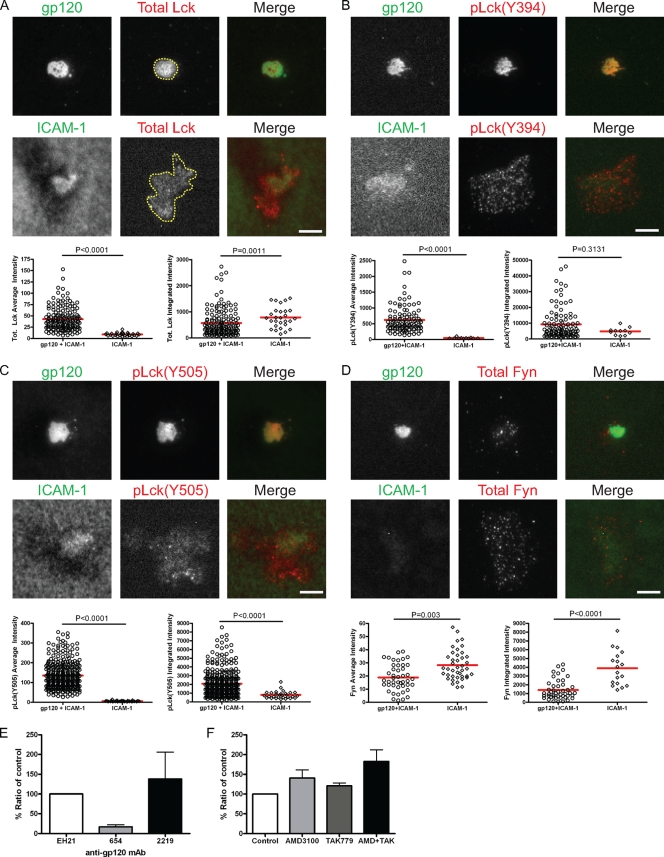
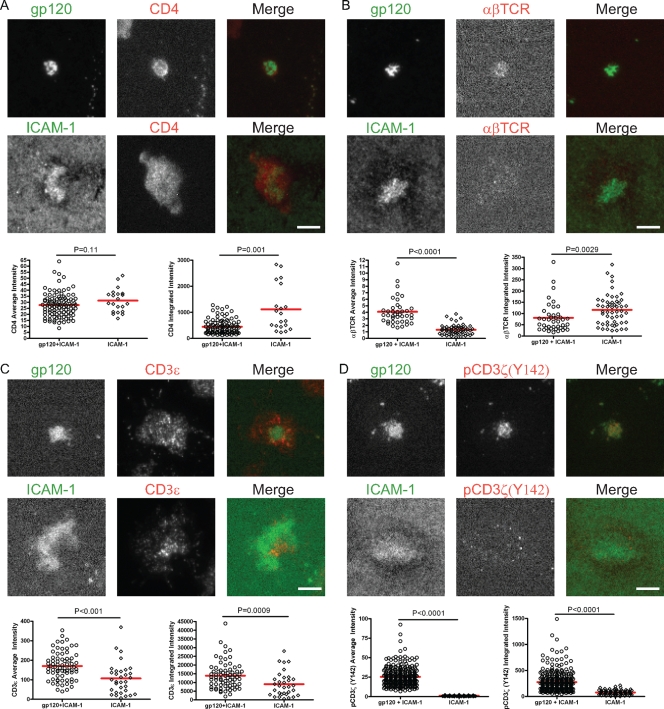
Cell-to-cell transmission of human immunodeficiency virus type 1 (HIV-1) occurs via a virological synapse (VS), a tight cell-cell junction formed between HIV-infected cells and target cells in which the HIV-1-infected cell polarizes and releases virions toward the noninfected target cell in a gp120- and intercellular adhesion molecule 1 (ICAM-1)-dependent process. The response of the target cell has been less studied. We utilized supported planar bilayers presenting gp120 and ICAM-1 as a reductionist model for the infected-cell membrane and investigated its effect on the target CD4 T cell. This study shows that HIV-1 gp120 interaction with its receptors is initially organized into microclusters that undergo F-actin-dependent consolidation into a central supramolecular activation complex (cSMAC). Src kinases are active in both gp120 microclusters and in the VS cSMAC. The early T-cell receptor (TCR) signaling machinery is partially activated at the VS, and signaling does not propagate to trigger Ca(2+) elevation or increase CD69 expression. However, these partial TCR signals act locally to create an F-actin-depleted zone. We propose a model in which the F-actin-depleted zone formed within the target CD4 T cell enhances the reception of virions by releasing the physical barrier for HIV-1 entry and facilitating postentry events.
Figures




References
-
- Arthos, J., C. Cicala, E. Martinelli, K. Macleod, D. Van Ryk, D. Wei, Z. Xiao, T. D. Veenstra, T. P. Conrad, R. A. Lempicki, S. McLaughlin, M. Pascuccio, R. Gopaul, J. McNally, C. C. Cruz, N. Censoplano, E. Chung, K. N. Reitano, S. Kottilil, D. J. Goode, and A. S. Fauci. 2008. HIV-1 envelope protein binds to and signals through integrin alpha4beta7, the gut mucosal homing receptor for peripheral T cells. Nat. Immunol. 9:301-309. - PubMed
-
- Barda-Saad, M., A. Braiman, R. Titerence, S. C. Bunnell, V. A. Barr, and L. E. Samelson. 2005. Dynamic molecular interactions linking the T cell antigen receptor to the actin cytoskeleton. Nat. Immunol. 6:80-89. - PubMed
-
- Barrero-Villar, M., J. R. Cabrero, M. Gordon-Alonso, J. Barroso-Gonzalez, S. Alvarez-Losada, M. A. Munoz-Fernandez, F. Sanchez-Madrid, and A. Valenzuela-Fernandez. 2009. Moesin is required for HIV-1-induced CD4-CXCR4 interaction, F-actin redistribution, membrane fusion and viral infection in lymphocytes. J. Cell Sci. 122:103-113. - PubMed
-
- Berg, L. J., L. D. Finkelstein, J. A. Lucas, and P. L. Schwartzberg. 2005. Tec family kinases in T lymphocyte development and function. Annu. Rev. Immunol. 23:549-600. - PubMed
-
- Bhaskar, P. T., and N. Hay. 2007. The two TORCs and Akt. Dev. Cell 12:487-502. - PubMed
Publication types
MeSH terms
Substances
Grants and funding
LinkOut - more resources
Full Text Sources
Research Materials
Miscellaneous
