


Hepatitis C virus infection among drug injectors in St Petersburg, Russia: social and molecular epidemiology of an endemic infection
- PMID: 19712125
- PMCID: PMC2763027
- DOI: 10.1111/j.1360-0443.2009.02687.x
Hepatitis C virus infection among drug injectors in St Petersburg, Russia: social and molecular epidemiology of an endemic infection
Abstract
Aims: To understand the epidemiology and transmission patterns of hepatitis C virus (HCV), the predominant blood borne-pathogen infecting injection drug users (IDUs), in a part of the former Soviet Union.
Design: Cross-sectional respondent-driven sample of IDUs.
Setting: St Petersburg, Russia.
Participants: A total of 387 IDUs were recruited in late 2005 and throughout 2006.
Measurements: Participants were surveyed to collect demographic, medical and both general and dyad-specific drug injection and sexual behaviors. A blood sample was collected to detect antibodies to hepatitis C and to amplify viral RNA for molecular analysis. The molecular data, including genotypes, were analyzed spatially and linkage patterns were compared to the social linkages obtained by respondent-driven sampling (RDS) for chains of respondents and among the injection dyads.
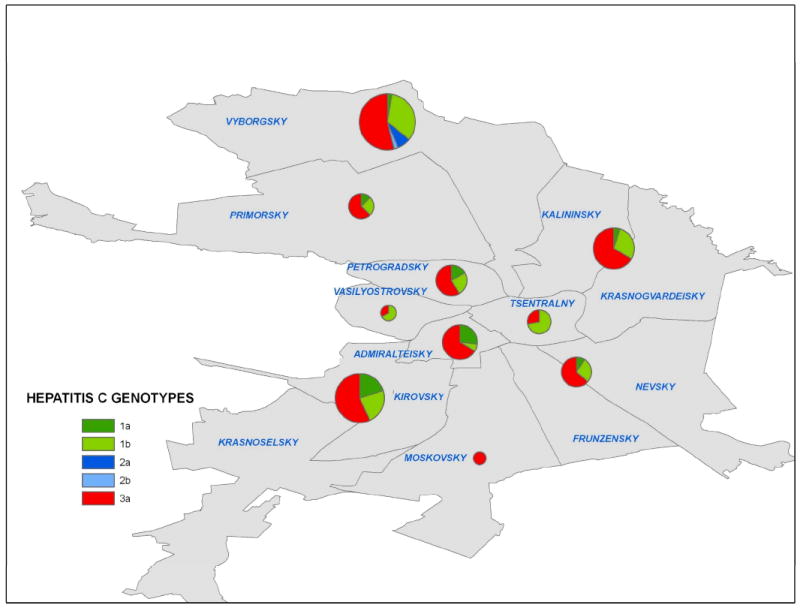
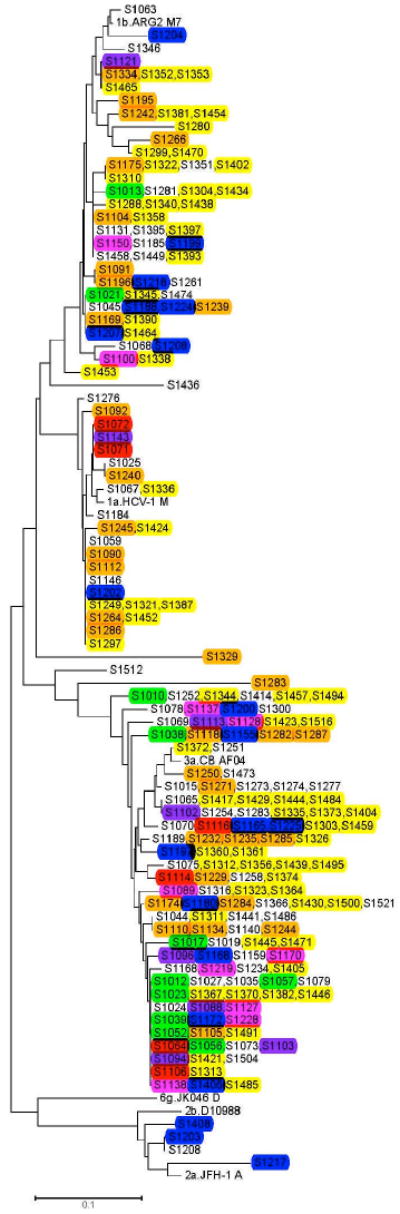
Findings: HCV infection was all but ubiquitous: 94.6% of IDUs were HCV-seropositive. Among the 209 viral sequences amplified, genotype 3a predominated (n = 119, 56.9%), followed by 1b (n = 61, 29.2%) and 1a (n = 25, 11.9%). There was no significant clustering of genotypes spatially. Neither genotypes nor closely related sequences were clustered within RDS chains. Analysis of HCV sequences from dyads failed to find associations of genotype or sequence homology within pairs.
Conclusions: Genotyping reveals that there have been at least five unique introductions of HCV genotypes into the IDU community in St Petersburg. Analysis of prevalent infections does not appear to correlate with the social networks of IDUs, suggesting that simple approaches to link these networks to prevalent infections, rather than incident transmission, will not prove meaningful. On a more positive note, the majority of IDUs are infected with 3a genotype that is associated with sustained virological response to antiviral therapy.
Conflict of interest statement
Figures
References
-
- Cohen J. The scientific challenge of hepatitis C. Science. 1999;285:26–30. - PubMed
-
- Alter MJ. Prevention of spread of hepatitis C. Hepatology. 2002;36:S93–S98. - PubMed
-
- Lauer GM, Walker BD. Hepatitis C virus infection. N Engl J Med. 2001;345:41–52. - PubMed
-
- Chaisson RE, Bacchetti P, Osmond D, et al. Cocaine use and HIV infection in intravenous drug users in San Francisco. Jama. 1989;261:561–565. - PubMed
Publication types
MeSH terms
Substances
Grants and funding
LinkOut - more resources
Full Text Sources
Medical
