


Perceiving pitch absolutely: comparing absolute and relative pitch possessors in a pitch memory task
- PMID: 19712445
- PMCID: PMC2749857
- DOI: 10.1186/1471-2202-10-106
Perceiving pitch absolutely: comparing absolute and relative pitch possessors in a pitch memory task
Abstract
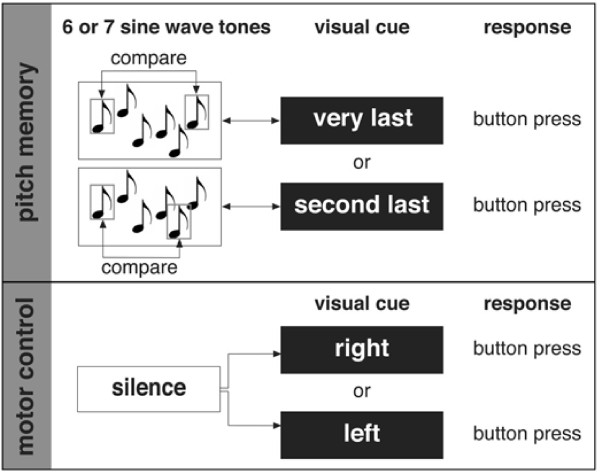
Background: The perceptual-cognitive mechanisms and neural correlates of Absolute Pitch (AP) are not fully understood. The aim of this fMRI study was to examine the neural network underlying AP using a pitch memory experiment and contrasting two groups of musicians with each other, those that have AP and those that do not.
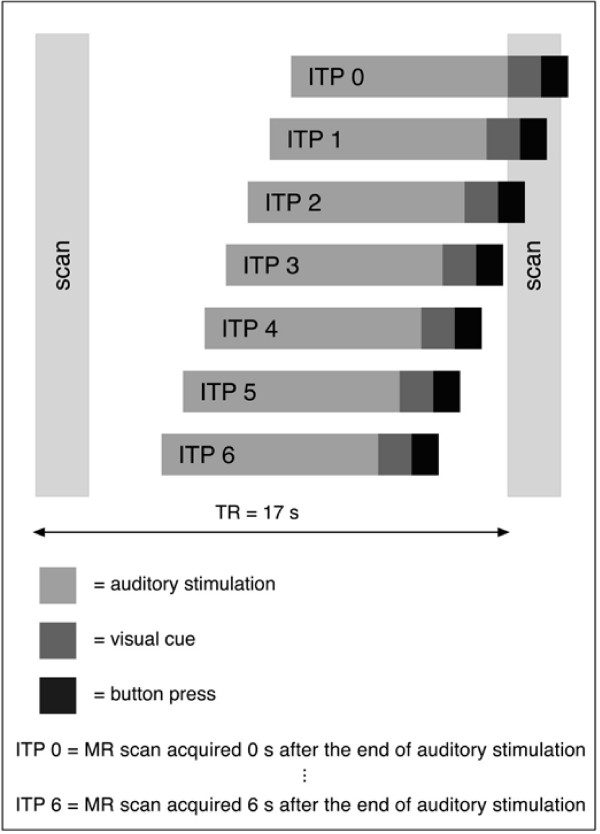
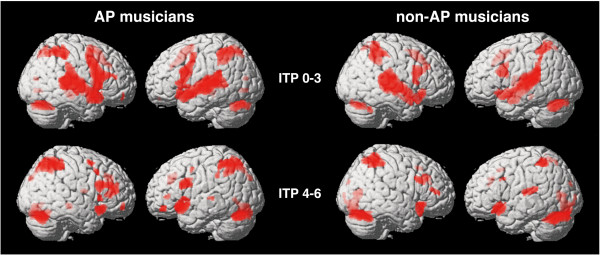
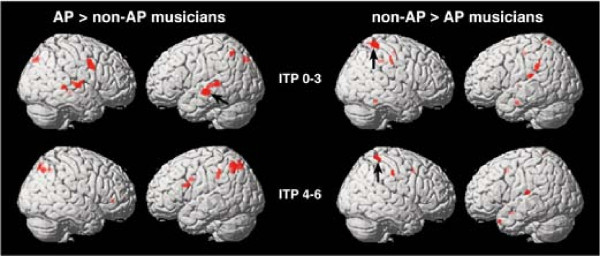
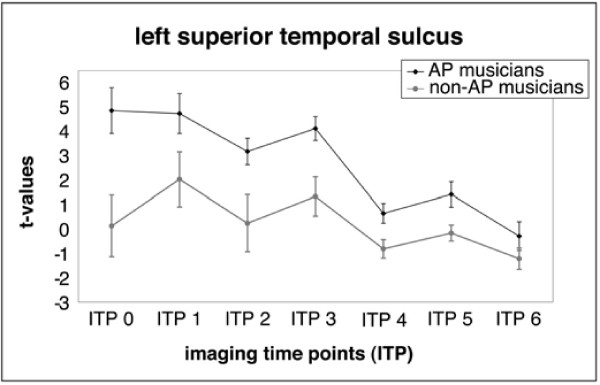
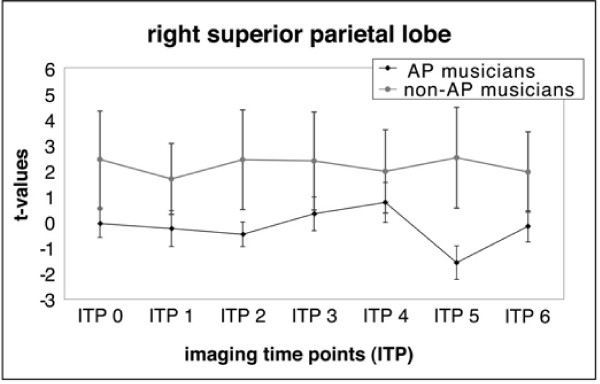
Results: We found a common activation pattern for both groups that included the superior temporal gyrus (STG) extending into the adjacent superior temporal sulcus (STS), the inferior parietal lobule (IPL) extending into the adjacent intraparietal sulcus (IPS), the posterior part of the inferior frontal gyrus (IFG), the pre-supplementary motor area (pre-SMA), and superior lateral cerebellar regions. Significant between-group differences were seen in the left STS during the early encoding phase of the pitch memory task (more activation in AP musicians) and in the right superior parietal lobule (SPL)/intraparietal sulcus (IPS) during the early perceptual phase (ITP 0-3) and later working memory/multimodal encoding phase of the pitch memory task (more activation in non-AP musicians). Non-significant between-group trends were seen in the posterior IFG (more in AP musicians) and the IPL (more anterior activations in the non-AP group and more posterior activations in the AP group).
Conclusion: Since the increased activation of the left STS in AP musicians was observed during the early perceptual encoding phase and since the STS has been shown to be involved in categorization tasks, its activation might suggest that AP musicians involve categorization regions in tonal tasks. The increased activation of the right SPL/IPS in non-AP musicians indicates either an increased use of regions that are part of a tonal working memory (WM) network, or the use of a multimodal encoding strategy such as the utilization of a visual-spatial mapping scheme (i.e., imagining notes on a staff or using a spatial coding for their relative pitch height) for pitch information.
Figures
References
-
- Miyazaki K. Musical pitch identification by absolute pitch possessors. Percept Psychophys. 1988;44(6):501–512. - PubMed
Publication types
MeSH terms
Grants and funding
LinkOut - more resources
Full Text Sources
