


Local restoration of dystrophin expression with the morpholino oligomer AVI-4658 in Duchenne muscular dystrophy: a single-blind, placebo-controlled, dose-escalation, proof-of-concept study
- PMID: 19713152
- PMCID: PMC2755039
- DOI: 10.1016/S1474-4422(09)70211-X
Local restoration of dystrophin expression with the morpholino oligomer AVI-4658 in Duchenne muscular dystrophy: a single-blind, placebo-controlled, dose-escalation, proof-of-concept study
Erratum in
- Lancet Neurol. 2009 Dec;8(12):1083
Abstract
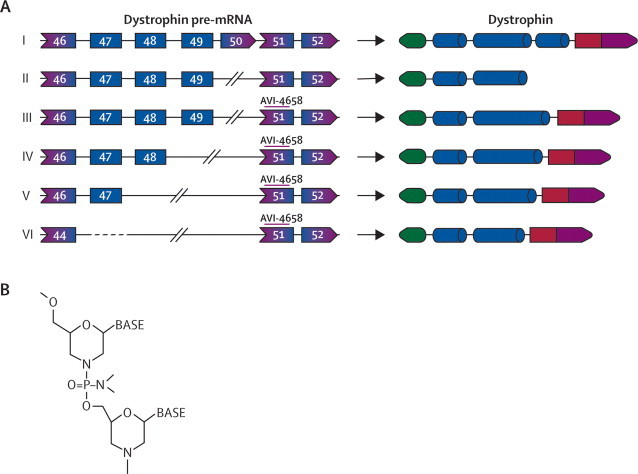
Background: Mutations that disrupt the open reading frame and prevent full translation of DMD, the gene that encodes dystrophin, underlie the fatal X-linked disease Duchenne muscular dystrophy. Oligonucleotides targeted to splicing elements (splice switching oligonucleotides) in DMD pre-mRNA can lead to exon skipping, restoration of the open reading frame, and the production of functional dystrophin in vitro and in vivo, which could benefit patients with this disorder.
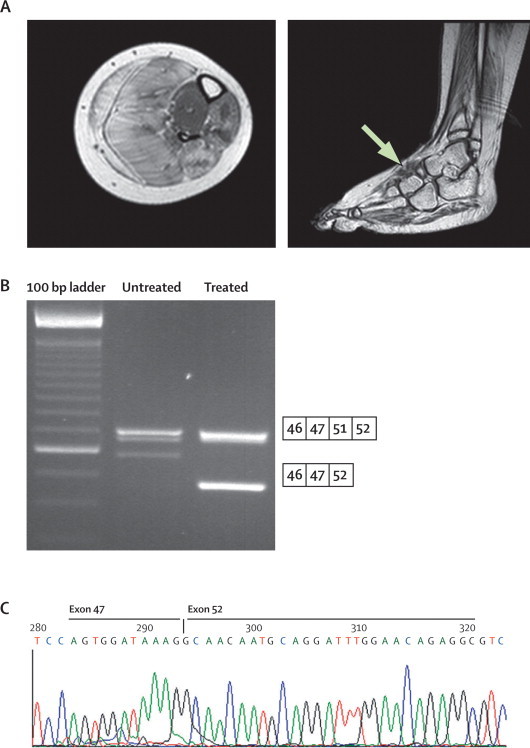
Methods: We did a single-blind, placebo-controlled, dose-escalation study in patients with DMD recruited nationally, to assess the safety and biochemical efficacy of an intramuscular morpholino splice-switching oligonucleotide (AVI-4658) that skips exon 51 in dystrophin mRNA. Seven patients with Duchenne muscular dystrophy with deletions in the open reading frame of DMD that are responsive to exon 51 skipping were selected on the basis of the preservation of their extensor digitorum brevis (EDB) muscle seen on MRI and the response of cultured fibroblasts from a skin biopsy to AVI-4658. AVI-4658 was injected into the EDB muscle; the contralateral muscle received saline. Muscles were biopsied between 3 and 4 weeks after injection. The primary endpoint was the safety of AVI-4658 and the secondary endpoint was its biochemical efficacy. This trial is registered, number NCT00159250.
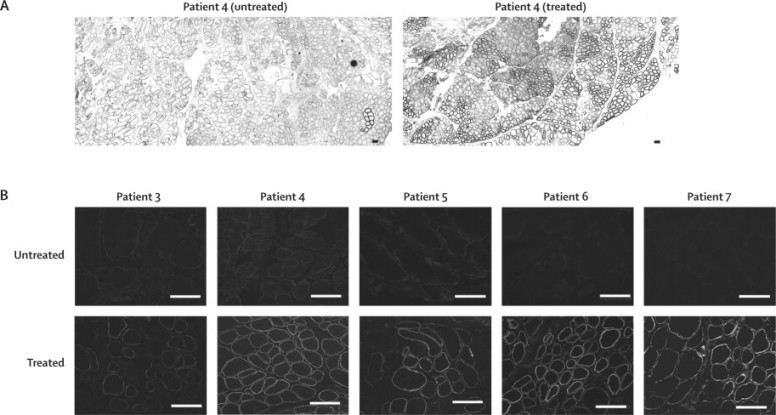
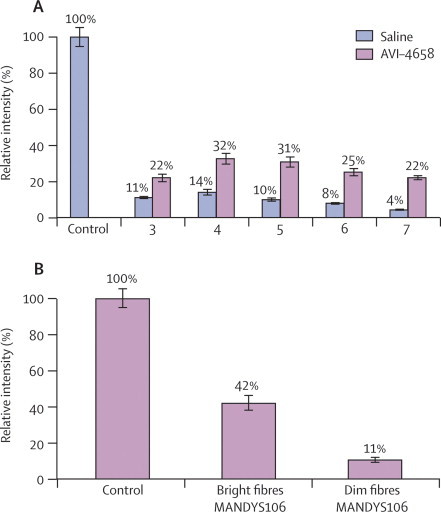
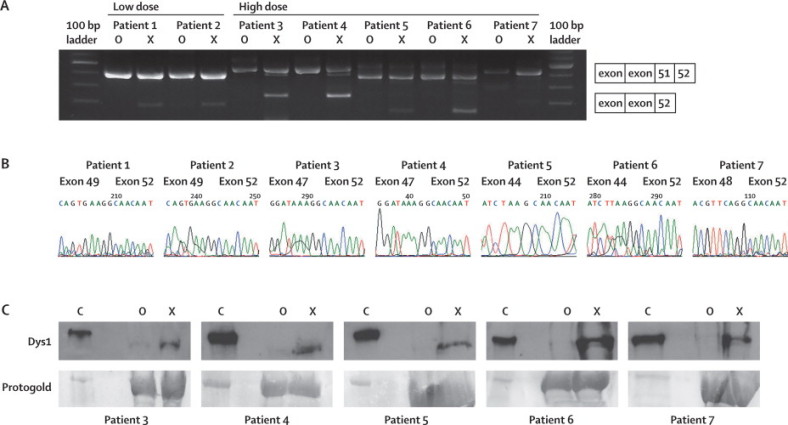
Findings: Two patients received 0.09 mg AVI-4658 in 900 microL (0.9%) saline and five patients received 0.9 mg AVI-4658 in 900 microL saline. No adverse events related to AVI-4658 administration were reported. Intramuscular injection of the higher-dose of AVI-4658 resulted in increased dystrophin expression in all treated EDB muscles, although the results of the immunostaining of EDB-treated muscle for dystrophin were not uniform. In the areas of the immunostained sections that were adjacent to the needle track through which AVI-4658 was given, 44-79% of myofibres had increased expression of dystrophin. In randomly chosen sections of treated EDB muscles, the mean intensity of dystrophin staining ranged from 22% to 32% of the mean intensity of dystrophin in healthy control muscles (mean 26.4%), and the mean intensity was 17% (range 11-21%) greater than the intensity in the contralateral saline-treated muscle (one-sample paired t test p=0.002). In the dystrophin-positive fibres, the intensity of dystrophin staining was up to 42% of that in healthy muscle. We showed expression of dystrophin at the expected molecular weight in the AVI-4658-treated muscle by immunoblot.
Interpretation: Intramuscular AVI-4658 was safe and induced the expression of dystrophin locally within treated muscles. This proof-of-concept study has led to an ongoing systemic clinical trial of AVI-4658 in patients with DMD.
Funding: UK Department of Health.
Figures
Comment in
-
Less is more: therapeutic exon skipping for Duchenne muscular dystrophy.Lancet Neurol. 2009 Oct;8(10):873-5. doi: 10.1016/S1474-4422(09)70229-7. Epub 2009 Aug 25. Lancet Neurol. 2009. PMID: 19713153 No abstract available.
References
-
- Eagle M, Baudouin SV, Chandler C, Giddings DR, Bullock R, Bushby K. Survival in Duchenne muscular dystrophy: improvements in life expectancy since 1967 and the impact of home nocturnal ventilation. Neuromuscul Disord. 2002;12:926–929. - PubMed
-
- Hoffman EP, Brown RH, Jr, Kunkel LM. Dystrophin: the protein product of the Duchenne muscular dystrophy locus. Cell. 1987;51:919–928. - PubMed
-
- Morris GE, Ellis JM, Nguyen TM. A quantitative ELISA for dystrophin. J Immunol Methods. 1993;161:23–28. - PubMed
Publication types
MeSH terms
Substances
Associated data
Grants and funding
LinkOut - more resources
Full Text Sources
Other Literature Sources
Medical
