


Comment
doi: 10.1038/4601085a.
Stem cells: The promises and perils of p53
- PMID: 19713919
- PMCID: PMC2974062
- DOI: 10.1038/4601085a
Item in Clipboard
Comment
Stem cells: The promises and perils of p53
Nature.
.
Abstract
Five studies show that disabling p53, an essential tumour-suppressor protein, improves the efficiency of stem-cell production. Are these results a ‘heads up’ that cancer cells and stem cells are disturbingly similar?
Figures
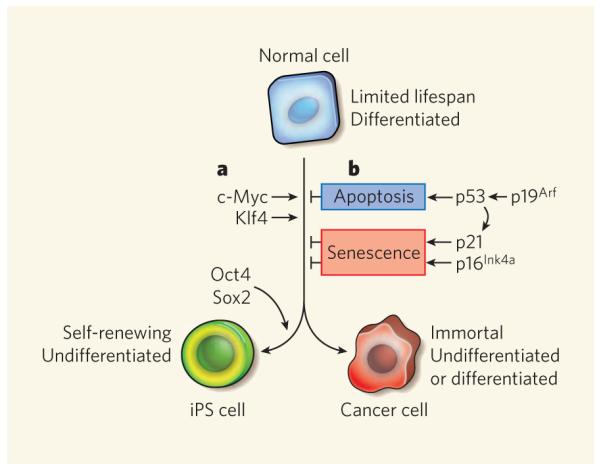
Normal fibroblasts, which are mature, differentiated cells, can be reprogrammed into induced pluripotent stem (iPS) cells or tumour cells by a combination of defined factors. a, The transcription factors c-Myc and Klf4 promote reprogramming of fibroblasts into iPS cells in a manner that conceptually parallels their roles in transformng normal cells into tumour cells. Oct4 and Sox2, although overexpressed in cancers, are currently thought to function specifically to promote iPS-cell formation. b, Conversely, the p53 tumour-suppressor protein, which can be induced by p19Arf, directly or indirectly limits the reprogramming of fibroblasts into iPS cells- or into transformed cancer cells by inducing apoptosis, or cellular senescence through its target protein, the cell-cycle inhibitor p21. Another cell-cycle inhibitor, p16Ink4a, also promotes cellular senescence directly to limit both processes. The Ink4a/Arf locus (not shown), which encodes p19Arf and p16Ink4a, is silenced during iPS reprogramming,.
Comment on
-
Linking the p53 tumour suppressor pathway to somatic cell reprogramming.Nature. 2009 Aug 27;460(7259):1140-4. doi: 10.1038/nature08311. Epub 2009 Aug 9. Nature. 2009. PMID: 19668186 Free PMC article.
-
The Ink4/Arf locus is a barrier for iPS cell reprogramming.Nature. 2009 Aug 27;460(7259):1136-9. doi: 10.1038/nature08290. Epub 2009 Aug 9. Nature. 2009. PMID: 19668188 Free PMC article.
-
A p53-mediated DNA damage response limits reprogramming to ensure iPS cell genomic integrity.Nature. 2009 Aug 27;460(7259):1149-53. doi: 10.1038/nature08287. Epub 2009 Aug 9. Nature. 2009. PMID: 19668189 Free PMC article.
-
Immortalization eliminates a roadblock during cellular reprogramming into iPS cells.Nature. 2009 Aug 27;460(7259):1145-8. doi: 10.1038/nature08285. Epub 2009 Aug 9. Nature. 2009. PMID: 19668190 Free PMC article.
-
Suppression of induced pluripotent stem cell generation by the p53-p21 pathway.Nature. 2009 Aug 27;460(7259):1132-5. doi: 10.1038/nature08235. Epub 2009 Aug 9. Nature. 2009. PMID: 19668191 Free PMC article.
References
-
- Hong H, et al. Nature. 2009 doi:10.1038/nature08235.
-
- Li H, et al. Nature. 2009 doi:10.1038/nature08290.
-
- Kawamura T, et al. Nature. 2009 doi:10.1038/nature08311.
-
- Utikal J, et al. Nature. 2009 doi:10.1038/nature08285.
-
- Marion R, et al. Nature. 2009 doi:10.1038/nature08287.
Publication types
MeSH terms
Substances
Grants and funding
LinkOut - more resources
Full Text Sources
Other Literature Sources
Research Materials
Miscellaneous
