


doi: 10.2353/ajpath.2009.081142.
Epub 2009 Aug 28.
Epigenetic dysregulation in cancer
Affiliations
- PMID: 19717641
- PMCID: PMC2751531
- DOI: 10.2353/ajpath.2009.081142
Item in Clipboard
Epigenetic dysregulation in cancer
Am J Pathol.
2009 Oct.
Abstract
One of the great paradoxes in cellular differentiation is how cells with identical DNA sequences differentiate into so many different cell types. The mechanisms underlying this process involve epigenetic regulation mediated by alterations in DNA methylation, histone posttranslational modifications, and nucleosome remodeling. It is becoming increasingly clear that disruption of the "epigenome" as a result of alterations in epigenetic regulators is a fundamental mechanism in cancer. This has major implications for the future of both molecular diagnostics as well as cancer chemotherapy.
Figures
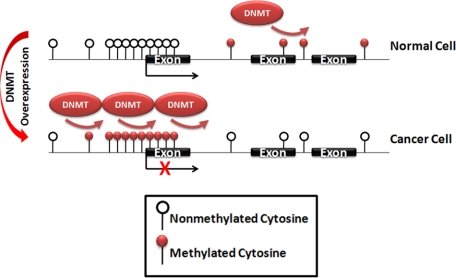
Aberrant DNA methylation patterns in cancer cells as a result of DNA methyltransferase overexpression. CpG dinucleotides are methylated in normal cells, whereas CpG islands, consisting of overrepresented CpG clusters near gene regulatory regions, are unmethylated. In contrast, cancer cells generally show global hypomethylation with hypermethylation at CpG islands, resulting in gene silencing at a subset of genes, including tumor suppressor genes.
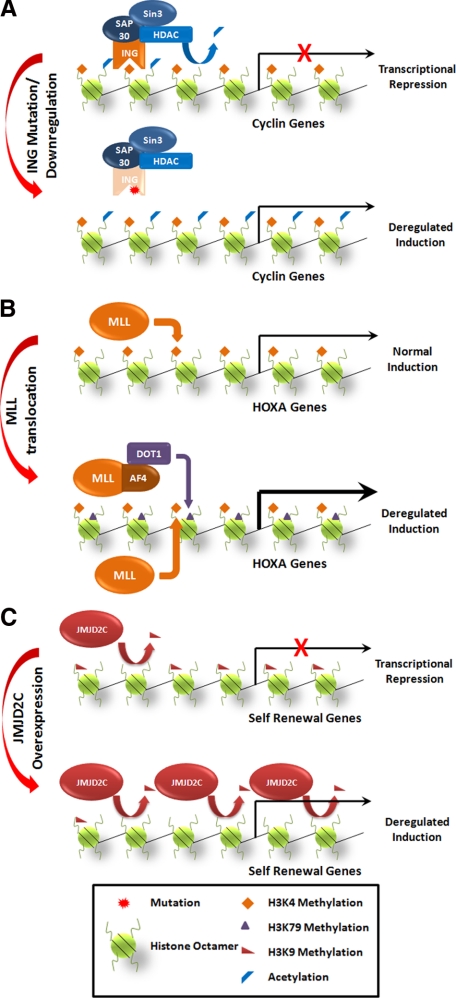
Disruption of histone readers, writers, and erasers in cancer. A: ING proteins use PHD fingers to recognize the trimethylated histone H3K4. Cell cycle arrest is mediated by the ING protein binding to proliferative genes, such as cyclins, and recruitment of HDAC complexes that deacetylate histone tails, resulting in gene silencing. Inactivating mutations or down-regulation of ING proteins results in deregulated cyclin expression and proliferation. B: MLL is a histone H3K4 methyltransferase that is required for maintenance of HOX gene expression. MLL translocations interact with various partners, including AF4, leading to the aberrant recruitment of the histone H3K79 methyltransferase Dot1. Dot1-mediated methylation at H3K79 results in deregulated expression of HOX genes, which are critical for transformation. Other proteins recruited by MLL fusion proteins that may also play a role in transcriptional activity are not shown. C: JMJD2C normally functions to demethylate H3K9, leading to transcriptional activation. In cancers that overexpress JMJD2C, a global reduction in H3K9 is observed, resulting in demethylation and increased expression of target genes such as self renewal genes, which likely contribute to tumorigenesis.
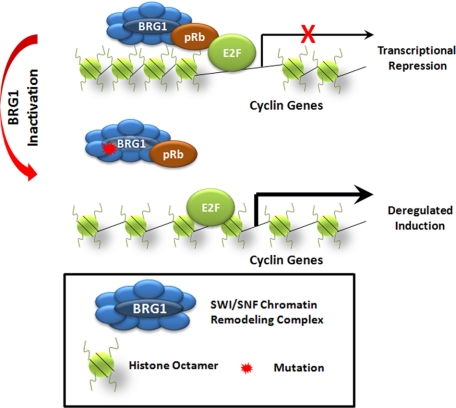
SWI/SNF-mediated nucleosomal remodeling and transcription in cancer. BRG1 is a DNA-dependent protein that functions in a SWI/SNF complex, which can remodel histones in several ways to make transcriptional start sites more accessible to transcription machinery. For example, SWI/SNF complexes allow histones to “slide” along DNA to expose DNA sequences as well as allow DNA looping away from histones to increase accessibility. BRG1 can also recruit pRb to regulate E2F target genes. Mutations in BRG1 in cancer inhibit the function of SWI/SNF complexes resulting to deregulated transcription.
References
-
- Holliday R. The inheritance of epigenetic defects. Science. 1987;238:163–710. - PubMed
-
- Esteller M. Epigenetics in cancer. N Engl J Med. 2008;358:1148–1159. - PubMed
-
- Wysocka J, Swigut T, Xiao H, Milne TA, Kwon SY, Landry J, Kauer M, Tackett AJ, Chait BT, Badenhorst P, Wu C, Allis CD. A PHD finger of NURF couples histone H3 lysine 4 trimethylation with chromatin remodelling. Nature. 2006;442:86–90. - PubMed
-
- Feinberg A, Tycko B. The history of cancer epigenetics. Nat Rev Cancer. 2004;4:143–153. - PubMed
-
- Eckhardt F, Lewin J, Cortese R, Rakyan VK, Attwood J, Burger M, Burton J, Cox TV, Davies R, Down TA, Haefliger C, Horton R, Howe K, Jackson DK, Kunde J, Koenig C, Liddle J, Niblett D, Otto T, Pettett R, Seemann S, Thompson C, West T, Rogers J, Olek A, Berlin K, Beck S. DNA methylation profiling of human chromosomes 6, 20 and 22. Nat Genet. 2006;38:1378–1385. - PMC - PubMed
MeSH terms
Grants and funding
LinkOut - more resources
Full Text Sources
Other Literature Sources
