


Adverse childhood events as risk factors for substance dependence: partial mediation by mood and anxiety disorders
- PMID: 19720467
- PMCID: PMC2763992
- DOI: 10.1016/j.addbeh.2009.07.004
Adverse childhood events as risk factors for substance dependence: partial mediation by mood and anxiety disorders
Abstract
Aims: Adverse childhood events (ACEs) are associated with negative health outcomes. We examined ACEs as risk factors for substance dependence (SD) and the mediating effects of mood and anxiety disorders on the relations between ACEs and SD risk.
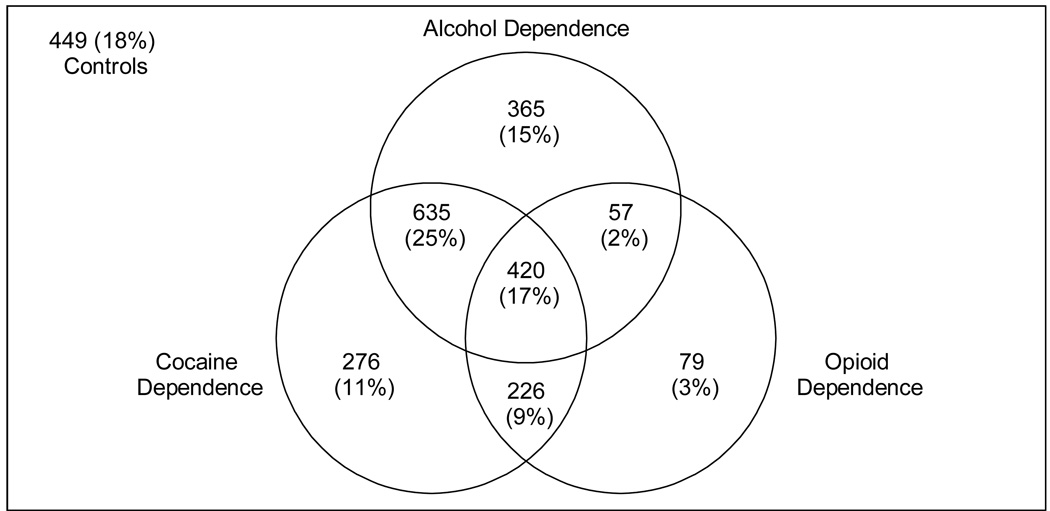
Design: We compared early life experiences in 2061 individuals with a lifetime diagnosis of alcohol, cocaine, or opioid dependence and 449 controls.
Measurements: Diagnostic and ACE data were obtained using the Semi-Structured Assessment for Drug Dependence and Alcoholism.
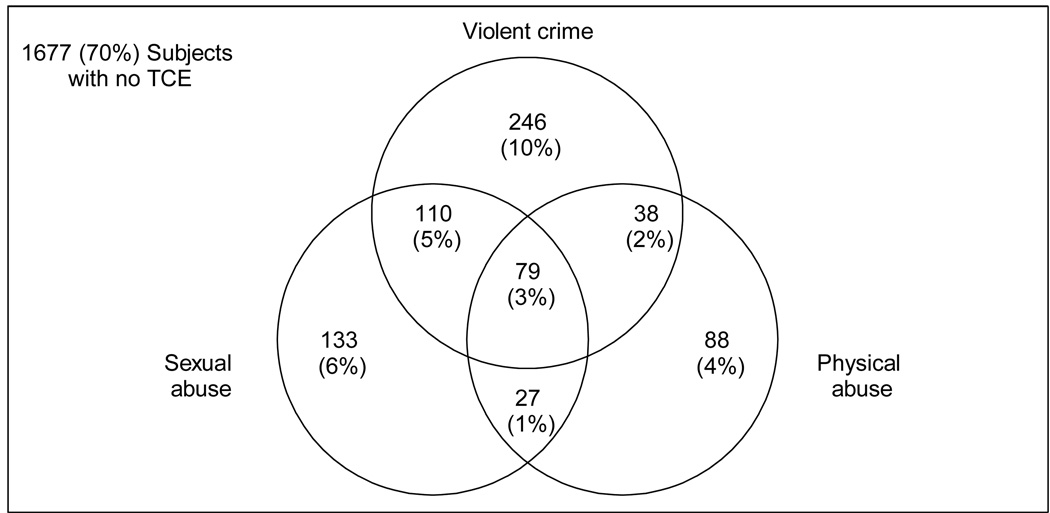
Findings: Childhood abuse or exposure to violent crime was positively related to the number of lifetime mood and anxiety disorders and to SD risk. Mood and anxiety disorders had their first onset a mean of nearly 3 years before the first SD diagnosis and partially mediated the effect of ACEs on SD risk.
Conclusion: ACEs appear to contribute additively to the risk of SD, with mood and anxiety disorders in the causal path for a portion of this risk. The identification and effective treatment of mood and anxiety disorders associated with ACEs could reduce the risk of developing SD.
Figures
References
-
- American Psychiatric Association. 4th Edition. American Psychiatric Press Inc: Washington, DC; 1994. Diagnostic and Statistical Manual of Mental Disorders.
-
- Anda RF, Felitti VJ, Bremner JD, Walker JD, Whitfield C, Perry BD, et al. The enduring effects of abuse and related adverse experiences in childhood. A convergence of evidence from neurobiology and epidemiology. European Archives of Psychiatry and Clinical Neuroscience. 2006;256(3):174–186. - PMC - PubMed
-
- Anda RF, Whitfield CL, Felitti VJ, Chapman D, Edwards VJ, Dube SR, et al. Adverse childhood experiences, alcoholic parents, and later risk of alcoholism and depression. Psychiatric Services. 2002;53(8):1001–1009. - PubMed
-
- Baron RM, Kenny DA. The moderator-mediator variable distinction in social psychological research: conceptual, strategic, and statistical considerations. Journal of Personality and Social Psychology. 1986;51(6):1173–1182. - PubMed
-
- Bernstein DP, Fink L, Handelsman L, Foote J, Lovejoy M, Wenzel K, et al. Initial reliability and validity of a new retrospective measure of child abuse and neglect. American Journal of Psychiatry. 1994;151(8):1132–1136. - PubMed
Publication types
MeSH terms
Grants and funding
- T32 GM008607/GM/NIGMS NIH HHS/United States
- R01 DA012690/DA/NIDA NIH HHS/United States
- R01 DA012849/DA/NIDA NIH HHS/United States
- K05 AA017435/AA/NIAAA NIH HHS/United States
- K24 DA015105/DA/NIDA NIH HHS/United States
- K24 AA013736/AA/NIAAA NIH HHS/United States
- AA03510/AA/NIAAA NIH HHS/United States
- DA12849/DA/NIDA NIH HHS/United States
- AA11330/AA/NIAAA NIH HHS/United States
- R01 DA018432/DA/NIDA NIH HHS/United States
- AA17435/AA/NIAAA NIH HHS/United States
- AA13736/AA/NIAAA NIH HHS/United States
- K24 DA022288/DA/NIDA NIH HHS/United States
- DA12690/DA/NIDA NIH HHS/United States
- R01 AA011330/AA/NIAAA NIH HHS/United States
- DA022288/DA/NIDA NIH HHS/United States
- DA15105/DA/NIDA NIH HHS/United States
LinkOut - more resources
Full Text Sources
Medical
Miscellaneous
