


Sympathetic neural mechanisms in human cardiovascular health and disease
- PMID: 19720780
- PMCID: PMC2735432
- DOI: 10.4065/84.9.822
Sympathetic neural mechanisms in human cardiovascular health and disease
Abstract
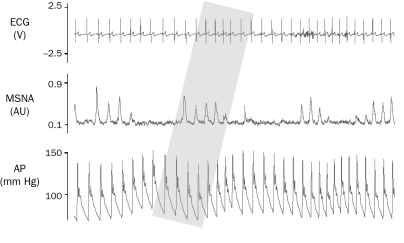
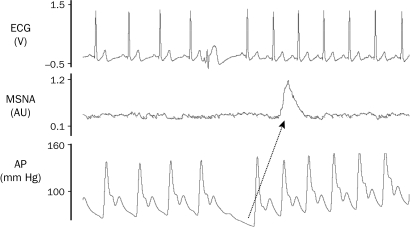
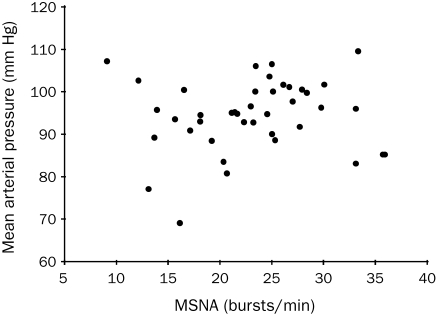
The sympathetic nervous system plays a key role in regulating arterial blood pressure in humans. This review provides an overview of sympathetic neural control of the circulation and discusses the changes that occur in various disease states, including hypertension, heart failure, and obstructive sleep apnea. It focuses on measurements of sympathetic neural activity (SNA) obtained by microneurography, a technique that allows direct assessment of the electrical activity of sympathetic nerves in conscious human beings. Sympathetic neural activity is tightly linked to blood pressure via the baroreflex for each individual person. However, SNA can vary greatly among individuals and that variability is not related to resting blood pressure; that is, the blood pressure of a person with high SNA can be similar to that of a person with much lower SNA. In healthy normotensive persons, this finding appears to be related to a set of factors that balance the variability in SNA, including cardiac output and vascular adrenergic responsiveness. Measurements of SNA are very reproducible in a given person over a period of several months to a few years, but SNA increases progressively with healthy aging. Cardiovascular disease can be associated with substantial increases in SNA, as seen for example in patients with hypertension, obstructive sleep apnea, or heart failure. Obesity is also associated with an increase in SNA, but the increase in SNA among patients with obstructive sleep apnea appears to be independent of obesity per se. For several disease states, successful treatment is associated with both a decrease in sympathoexcitation and an improvement in prognosis. This finding points to an important link between altered sympathetic neural mechanisms and the fundamental processes of cardiovascular disease.
Figures
References
-
- Low PA, ed. Clinical Autonomic Disorders: Evaluation and Management 2nd ed.Philadelphia, PA: Lippincott Williams & Wilkins; 1997.
-
- Robertson D. The epidemic of orthostatic tachycardia and orthostatic intolerance. Am J Med Sci. 1999;317(2):75-77 - PubMed
-
- Kellogg DL, Jr, Pérgola PE, Piest KL, et al. Cutaneous active vasodilation in humans is mediated by cholinergic nerve cotransmission. Circ Res. 1995;77(6):1222-1228 - PubMed
-
- Stephens DP, Aoki K, Kosiba WA, Johnson JM. Nonnoradrenergic mechanism of reflex cutaneous vasoconstriction in men. Am J Physiol Heart Circ Physiol. 2001;280(4):H1496-H1504 - PubMed
-
- Benarroch EE. Neuropeptides in the sympathetic system: presence, plasticity, modulation, and implications. Ann Neurol. 1994;36(1):6-13 - PubMed
Publication types
MeSH terms
LinkOut - more resources
Full Text Sources
Research Materials
