


Enhancement of muscle mitochondrial oxidative capacity and alterations in insulin action are lipid species dependent: potent tissue-specific effects of medium-chain fatty acids
- PMID: 19720794
- PMCID: PMC2768163
- DOI: 10.2337/db09-0784
Enhancement of muscle mitochondrial oxidative capacity and alterations in insulin action are lipid species dependent: potent tissue-specific effects of medium-chain fatty acids
Erratum in
- Diabetes. 2010 May;59(5):1283
Abstract
Objective: Medium-chain fatty acids (MCFAs) have been reported to be less obesogenic than long-chain fatty acids (LCFAs); however, relatively little is known regarding their effect on insulin action. Here, we examined the tissue-specific effects of MCFAs on lipid metabolism and insulin action.
Research design and methods: C57BL6/J mice and Wistar rats were fed either a low-fat control diet or high-fat diets rich in MCFAs or LCFAs for 4-5 weeks, and markers of mitochondrial oxidative capacity, lipid levels, and insulin action were measured.
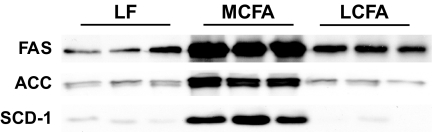
Results: Mice fed the MCFA diet displayed reduced adiposity and better glucose tolerance than LCFA-fed animals. In skeletal muscle, triglyceride levels were increased by the LCFA diet (77%, P < 0.01) but remained at low-fat diet control levels in the MCFA-fed animals. The LCFA diet increased (20-50%, P < 0.05) markers of mitochondrial metabolism in muscle compared with low-fat diet-fed controls; however; the increase in oxidative capacity was substantially greater in MCFA-fed animals (50-140% versus low-fat-fed controls, P < 0.01). The MCFA diet induced a greater accumulation of liver triglycerides than the LCFA diet, likely due to an upregulation of several lipogenic enzymes. In rats, isocaloric feeding of MCFA or LCFA high-fat diets induced hepatic insulin resistance to a similar degree; however, insulin action was preserved at the level of low-fat diet-fed controls in muscle and adipose from MCFA-fed animals.
Conclusions: MCFAs reduce adiposity and preserve insulin action in muscle and adipose, despite inducing steatosis and insulin resistance in the liver. Dietary supplementation with MCFAs may therefore be beneficial for preventing obesity and peripheral insulin resistance.
Figures
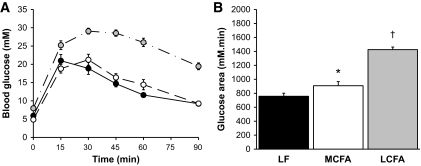
 )-fed mice. A: Blood glucose levels after an intraperitoneal glucose load (2 g/kg). B: Incremental areas under the curve as an indicator of glucose clearance. Data represent the means ± SE of 5–11 mice. *P < 0.01 vs. low fat; †P < 0.01 vs. low fat and MCFAs.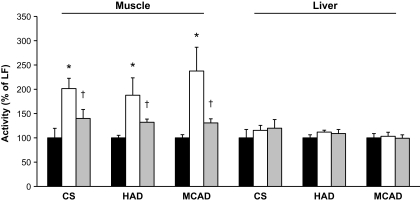
 ) diets. Data represent the means ± SE of 5–6 mice. *P < 0.01 vs. low fat and LCFAs; †P < 0.01 vs. low fat.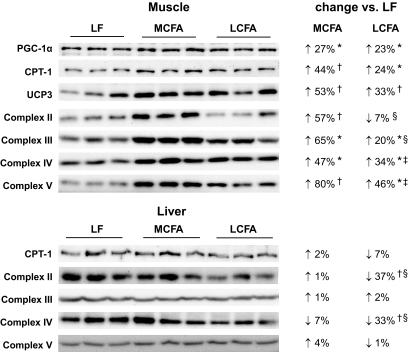
References
-
- Kraegen EW, Cooney GJ: Free fatty acids and skeletal muscle insulin resistance. Curr Opin Lipidol 2008;19:235–241 - PubMed
-
- Turner N, Heilbronn LK: Is mitochondrial dysfunction a cause of insulin resistance? Trends Endocrinol Metab 2008;19:324–330 - PubMed
-
- Storlien LH, Jenkins AB, Chisholm DJ, Pascoe WS, Khouri S, Kraegen EW: Influence of dietary fat composition on development of insulin resistance in rats: relationship to muscle triglyceride and omega-3 fatty acids in muscle phospholipid. Diabetes 1991;40:280–289 - PubMed
-
- Park SY, Cho YR, Kim HJ, Higashimori T, Danton C, Lee MK, Dey A, Rothermel B, Kim YB, Kalinowski A, Russell KS, Kim JK: Unraveling the temporal pattern of diet-induced insulin resistance in individual organs and cardiac dysfunction in C57BL/6 mice. Diabetes 2005;54:3530–3540 - PubMed
Publication types
MeSH terms
Substances
LinkOut - more resources
Full Text Sources
Other Literature Sources
Medical
