Review
. 2009 Sep;73(3):529-41, Table of Contents.
doi: 10.1128/MMBR.00042-08.

Microbial NAD metabolism: lessons from comparative genomics

Affiliations
Review

Microbial NAD metabolism: lessons from comparative genomics

Francesca Gazzaniga et al. Microbiol Mol Biol Rev. 2009 Sep.

Abstract

NAD is a coenzyme for redox reactions and a substrate of NAD-consuming enzymes, including ADP-ribose transferases, Sir2-related protein lysine deacetylases, and bacterial DNA ligases. Microorganisms that synthesize NAD from as few as one to as many as five of the six identified biosynthetic precursors have been identified. De novo NAD synthesis from aspartate or tryptophan is neither universal nor strictly aerobic. Salvage NAD synthesis from nicotinamide, nicotinic acid, nicotinamide riboside, and nicotinic acid riboside occurs via modules of different genes. Nicotinamide salvage genes nadV and pncA, found in distinct bacteria, appear to have spread throughout the tree of life via horizontal gene transfer. Biochemical, genetic, and genomic analyses have advanced to the point at which the precursors and pathways utilized by a microorganism can be predicted. Challenges remain in dissecting regulation of pathways.


Figures
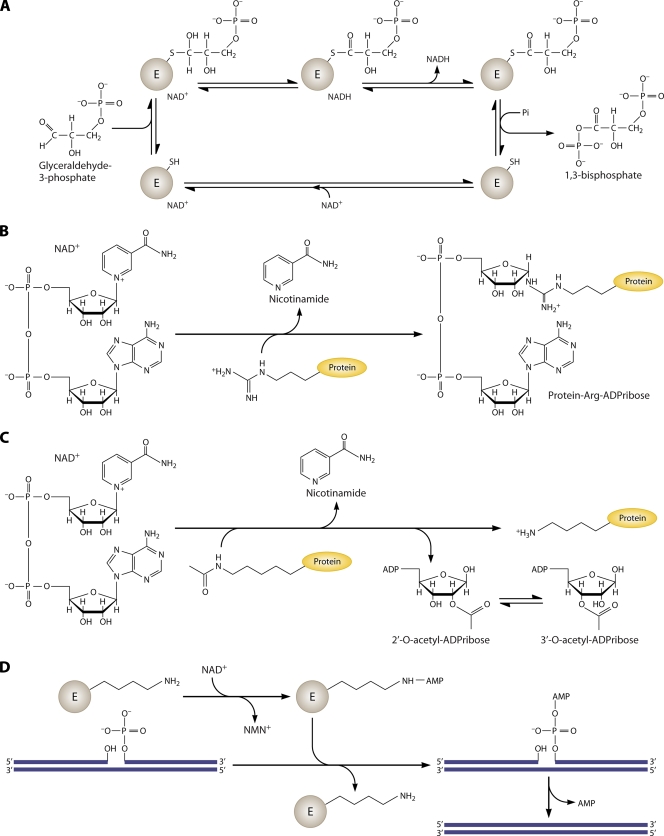
FIG. 1.
FIG. 1.
Biochemical reactions of NAD. (A) NAD is utilized as a coenzyme in the conversion of glyceraldehyde 3-phosphate to 1,3-bisphosphate by glyceraldehyde phosphate dehydrogenase. The enzyme-bound NAD promotes formation of a covalent thiohemiacetal intermediate and conversion to a dehydrogenated thioester with conversion of the coenzyme to NADH. The bound thioester is then phosphorylated to the 1,3-bisphosphate product. (B) NAD is the ADP-ribose donor for ADP-ribose transfer reactions by ADP-ribose transferases. The depicted reaction involves protein arginine ADP-ribosylation with production of nicotinamide. (C) Sirtuins are NAD-dependent protein lysine deacetylases. In sirtuin reactions, NAD is the acetyl acceptor, forming 2′- and 3′-acetylated ADP-ribose plus nicotinamide and the nonmodified protein lysine, from an acetylated protein Lys. (D) Bacterial DNA ligases utilize NAD to adenylylate the ligase active-site lysine residue, which activates the 5′ phosphate of a nicked DNA substrate, forming an adenylylated nicked substrate. The enzyme then promotes the attack of the 3′ hydroxyl on the 5′ phosphate, releasing AMP and forming a DNA phosphodiester bond.
FIG. 2.
FIG. 2.
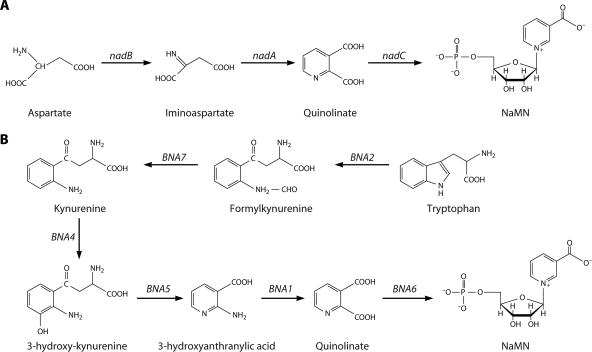
De novo biosynthesis of NAD. (A) Schematic diagram of NAD biosynthesis from aspartate to NaMN (E. coli gene names). In some archaea and thermotoga, the first step is catalyzed by aspartate dehydrogenase rather than aspartate oxidase (67). (B) Schematic diagram of NAD biosynthesis from tryptophan to NaMN (S. cerevisiae gene names).
FIG. 3.
FIG. 3.
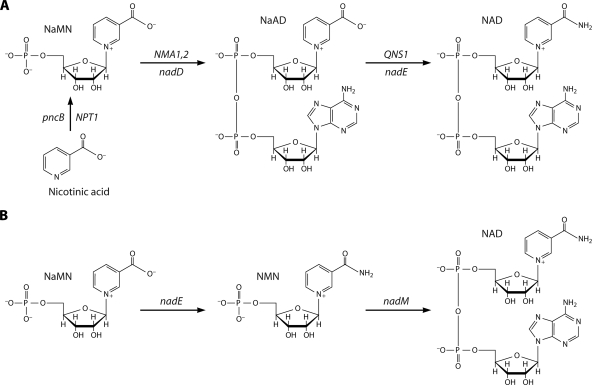
Synthesis of NAD through the NaMN intermediate. (A) In the Preiss-Handler pathway, nicotinic acid is salvaged to NAD via NaMN and NaAD intermediates. The pathway is depicted with S. cerevisiae gene names over the arrows and E. coli gene names under the arrows. (B) In F. tularensis, the de novo pathway depicted in Fig. 2A was found, but the nadD gene was found to be missing. Utilization of NaMN depends on NaMN amidation to NMN by a unique nadE gene, followed by NMN adenylylation by nadM.
FIG. 4.
FIG. 4.
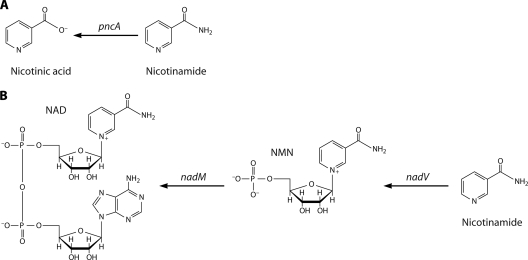
Nicotinamide salvage. (A) Nicotinamidases homologous to E. coli pncA convert nicotinamide to nicotinic acid for Preiss-Handler salvage. (B) Nicotinamide phosphoribosyltransferases homologous to the H. ducreyi and F. tularensis nadV products convert nicotinamide to NMN for adenylylation to NAD. Vertebrate nadV homologs are also termed NAMPT, PBEF, and Visfatin. Bacterial NMN adenylyltransferase, encoded by nadM, converts NMN to NAD. Eukaryotic enzymes do not discriminate well between NaMN and NMN adenylylation, such that most eukaryotic NaMN adenylyltransferases, such as S. cerevisiae Nma1 and Nma2 (depicted in Fig. 3A), are also NMN adenylyltransferases.
FIG. 5.
FIG. 5.
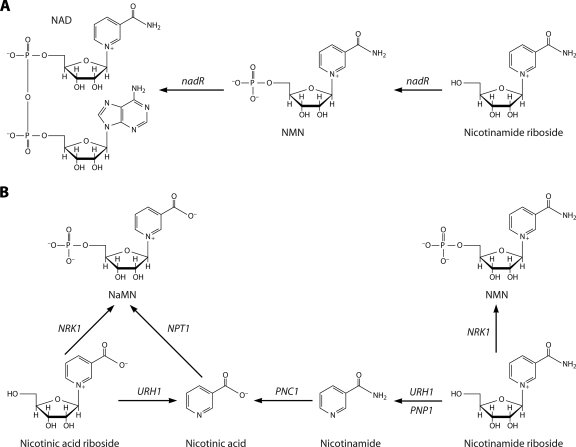
Nicotinamide riboside and nicotinic acid riboside salvage. (A) Nicotinamide riboside salvage in H. influenzae is mediated by the nicotinamide riboside kinase domain and the NMN adenylyltransferase domain of nadR. (B) Nicotinamide riboside and nicotinic acid riboside salvage in S. cerevisiae is mediated by nicotinamide riboside kinase (NRK1)-dependent and nucleoside-splitting pathways.
FIG. 6.
FIG. 6.
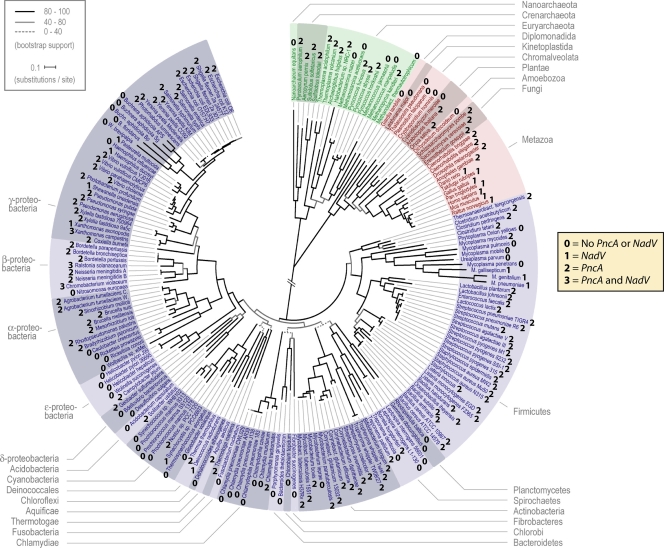
Nicotinamide metabolism throughout the tree of life. The tree of life calculated with universally conserved proteins (17) was annotated on the basis of possession of apparent pncA and nadV orthologs. For each fully sequenced genome, we scored the organism as carrying nadV (1), pncA (2), both genes (3), or neither gene (0). (Adapted from reference with permission from AAAS.)
FIG. 7.
FIG. 7.
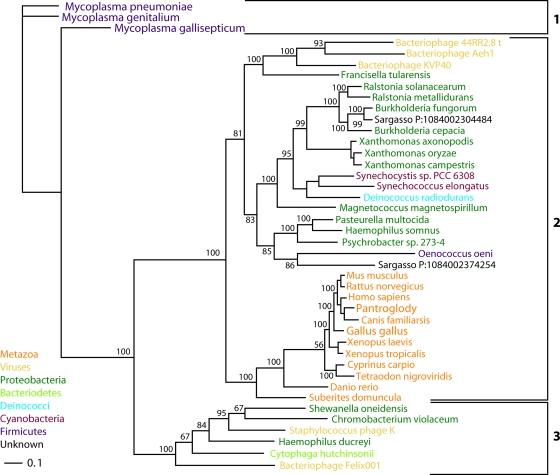
nadV phylogeny. The nadV phylogenetic tree was calculated with Bayeseian analysis (28, 52) using the sequence from Mycoplasma pneumoniae as the outgroup. Protein clades 1 to 3 are indicated. Bayesian posterior probabilities are indicated for nodes. Branch lengths are proportional to evolutionary distance.
FIG. 8.
FIG. 8.
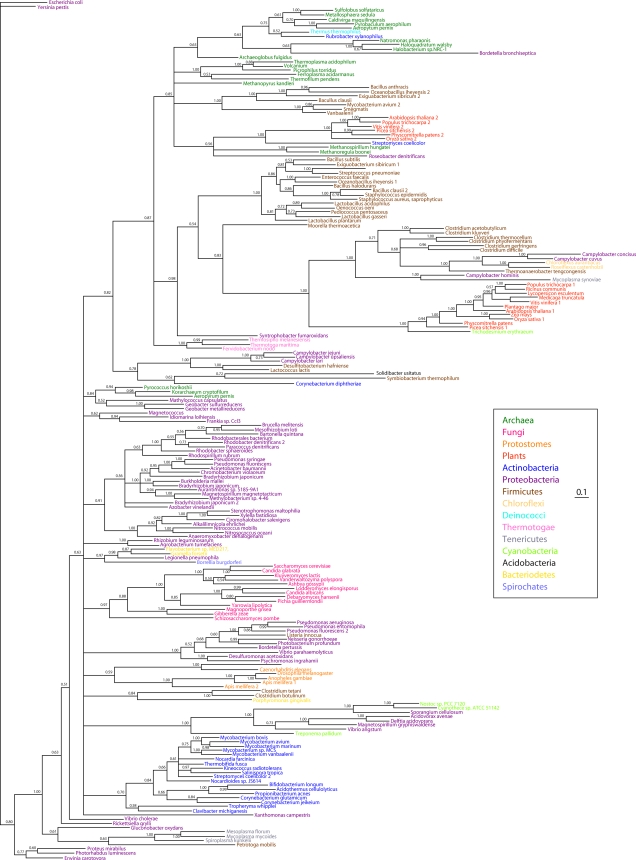
pncA phylogeny. The pncA phylogenetic tree was calculated with Bayesian analysis (28, 52) using the sequence from Escherichia coli as the outgroup. Nearly identical phylogenetic tree topologies were obtained with other sequences as the outgroup. Bayesian posterior probabilities are indicated for nodes. Branch lengths are proportional to evolutionary distance.
FIG. 9.
FIG. 9.
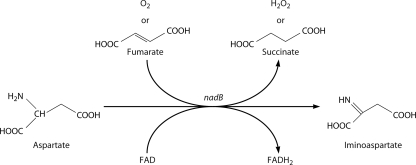
l-Aspartate oxidase can function without oxygen. The FAD-dependent reaction catalyzed by l-aspartate oxidase can utilize fumarate as the electron acceptor, thereby producing iminoaspartate, succinate, and reduced FAD under anaerobic conditions. The molecular oxygen-utilizing reaction produces iminoaspartate, hydrogen peroxide, and reduced FAD.

References

    1. Anderson, R. M., K. J. Bitterman, J. G. Wood, O. Medvedik, H. Cohen, S. S. Lin, J. K. Manchester, J. I. Gordon, and D. A. Sinclair. 2002. Manipulation of a nuclear NAD+ salvage pathway delays aging without altering steady-state NAD+ levels. J. Biol. Chem. 27718881-18890. - PubMed
    1. Belenky, P., K. L. Bogan, and C. Brenner. 2007. NAD(+) metabolism in health and disease. Trends Biochem. Sci. 3212-19. - PubMed
    1. Belenky, P., K. C. Christensen, F. S. Gazzaniga, A. Pletnev, and C. Brenner. 2009. Nicotinamide riboside and nicotinic acid riboside salvage in fungi and mammals: Quantitative basis for Urh1 and purine nucleoside phosphorylase function in NAD+ metabolism. J. Biol. Chem. 284158-164. - PMC - PubMed
    1. Belenky, P., F. G. Racette, K. L. Bogan, J. M. McClure, J. S. Smith, and C. Brenner. 2007. Nicotinamide riboside promotes Sir2 silencing and extends lifespan via Nrk and Urh1/Pnp1/Meu1 pathways to NAD(+). Cell 129473-484. - PubMed
    1. Benson, D. A., I. Karsch-Mizrachi, D. J. Lipman, J. Ostell, and D. L. Wheeler. 2005. GenBank. Nucleic Acids Res. 33D34-D38. - PMC - PubMed

Publication types

LinkOut - more resources